
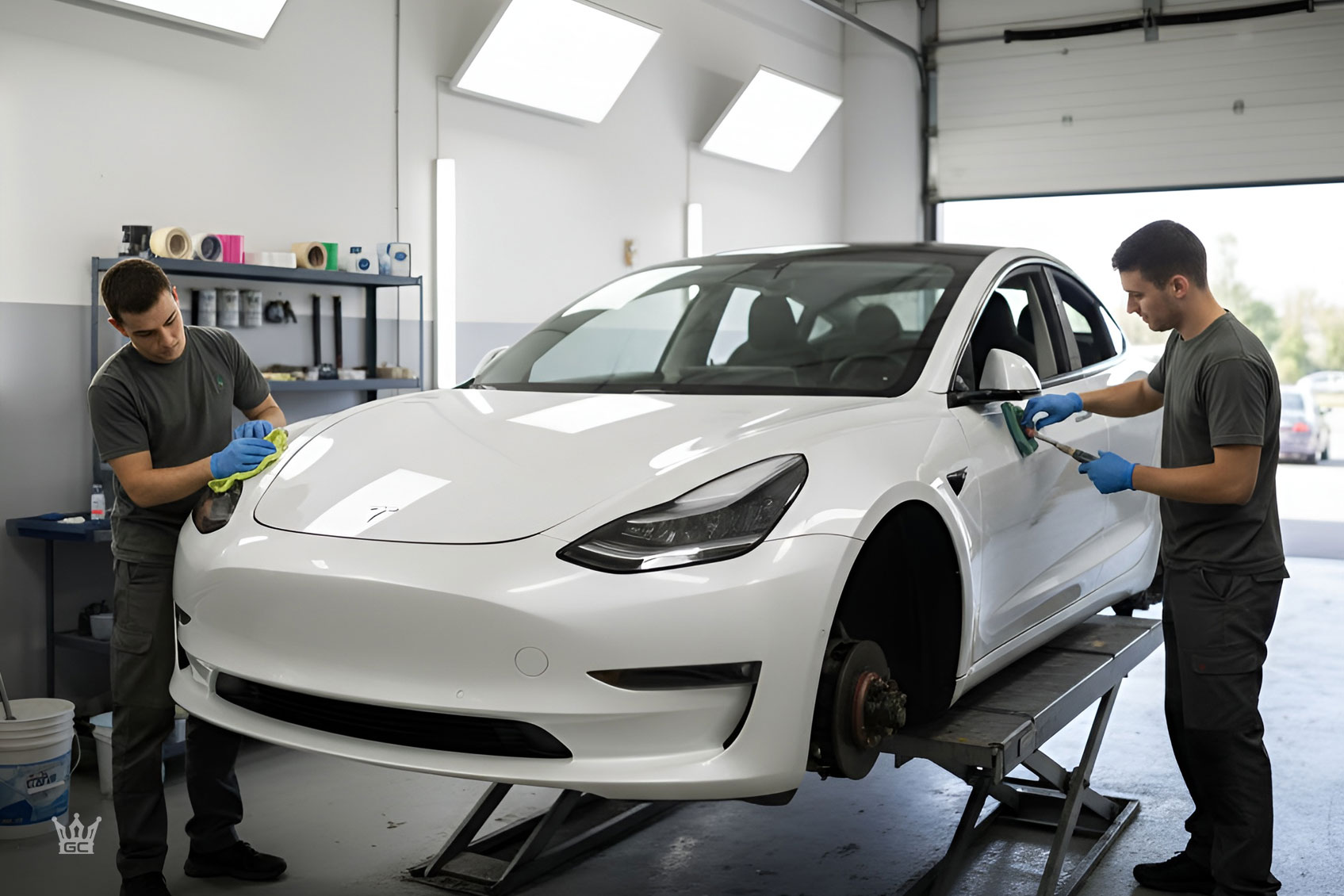
So you’ve decided to give your Tesla or another EV a fresh new look with a vinyl wrap or protect its original paint with paint protection film (PPF). This is a rewarding project, but the secret to a professional-grade finish lies in meticulous preparation. Properly prepping an EV involves creating a clean workspace, performing a deep decontamination wash, correcting any paint flaws, and ensuring the vehicle is bone dry before a single piece of film is applied.
This guide provides a step-by-step checklist to walk you through the prep work, ensuring your DIY installation looks incredible and lasts for years.
The Foundation: Setting Up Your DIY Workspace
You can’t achieve a clean finish in a dusty environment. Your installation space is the first and most critical element for success. A clean garage is your best bet.
Workspace Preparation and Dust Control
Your goal is to make your garage as clean and dust-free as possible. Any speck of dust, hair, or debris floating in the air can get trapped under the film, creating a frustrating and visible imperfection. Before you bring the car in, give your garage a thorough cleaning. Sweep and vacuum the floors, wipe down any workbenches, and remove clutter. A great pro tip is to lightly mist the floor with water right before you start working; this helps keep any remaining dust from becoming airborne.
The Importance of a Climate Controlled Indoor Space
Installing a wrap or PPF outdoors is setting yourself up for failure. An indoor space like a garage is essential to eliminate contaminants like windblown dust and insects and to control the temperature. Vinyl and PPF are best applied within a specific temperature range, typically between 18°C and 24°C (65°F to 75°F).
-
Too cold: The film becomes stiff and rigid, and its adhesive won’t bond correctly.
-
Too hot: The film can become too soft and stretchy, making it easy to overstretch and distort.
Try to work on a mild day. If your garage is very cold or hot, consider using a portable space heater or air conditioner to help bring the environment closer to that ideal temperature window.
Lighting for a Flawless Finish
You can’t fix imperfections you can’t see. Good lighting is crucial for spotting tiny bubbles, dust particles, and other flaws during the prep and installation stages. Bright, multi-angle overhead lighting is ideal. Consider investing in some powerful LED shop lights or using portable work lights on stands to illuminate the sides of the vehicle. A headlamp can also be invaluable for close-up work.
Surgical Cleanliness: Preparing Your Tesla’s Surface
Once your workspace is ready, the focus shifts to the vehicle. The surface must be perfectly clean for the film’s adhesive to form a strong, permanent bond.
Step 1: Thorough Vehicle Wash and Decontamination
This is much more than a quick wash. One of the most common DIY mistakes is failing to properly decontaminate the surface. Start with a thorough two-bucket hand wash using a pH-neutral car soap to remove all loose dirt. The critical next step is removing invisible contaminants like waxes, sealants, and oils.
To do this, you’ll perform a degreasing wipe-down with an isopropyl alcohol (IPA) solution (a 50/50 or 70/30 mix of IPA and distilled water works well). Spray the solution onto a clean microfiber towel—never directly onto the car—and wipe down every panel. For surfaces that still feel rough to the touch, a clay bar treatment is necessary to pull out embedded contaminants like industrial fallout or tree sap, leaving the paint as smooth as glass.
Step 2: Surface Inspection and Paint Correction
A common misconception is that a wrap or PPF will hide paint flaws. In reality, these thin films will magnify them. A cluster of rock chips will look like a field of bumps under the film, and a deep scratch will still be visible.
Carefully inspect every inch of your Tesla’s paint with a bright light.
-
Minor Swirls/Scratches: These can often be polished out using a dual-action (DA) polisher with a light polishing compound. This is a manageable DIY task for beginners.
-
Deep Chips/Scratches: These should be repaired before installation. Use a touch-up paint pen to fill the chip, let it dry completely, and then carefully wet-sand it to be level with the surrounding paint.
-
Failing Clear Coat: Wrapping over peeling or flaking paint is not recommended. The film will not adhere properly and will likely pull more paint off if it’s ever removed. This type of damage must be professionally repaired first.
Step 3: Critical Drying Time
Patience is a virtue in vehicle wrapping. After the deep clean, the vehicle must be completely dry. Water hides in panel gaps, behind trim, under mirror housings, and in light recesses. If this moisture seeps out during installation, it will compromise the adhesive and cause the film to fail. Use a pet dryer, an electric leaf blower, or compressed air to force water out of all crevices. It’s a great practice to let the vehicle sit in the garage overnight to ensure every last drop has evaporated.
The Finer Details: Hardware and Tool Prep
With a perfectly clean and dry car, you can move on to the final prep stages. This is where attention to detail really pays off.
Trim, Mirror, Badge, and Camera Removal (Advanced)
For the cleanest possible finish with expertly tucked edges, many installers remove parts like door handles, mirrors, badges, and lights. This allows you to apply the film over the entire panel smoothly and wrap it around the edges, leaving no original paint showing.
Warning: This is an advanced step. Before you remove anything, research your specific Tesla model on YouTube to find tutorials. Keep all fasteners and clips organized and labeled for easy reassembly. If you’re not comfortable with this, you can still get a good result by carefully trimming the film around these objects.
Protecting Sensitive EV Components (Charging Port & Sensors)
EVs have unique features that require special attention during prep.
-
Charging Port: This is a direct electrical connection. Use masking tape to carefully seal off the charging port area to prevent any water or cleaning solutions from getting inside during the wash stages.
-
Sensors and Cameras: Autopilot cameras, parking sensors, and other sensors are critical. Never apply film over a camera lens. You will need to carefully trim around them. Most non-metallic films can be applied over parking sensors without affecting performance, but you should always test them after installation to be sure.
If you want to see how professionals tackle these unique EV challenges, you can check out our gallery of completed projects, including a Tesla Model X satin PPF full wrap and a BYD Seal EV satin PPF full wrap.
Preparing Your DIY Tools and Solutions
Having all your tools and solutions ready before you start is key to a smooth process.
-
Essential Tools: A good set of felt-tipped squeegees, a sharp snap-off knife with 30-degree blades, a heat gun, lint-free microfiber towels, and at least two quality spray bottles.
-
Solutions: For PPF and wet-apply vinyl, you’ll need two primary solutions.
-
Slip Solution: In one spray bottle, mix distilled water with a few drops of non-moisturizing baby shampoo (like Johnson’s). This allows you to slide the film into the perfect position on the panel.
-
Tack Solution: In the second bottle, mix 750 ml DI/distilled/filtered water with 250 ml of 70% isopropyl alcohol (i.e., 75% water / 25% IPA). This is used to flush out the slip solution and help the adhesive “tack up” and stick firmly.
-
The Art of Application
With all the prep work complete, you’re ready for the main event.
Planning the Panel Sequence
It’s best to work panel by panel. Create a plan of attack to ensure a seamless look. Start with larger, flatter panels like the hood or roof to build your confidence before moving on to complex bumpers and mirrors. If your wrap has a pattern, planning the sequence is critical to ensure the design flows correctly across the vehicle.
Managing Panel Gaps and Alignment
The mark of a quality installation is how the gaps between panels are handled. The film should never be stretched across a gap (e.g., from a door to a fender). Instead, apply the film to one panel, trim it along the edge, and wrap it around into the gap. Then, apply film to the next panel and do the same. This prevents the vinyl from lifting when doors are opened and gives you that professional, paint-like finish.
Aftercare: Keeping Your New Wrap or PPF Perfect
Your job isn’t done when the last panel is wrapped. Proper maintenance is essential for longevity.
PPF Safe Cleaning Product Selection
Using the right cleaning products is vital. For a detailed guide, see our step-by-step instructions on how to clean paint protection film (PPF).
-
Do Use: pH-neutral car wash soap, soft microfiber wash mitts, and dedicated wrap or PPF detailer sprays.
-
Don’t Use: Abrasive brushes, carnauba wax (especially on matte or satin films), or harsh chemical degreasers.
-
Pressure Washers: Use with extreme caution. Hold the nozzle at least 30 cm (12 in.) away and perpendicular (90° ±10°) to the film, or a minimum of 100 cm (1 m) away at a 30° angle or higher. and never aim it directly at the edges of the film, as this can cause it to lift.
Gentle hand washing is always the safest and most effective method for keeping your wrap or PPF looking its best.
FAQ: Your Top DIY Questions Answered
Absolutely! This guide is designed to help you do just that. The most important part is the decontamination stage—being meticulous about removing all waxes, sealants, and oils is the key to ensuring the film’s adhesive will bond properly.
For the best, most seamless result, yes. Removing emblems allows for a smooth, single piece of film to be applied to the panel. The badges can then be carefully reapplied on top of the wrap. If you’re not comfortable removing them, you can trim the film around them, but it requires a very steady hand.
Yes, this is highly recommended. PPF will protect against future chips, but it will not hide existing damage. In fact, the clear, glossy film can make existing chips and deep scratches even more noticeable. Filling and smoothing them before you start is a critical prep step.
Do not rush the prep work. For a first-timer, it’s wise to set aside several hours or even a full day just for the wash, decontamination, and any minor paint correction. The cleaner the car is, the better your final result will be.
When done correctly with a quality non-metallic film, wrapping over sensors typically does not affect their functionality. However, you should always test all sensors after the job is complete to confirm they are working perfectly.
An indoor space like a garage prevents dust and debris from getting under the film and allows you to maintain the optimal temperature for the vinyl to conform and adhere properly, ensuring a durable and flawless result.
By following these steps, you’re on your way to a stunning DIY result. If you get partway through and decide the project is more than you want to tackle, or you’d prefer a professional to handle it from the start, our team is always here to help. Contact Gold Coast Wrap Kings today for advice or a professional quote.