
TL;DR
Self-healing paint protection film (PPF) is a clear thermoplastic urethane layer applied to your car’s painted surfaces that absorbs stone chips, scratches, and UV damage. The “self-healing” part refers to an elastomeric polymer topcoat that uses heat to erase light surface scratches on its own. It works especially well in warm climates like Queensland, where ambient temperatures naturally trigger the healing process. It handles micro-scratches and swirl marks with ease, but it won’t magically fix deep gouges, rock chip punctures, or missing paint.
The 30-Second Definition
Paint protection film, commonly called PPF, clear bra, or clear paint film, is a transparent thermoplastic urethane (TPU) film applied directly over your vehicle’s paintwork. It acts as a sacrificial barrier against the things that damage paint every day: stone chips, bug splatter, bird droppings, minor scuffs, and UV radiation.
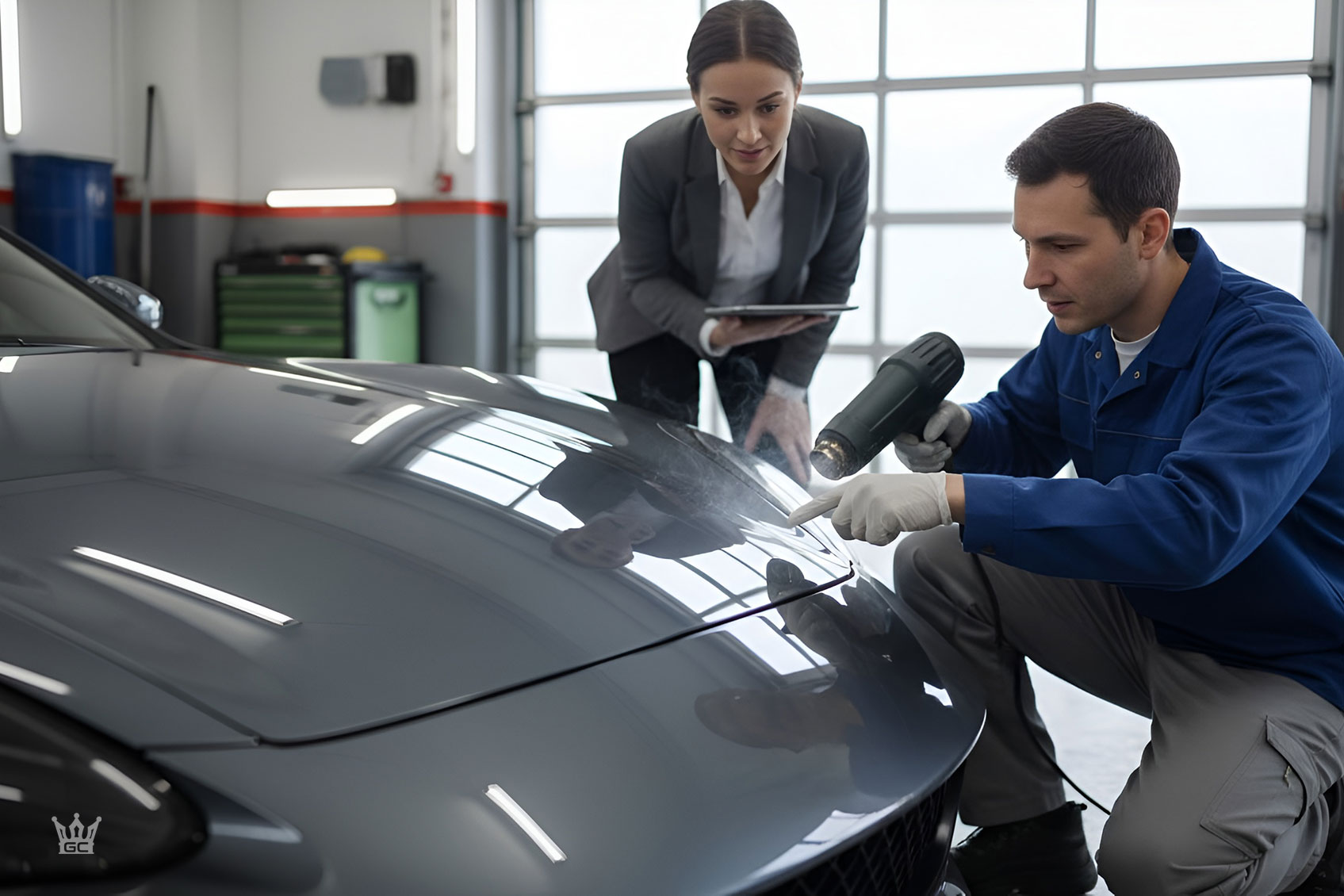
Self-healing PPF takes this a step further. The film’s topcoat contains an elastomeric polymer with shape-memory properties. When light scratches appear on the surface, heat causes the polymer chains to relax and realign, effectively erasing the mark. Park your car in the sun for a few minutes on a warm day and watch a fresh swirl mark disappear.
That is what self-healing paint protection film is, explained without the marketing fluff. The rest of this guide covers exactly how it works, what it realistically fixes (and what it does not), and why Queensland’s climate gives it a genuine advantage.
For a broader overview of PPF coverage options and how installations typically work, the PPF coverage and care guide covers that ground in detail.
A Brief History: From Helicopter Blades to Your Bonnet
The origins of paint protection film are military. During the Vietnam War, helicopter rotor blades and sensitive components on military transport vehicles were constantly damaged by flying shrapnel and debris. The US military asked 3M to develop a solution that was lightweight and nearly invisible. The result was a replaceable urethane film, far cheaper than repairing or replacing damaged rotor blades (source).
That military-grade concept eventually migrated to motorsport, then to the consumer automotive market. Today’s self-healing PPF is a far cry from those early military films, but the core principle remains the same: a sacrificial, replaceable layer that absorbs damage so the surface underneath stays perfect.
How Self-Healing PPF Actually Works
The Three-Layer Anatomy
Modern self-healing PPF is built in three distinct layers, each with a specific job:
-
Clear Topcoat (the self-healing layer): This is where the magic happens. It’s typically 0.5 to 1 mil thick and contains the elastomeric polymer that gives the film its shape-memory properties. When scratched, the polymer chains deform but retain the ability to snap back into their original arrangement when heated (source).
-
Polyurethane (TPU) Middle Layer: This is the body of the film. At 6 to 8 mils total thickness (including all three layers), the TPU core provides impact absorption. When a rock hits your bonnet at highway speed, this layer stretches to absorb the energy rather than letting it pass through to the paint.
-
Adhesive Layer: Bonds the film to your vehicle’s painted surface. Quality adhesives are pressure-sensitive and designed to leave zero residue when the film is eventually removed, even after years of service.
The Heat-Activation Mechanism
The self-healing topcoat contains an elastomeric polymer coating that reacts to heat. When exposed to sunlight or another heat source, the polymer molecules rearrange themselves to erase minor scratches and imperfections (source).
At approximately 140°F (60°C), the polymer chains undergo a relaxation process that allows them to realign, creating a smoothing effect that gradually eliminates surface-level scratches (source).
Think of it like a memory foam mattress. Press your hand into it and it deforms. Remove your hand and it slowly returns to its original shape. The PPF topcoat works on the same principle, just triggered by heat instead of the absence of pressure.
Temperature and Healing Speed
How fast self-healing PPF works depends directly on temperature. Here is what to expect at different ambient ranges:
|
Temperature Range |
Healing Speed |
Practical Context |
|---|---|---|
|
15–27°C (60–80°F) |
Slow, hours to days |
Cool winter mornings, shaded parking |
|
27–38°C (80–100°F) |
Moderate, 30–60 minutes |
Typical spring/autumn afternoon |
|
38–55°C (100–130°F) |
Fast, 5–15 minutes |
Warm summer day, car in direct sun |
|
55–65°C (130–150°F) |
Near-instant, seconds to minutes |
Hot summer surface temperature |
|
Above 82°C (180°F) |
Risk of film damage |
Avoid excessive heat gun application |
(Source)
This temperature relationship is why understanding self-healing paint protection film explained in a local context matters so much. A car parked outdoors in Melbourne’s winter will heal far more slowly than one sitting in a Gold Coast driveway in January.
To see self-healing PPF in action on a high-performance vehicle, the Corvette Stingray full-body PPF project shows how ultra-clear self-healing film protects a car built for track days.
What Self-Healing PPF Fixes vs. What It Doesn’t
This is the single biggest source of confusion around self-healing paint protection film. Marketing videos show dramatic scratch-and-heal demonstrations. Forums are full of owners calling it overhyped. The truth sits in between, and the distinction is straightforward once you understand it.
The Fingernail Test
Installers and experienced owners use a simple rule of thumb: run your fingernail across the scratch. If your nail catches in the groove, the scratch has penetrated too deep for self-healing to fix. If it glides over smoothly, the mark is surface-level and will likely heal with heat.
What Self-Healing Will Fix
-
Light wash swirls and micro-marring
-
Soft surface scuffs (transfer marks from brushing against something)
-
Light fingernail marks
-
Automated car wash brush marks
-
Gentle rub marks from bags, clothing, or garage clutter
What Self-Healing Will Not Fix
-
Deep scratches that catch your fingernail
-
Rock chips that have punctured through the film
-
Cuts, tears, or lifted edges
-
Yellowing or haze from chemical contamination or age
-
Missing paint underneath the film
(Source)
Four Common Myths, Addressed Directly
Myth 1: Self-healing PPF heals rock chips.
No. The film absorbs rock impacts and prevents them from reaching your paint, which is its primary job. But a hard enough hit will leave a visible mark in the film itself. Practitioners on a 4Runner forum put it bluntly: “don’t believe the self-healing hype” when it comes to rock chips. The film takes the hit so your paint doesn’t have to, but the chip remains visible in the PPF. The real value? Remove the film years later and find pristine paint underneath (source).
Myth 2: Any scratch will heal.
Only shallow, surface-level defects. If it’s deep enough to catch a fingernail, assume it won’t heal.
Myth 3: More heat is always better.
Overheating causes problems. Excessive heat from a heat gun can lift edges, distort the film, or cause permanent warping. One Corvette forum member warned: “When using a heat gun or hair dryer it doesn’t need to be HOT, just warm. I have seen PPF melted by someone who thinks more heat is better” (source).
Myth 4: All self-healing PPF is the same quality.
Brand and formulation matter significantly. Budget films with self-healing claims may use thinner or less durable topcoats that degrade faster.
Heat-Activated vs. Instant Self-Healing: A Distinction Most People Miss
Not all self-healing PPF uses the same mechanism, and this is a detail that almost no one covers when explaining what self-healing paint protection film is.
There are two broad categories:
Instant Self-Healing PPF
Uses a softer topcoat that rebounds at room temperature. Demos look incredible because scratches vanish with a simple wipe. The trade-off is that softer surfaces are more prone to chemical staining, water spotting, and fading. The effective lifespan of the self-healing property tends to be shorter.
Heat-Activated Self-Healing PPF
Uses a firmer, more durable topcoat that requires warmth (sunlight, warm water, gentle heat) to trigger the healing. It won’t vanish with a finger swipe in a showroom, but the topcoat resists chemical staining and environmental contamination better over the long term. The self-healing performance lasts significantly longer (source).
For owners in Queensland, heat-activated PPF is the obvious choice. The sun does the work for you, and you get the durability benefits without sacrificing healing speed. In cooler climates where owners have to manually trigger healing with warm water or a hair dryer, instant self-healing has more appeal despite its drawbacks.
Why Self-Healing PPF Works Better on the Gold Coast
Here is something no US-based PPF guide can tell you: Queensland is one of the best environments on earth for heat-activated self-healing paint protection film.
Australia has some of the highest levels of UV radiation in the world (source). The UV index regularly hits “extreme” levels across southeast Queensland, and surface temperatures on parked cars routinely exceed 60°C (140°F) in summer, which is right in the sweet spot for rapid self-healing activation.
This creates a two-fold advantage:
Faster, more consistent healing. Where car owners in London or Seattle might wait hours or days for light scratches to heal (or need to pour warm water over the film), Gold Coast vehicles parked in a driveway or outdoor car park are self-healing continuously throughout the day. That grocery store car park scratch from a wayward trolley? Gone by the time you drive home.
Superior UV protection for your paint. High-quality PPF offers UV rejection of up to 99% (source). In a climate where UV rays break down clear coat polymers and cause oxidation (think faded red paint turning pink, or clear coat peeling on bonnets and roofs), that UV barrier is doing serious work every single day (source).
Whether you’re daily-driving a Tesla through Surfers Paradise or keeping a weekend sports car in the garage between track days, the Gold Coast climate turns self-healing PPF from a nice feature into one that actively works harder than it would almost anywhere else.
For EV owners specifically, the EV protection portfolio shows how PPF is applied around sensors, cameras, and the unique panel shapes common to electric vehicles.
How Long Does the Self-Healing Effect Last?
Self-healing is not permanent. The elastomeric polymer in the topcoat degrades over time, primarily from UV exposure (even though the film filters most UV away from your paint, the topcoat itself absorbs that energy). Here is a realistic timeline based on installer data:
|
Age of Film |
Self-Healing Effectiveness |
What to Expect |
|---|---|---|
|
0–3 years |
~100% (optimal) |
Scratches heal quickly and completely |
|
3–5 years |
90–95% |
Slight reduction, barely noticeable |
|
5–7 years |
75–85% |
Some deeper swirls may not fully resolve |
|
7–10 years |
50–70% |
Healing is slower and less complete |
|
10+ years |
Significantly reduced |
Film still protects paint but self-healing is largely spent |
(Source)
Most premium self-healing PPF carries a 10-year warranty. Realistically, the self-healing performs at its best during the first five to seven years, which aligns with typical ownership cycles for new vehicles.
Self-healing PPF can reduce stone chips and abrasions to vehicle paint by up to 87% based on independent laboratory testing (source). Even as self-healing degrades, the physical protection of the TPU layer remains intact until the film is removed.
Self-Healing PPF Finish Options: Gloss, Satin, and Matte
Self-healing technology is not limited to clear gloss film. Modern PPF comes in several finishes:
Gloss (clear): The original and most popular option. Virtually invisible on the car, preserving the factory paint colour and shine exactly as-is. Best for owners who want protection without changing appearance.
Satin: Gives the car a smooth, low-sheen finish that looks like a fresh satin paint job. Consumer preference for matte and satin finishes has driven a 30% increase in stealth-film sales (source). Satin PPF is especially popular on dark-coloured vehicles where it creates a striking visual contrast.
Matte: Takes the sheen down further for a flat, stealth-fighter aesthetic. Popular on sports cars and luxury SUVs.
All three finishes are available with self-healing topcoats. The choice between them is aesthetic, not functional.
If you’re weighing satin against gloss for a specific vehicle, the satin vs. gloss PPF decision guide for Tesla Model Y breaks down the visual and practical trade-offs in detail. And the Land Rover Defender satin PPF project shows what a full satin wrap looks like on a large, complex vehicle.
Self-Healing PPF vs. Ceramic Coating
This comparison comes up constantly, and the answer is simple: they protect against different things.
PPF protects against what hits your paint: rocks, gravel, bugs, shopping trolleys, tree branches. It’s a physical barrier.
Ceramic coating protects against what sits on your paint: chemical contaminants, water spots, bird droppings, UV fading. It’s a chemical barrier that creates a hydrophobic surface.
They are not competitors. They are complementary. Many professionals now recommend PPF underneath for impact protection with a ceramic coating applied on top for hydrophobic properties and easier cleaning. Adding ceramic coating over PPF typically runs an additional $500 to $1,200 (source).
Some premium self-healing PPF brands (like STEK DYNOshield) include a hydrophobic topcoat built into the film itself, reducing the need for a separate ceramic layer.
For a more detailed comparison of these two protection methods, including when each makes more sense on its own, the PPF vs. ceramic coating guide covers the decision thoroughly.
Care and Maintenance for Self-Healing Longevity
Self-healing PPF is low-maintenance, but a few habits will extend both the film’s lifespan and its self-healing performance:
Do:
-
Wash by hand with a pH-neutral car shampoo
-
Use microfibre mitts and towels (not sponges or chamois)
-
Pour warm water over stubborn surface scratches to trigger healing faster
-
Park in the sun occasionally to activate self-healing across the whole surface
-
Apply a PPF-safe spray sealant every few months for extra gloss and protection
Don’t:
-
Use abrasive polishing compounds on the film
-
Run it through harsh automatic car washes with stiff bristle brushes
-
Apply a heat gun at maximum temperature (warm, never hot)
-
Use solvent-based cleaners or degreasers directly on the film
-
Ignore contamination buildup (tree sap, bird droppings), which can stain if left too long
For a step-by-step cleaning walkthrough, the PPF cleaning guide covers the specific products and techniques that work best.
Cost Context in Australia
PPF pricing varies based on how much of the vehicle you cover and the complexity of the panels. As a general guide for the Australian market:
-
Full front PPF (bonnet, front bumper, fenders, mirrors): starting from roughly $1,500 to $2,500+
-
Full body PPF: approximately $5,000 to $10,000+ depending on vehicle size and complexity
Self-healing PPF sits at the premium end of these ranges, but the longer effective lifespan (compared to non-healing film lasting 3 to 5 years, self-healing film lasts 5 to 10 years) offsets the higher initial cost. The ROI on PPF for car owners is estimated at 60 to 80% of the film’s cost recovered at resale (source).
Black-coloured vehicles make up 35% of all PPF installations, largely because scratches and swirl marks are most visible on dark paint (source). Owners of dark vehicles tend to see the most dramatic visual benefit from self-healing technology.
If you’re considering self-healing PPF for your vehicle on the Gold Coast, get in touch with Gold Coast Wrap Kings to discuss coverage options and get a quote tailored to your specific vehicle.
Key Glossary Terms
TPU (Thermoplastic Polyurethane): The flexible, impact-absorbing polymer that forms the main body of paint protection film.
Elastomeric Polymer: A rubber-like material with shape-memory properties that allows the PPF topcoat to “remember” its smooth original state and return to it when heated.
Hydrophobic Top Coat: A water-repelling surface layer that causes water to bead and roll off, carrying dirt and contaminants with it.
Mil: A unit of measurement equal to one-thousandth of an inch. PPF is typically 6 to 8 mils thick in total.
Clear Bra: An older term for paint protection film, originating from the era when PPF was primarily applied to the front end of vehicles (like a “bra” for the bonnet and bumper).
Pre-cut Patterns: Computer-cut PPF templates designed for specific vehicle models, ensuring precise coverage of each panel without the need for hand-trimming on the car. Reduces installation time and minimises the risk of blade marks on paint.
Frequently Asked Questions
It genuinely works for surface-level scratches, swirl marks, and light scuffs. The elastomeric polymer topcoat has measurable shape-memory properties triggered by heat. What it cannot do is heal deep scratches, punctures, or damage to the paint underneath. The marketing tends to oversell it by showing dramatic demonstrations without acknowledging these limitations. Understand what it heals and what it doesn’t, and you’ll find it delivers real value.
The film itself can last 7 to 10 years or longer. The self-healing property performs at its best during the first 3 to 5 years, gradually decreasing after that. By year 7 to 10, self-healing effectiveness drops to roughly 50 to 70%, though the physical protection of the film remains intact.
Yes. Pouring warm (not boiling) water over the scratched area will activate the healing process. A hair dryer on a low, warm setting also works. Avoid using a heat gun at high temperatures, as this can warp or damage the film.
For most owners, yes. Standard non-healing PPF lasts 3 to 5 years before surface degradation becomes noticeable. Self-healing PPF maintains its appearance for 5 to 7 years or longer because the topcoat continuously repairs minor surface damage. The longer effective lifespan and better resale appearance typically justify the price difference, especially on vehicles driven daily.
It works, but much more slowly. At temperatures below 27°C (80°F), healing can take hours or even days. In very cold climates, owners often need to manually trigger healing with warm water. This is one reason why warmer regions like Queensland see better real-world results from self-healing technology.
Absolutely, and many professionals recommend it. Ceramic coating adds a hydrophobic layer on top of the PPF, making the car easier to clean and providing extra chemical resistance. It does not interfere with the self-healing function of the film underneath.
High-quality gloss PPF is virtually invisible once installed. You would need to look closely at panel edges to know it’s there. Satin and matte PPF will change the appearance of your vehicle, giving it a lower-sheen or flat finish, which is an intentional aesthetic choice. Modern PPF has a yellowing resistance rating of Delta E less than 1.0 over five years, meaning colour shift is negligible with premium film (source).
Any vehicle benefits, but certain categories see the greatest return. 70% of new Porsche owners opt for some level of PPF installation, and 15% of Tesla owners install PPF within their first month of ownership (source). Vehicles with soft paint (common on European and Japanese manufacturers), dark colours, and high resale value get the most visible and financial benefit. Owners using their vehicles for track days, off-road driving, or long highway commutes also see strong returns from the physical protection alone. To explore PPF service options on the Gold Coast, Gold Coast Wrap Kings offers self-healing and hydrophobic PPF for everything from daily drivers to supercars.