
TL;DR
Paint protection film (PPF) is a transparent polyurethane film that acts as a physical barrier between your vehicle’s paint and the outside world. It absorbs kinetic energy from rock chips, blocks UV rays, resists chemical damage from bird droppings and tree sap, and self-heals light scratches when exposed to heat. No other product on the market offers this combination of physical and chemical protection. Understanding how PPF protects a vehicle starts with its three-layer construction and the specific threats each layer is engineered to handle.
What Is PPF? A Quick Definition
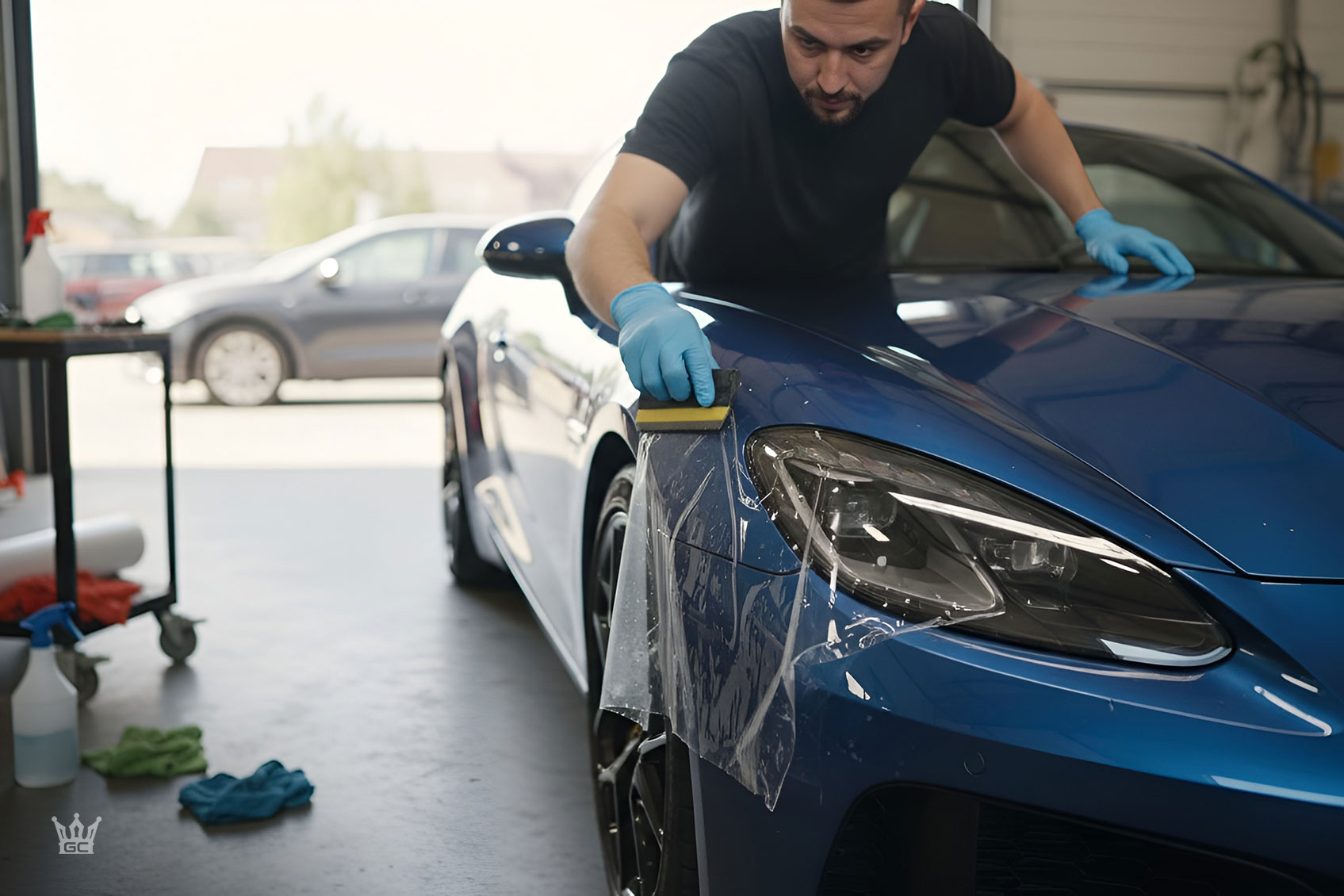
Paint protection film is a thermoplastic polyurethane (TPU) film applied to the painted surfaces of a vehicle to protect the paint. You might hear it called “clear bra,” “helicopter tape,” or simply PPF.
The concept started far from showrooms. During the Vietnam War in the 1960s, 3M developed a durable, lightweight urethane film to protect helicopter rotor blades from debris and shrapnel. Military crews called it “heli tape.” Decades later, the automotive industry adopted the same technology, refined the chemistry, and made it optically clear.
The simplest way to think about it: PPF is a sacrificial layer. It absorbs damage so your paint doesn’t have to. Edmunds compared it to a screen protector on a phone, which is a useful analogy. But the engineering behind automotive-grade PPF is considerably more sophisticated than any phone accessory.
For a broader overview of coverage options and film types, our complete PPF guide covering options and care goes deeper.
What PPF Is Made Of: The Three-Layer Structure
Understanding how PPF protects a vehicle requires looking at what’s inside the film itself. Modern PPF consists of three distinct layers, each engineered for a specific job.
The Top Coat
The outermost layer is a hydrophobic, stain-resistant coating. It repels water, dirt, bird droppings, and tree sap before they reach the film beneath. This is also the layer responsible for PPF’s self-healing capability, which we’ll cover in the next section. Think of it as the first line of defence: a slick, chemical-resistant surface that prevents contaminants from bonding to the film.
The Polyurethane (TPU) Core
This is the workhorse. The TPU core is a flexible, impact-absorbing layer that disperses kinetic energy laterally when struck by road debris. When a stone hits your bonnet at highway speed, the core absorbs and spreads that force across a wider area rather than letting it concentrate on a single point of paint. This is why PPF stops rock chips while ceramic coatings and waxes cannot. They lack this physical impact layer entirely.
The Adhesive Layer
The bottom layer bonds the film to your vehicle’s paint. It’s engineered to hold firmly over years of heat cycling, washing, and road vibration, yet release cleanly during professional removal without pulling paint or leaving residue.
This three-layer construction is what separates PPF from every other form of paint protection. Each layer contributes a distinct function, and together they create a comprehensive shield.
How Self-Healing Actually Works
PPF’s self-healing ability is its most talked-about feature, and it’s genuinely impressive when you see it in action. But it’s not magic. It’s polymer science.
The top coat uses an elastomeric polymer that maintains a “memory” of its original shape. When a light scratch disrupts the surface, three mechanisms work together to repair it:
Thermal movement. Heat softens the polymer chains in the top coat, making them malleable enough to flow back into their original position. This is why scratches seem to vanish on a warm day.
Elastic recovery. The polymer acts somewhat like memory foam. After being deformed, it wants to return to its original shape. This happens continuously at the molecular level.
Surface tension. Once the polymer chains begin to move, surface tension smooths out remaining imperfections, restoring the glossy, uniform finish.
Heat triggers this process. Sunlight is usually enough. Warm water or careful use of a heat gun speeds things up on cooler days. In Queensland, where summer temperatures regularly push past 35°C, self-healing often happens while your car sits in a parking lot.
What Self-Healing Fixes (and What It Doesn’t)
Self-healing handles swirl marks, light scratches from car washes, and minor surface abrasions. It does not repair deep gouges, punctures from sharp objects, or cuts that penetrate through the film. A useful way to think about it: if you can feel the scratch with your fingernail catching in it, the film likely self-healed. If a sharp object punched through the film entirely, the damage stays.
Knowing how to maintain PPF properly extends both its life and its self-healing performance. Our guide on how to clean and maintain PPF covers best practices.
What Specific Threats PPF Blocks
Here’s where understanding how PPF protects your vehicle gets practical. Each threat maps back to one or more of those three layers doing their job.
Rock Chips and Road Debris
This is the primary reason people buy PPF. Gravel, stones, road grit, and even sand kicked up by the vehicle ahead will pit and chip unprotected paint over time. The TPU core absorbs the impact energy and disperses it laterally across the adhesive layer.
How effective is this? The automotive industry uses the SAE J400 Gravelometer Test, which fires 500 grams of crushed steel gravel at a panel at 70 PSI. Premium 8 to 10 mil films consistently score 9 or 10 out of 10 on the chipping scale, and most premium films are effective against rock chips at speeds up to roughly 120 km/h.
Practitioners on vehicle forums (4Runner, Lexus GX, and Tesla owner communities) consistently report that PPF’s value is most obvious on high-impact areas like the bonnet, front bumper, and side mirrors. The most common regret among new car buyers on these forums? Not getting PPF installed early enough.
UV Rays
PPF blocks UV penetration, preventing the fading, oxidation, and clear-coat breakdown that UV radiation causes over time. This matters everywhere, but it matters especially in Queensland.
Australia receives some of the highest UV radiation levels in the world due to its proximity to the ozone hole over Antarctica and a cleaner atmosphere that filters less UV. The UV Index on the Gold Coast regularly exceeds 11 (classified as “extreme”) during summer months. Paint fades faster here than in the US or UK, where most PPF marketing originates. For Gold Coast vehicle owners, UV protection from PPF isn’t a nice bonus. It’s one of the core reasons to invest.
Bird Droppings, Tree Sap, and Bug Splatter
These are acidic. Left on unprotected paint for even a few days, bird droppings and tree sap etch into the clear coat, leaving permanent marks. The hydrophobic top coat on PPF prevents these contaminants from bonding to the surface. They sit on top of the film rather than attacking your paint, making them easy to wash away before any damage occurs.
Acid Rain, Water Spots, and Road Salt
The top coat’s chemical resistance extends to acidic rainwater, mineral-heavy water spots, and road salt. While road salt is less of a concern on the Gold Coast than in cooler climates, coastal salt air is a constant factor for vehicles parked or driven near the beach.
Light Scratches from Everyday Life
Car park brushes, jacket zippers, shopping bags dragged across a panel, fingernails around door handles. These minor abrasions are exactly what PPF’s self-healing top coat is designed to handle. The film takes the scratch, heats up, and repairs itself.
How Film Thickness Affects Protection
Not all PPF is the same thickness, and thickness directly determines how much punishment the film can absorb. This is a detail most guides skip, but it matters when choosing the right film for your vehicle and lifestyle.
According to Dupotop Films’ thickness guide, standard tiers break down like this:
6.5 mil is designed for everyday commuters. It provides balanced protection against typical road debris and is the easiest to install. Good for daily drivers that stick to paved roads.
7.5 to 8 mil offers enhanced scratch and stone-chip resistance. This is the sweet spot for luxury, sports, and higher-value vehicles that see regular highway driving.
9.5 to 10 mil delivers maximum impact protection. Edmunds notes that 10 mil PPF is recommended for off-roading or vehicles frequently exposed to environments where paint damage is likely, such as work sites or fire trails.
Thicker film means more protection, but it also requires more skill to install cleanly, particularly around compound curves, panel edges, and recessed areas. Professional installation with plotter-cut templates becomes critical at the higher thickness tiers.
For vehicles that see off-road duty, our bush wraps and off-road paint protection guide covers the specific considerations for 4x4s and utes.
What PPF Cannot Protect Against
Being honest about PPF’s limits builds a more accurate picture of how PPF protects a vehicle, and helps you set realistic expectations.
Major impacts and dents. PPF is not armour plating. A door ding from a careless driver in a parking lot, a shopping trolley hit, or a significant impact will still dent the panel underneath. The film may prevent the paint from chipping at the impact point, but the metal beneath will deform.
Deep gouges from sharp objects. A key dragged with force, a screwdriver, or a branch that punctures rather than scratches will cut through the film. PPF is designed to absorb and self-heal surface-level damage, not resist deliberate or high-force penetration.
Budget film degradation. This is important and rarely discussed in consumer-facing content. There are two types of TPU: aliphatic and aromatic. Aliphatic TPU (used in premium films from brands like XPEL, 3M, and SunTek) stays optically clear for 10 or more years. Aromatic TPU (used in cheaper films) degrades under UV, turning yellow and brittle over time. In Australian conditions, where UV is extreme, this distinction matters even more. Budget film that would last acceptably in a mild European climate may yellow within a few years on the Gold Coast.
Poor installation. The film itself can be perfectly engineered, but bubbles, orange peel texture, and edge lifting from a bad installation negate its protective value. Enthusiast communities are nearly unanimous on this point: complaints about PPF performance almost always trace back to installation quality rather than the film itself. Pre-cut digital templates (plotter-cut patterns) ensure precision fit, and experienced installers know how to wrap edges cleanly so debris can’t lift the film.
Think of PPF like a bulletproof vest. It’s designed to take the hit so you don’t have to, but it’s not invincible.
PPF vs. Ceramic Coating: A Quick Clarification
These two products are frequently confused, and the distinction is simple once you understand it.
PPF is a physical barrier. It absorbs impacts, prevents chips and scratches, and blocks UV. It has actual thickness, flexibility, and mass.
Ceramic coating is a chemical barrier. It bonds to paint (or to PPF) at the molecular level and adds hydrophobicity, UV resistance, and easier cleaning. But it offers zero impact protection. A ceramic-coated bonnet will still chip from a stone strike.
Wikipedia’s PPF entry puts it directly: PPF is designed for physical protection against road debris and scratching, while sealants (like ceramic coatings) are liquid-applied and designed for UV and chemical resistance.
The best approach is both together: PPF underneath to handle physical threats, ceramic coating on top for additional hydrophobicity and easier maintenance. For a detailed comparison, see our breakdown of PPF vs. ceramic coating and which is right for your situation.
Does PPF Protect Resale Value?
Yes, and the data is now stronger than opinions. A national survey commissioned by XPEL in June 2025, conducted among 300 US auto dealership decision-makers by Atomik Research (±3% margin of error at 95% confidence), found:
-
96% believe PPF applied to all painted surfaces retains more value over initial ownership
-
70% cite resale value retention gains of up to 15%
-
92% say vehicles with full PPF would fetch higher resale pricing as pre-owned inventory
-
91% recommend protecting all exterior surfaces, not just the front end
This transforms the PPF conversation from “cost” to “investment.” A vehicle that presents with chip-free, unfaded paint at trade-in time simply commands more money.
As for lifespan, modern PPF can last up to 15 years under ideal conditions (garaged storage, ceramic coating on top, regular maintenance). Most owners can realistically expect 5 to 10 years of strong performance. Premium brands back this with 10-year warranties covering yellowing, cracking, and delamination.
If you’re considering PPF for a new car, our guide to the best paint protection options for new vehicles walks through the decision.
Where to Prioritise PPF on Your Vehicle
Not everyone needs (or wants to budget for) full-body coverage. Here’s how to think about prioritisation.
Full front coverage is the minimum worth doing. This means the bonnet, front bumper, front fenders, side mirrors, and headlights. These are the areas that face the most road debris. Enthusiast forums are clear on this point: partial bonnet coverage (half bonnet or “bra line” coverage) is a false economy because the visible cut line collects dirt and the exposed paint above it still chips.
High-impact secondary areas include door edges, rocker panels, rear wheel arches, and the area behind the rear wheels. These catch flung debris from your own tyres.
Full-body coverage makes sense for luxury vehicles, sports cars, and any vehicle regularly exposed to harsh conditions. On the Gold Coast, the combination of M1 Pacific Motorway stone chips, coastal salt air, intense UV, and heavy insect exposure creates a multi-threat environment that PPF directly addresses across every panel.
EV owners represent a rapidly growing PPF segment. Tesla and BYD vehicles use single-stage paint that is notably softer than traditional multi-coat systems, making them more susceptible to chips and scratches. PPF is also formulated to be transparent to the sensors and cameras that EVs rely on, so it won’t interfere with Autopilot or parking assist systems. You can see examples of EV-specific work on our EV wraps and protection portfolio.
One contrarian view worth acknowledging: for lower-value vehicles (sub-$30,000) that won’t be kept long-term, the cost-to-value ratio of full-body PPF becomes harder to justify. In those cases, a full front package targeting the highest-impact areas usually makes the most sense.
Putting It All Together
How PPF protects a vehicle comes down to physics and chemistry working in layers. The TPU core absorbs and disperses impact energy from road debris. The top coat repels chemicals, blocks UV, and self-heals light scratches through heat-activated polymer recovery. The adhesive holds everything in place without compromising your factory paint.
No wax, sealant, or ceramic coating can replicate what PPF does. Those products protect against chemical and UV threats, and they do it well. But only PPF provides a genuine physical barrier, the kind of protection that stops a stone from chipping your bonnet at 110 km/h on the M1.
For Gold Coast vehicles especially, where extreme UV, highway debris, salt air, and insect exposure converge, PPF addresses every major threat in a single application.
If you’re weighing up PPF for your vehicle, explore coverage options with our PPF specialists or get in touch for a quote.
Frequently Asked Questions
The polyurethane core layer absorbs the kinetic energy from stone impacts and disperses the force laterally across a wider area rather than letting it concentrate on a single point. In standardised SAE J400 Gravelometer testing, premium 8 to 10 mil films score 9 or 10 out of 10 on chip resistance, protecting effectively at speeds up to approximately 120 km/h.
Yes. The top coat contains an elastomeric polymer with shape memory. When heat (from sunlight, warm water, or a heat gun) softens the polymer chains, they flow back into their original position, erasing light scratches and swirl marks. It won’t fix deep cuts or punctures, but for everyday surface-level damage, it works reliably.
Premium aliphatic TPU films with proper care last 5 to 10 years in typical conditions, and up to 15 years with garaged storage and ceramic coating on top. Australia’s extreme UV accelerates degradation of budget aromatic TPU films, which may yellow within a few years. Choosing premium film is more important here than in lower-UV climates.
Yes. The adhesive layer is engineered for clean removal. A professional installer uses heat to soften the adhesive and peels the film away without pulling paint or leaving residue. This is one reason PPF protects resale value: it preserves factory paint in original condition underneath.
For most daily drivers, a full front PPF package (bonnet, bumper, fenders, mirrors) provides strong protection where it matters most. The June 2025 XPEL dealer survey showed that 96% of dealership decision-makers believe PPF retains vehicle value, with up to 15% higher resale pricing reported. Whether full-body coverage is warranted depends on the vehicle’s value and how long you plan to keep it.
PPF is increasingly popular on EVs. Tesla and BYD vehicles have softer single-stage paint that chips and scratches more easily than traditional multi-coat finishes. Modern PPF is formulated to be transparent to sensors and cameras, so it won’t interfere with driver-assist systems.
PPF is a physical film that absorbs impacts, blocks UV, and self-heals scratches. Ceramic coating is a liquid-applied chemical layer that adds hydrophobicity and makes cleaning easier but provides zero impact protection. They serve different purposes, and the ideal setup is PPF with ceramic coating applied on top.
Absolutely. Thinner films (6.5 mil) suit everyday commuters on paved roads. Mid-range films (7.5 to 8 mil) are the standard for luxury and sports vehicles. Thicker films (9.5 to 10 mil) are designed for off-road use, track days, and high-debris environments. Thicker film requires more installation skill, making professional application essential.