
TL;DR
Paint protection film (PPF) is a transparent, self-healing polyurethane film that physically shields your car’s paint from stone chips, scratches, UV damage, and environmental contaminants. For most new car owners on the Gold Coast, PPF is a smart investment because Queensland’s extreme UV radiation, salt air, and M1 highway debris degrade unprotected paint faster than almost anywhere else in Australia. You don’t necessarily need full-body coverage, though. The right level depends on your vehicle, your driving habits, and your budget.
What Is PPF, Exactly?
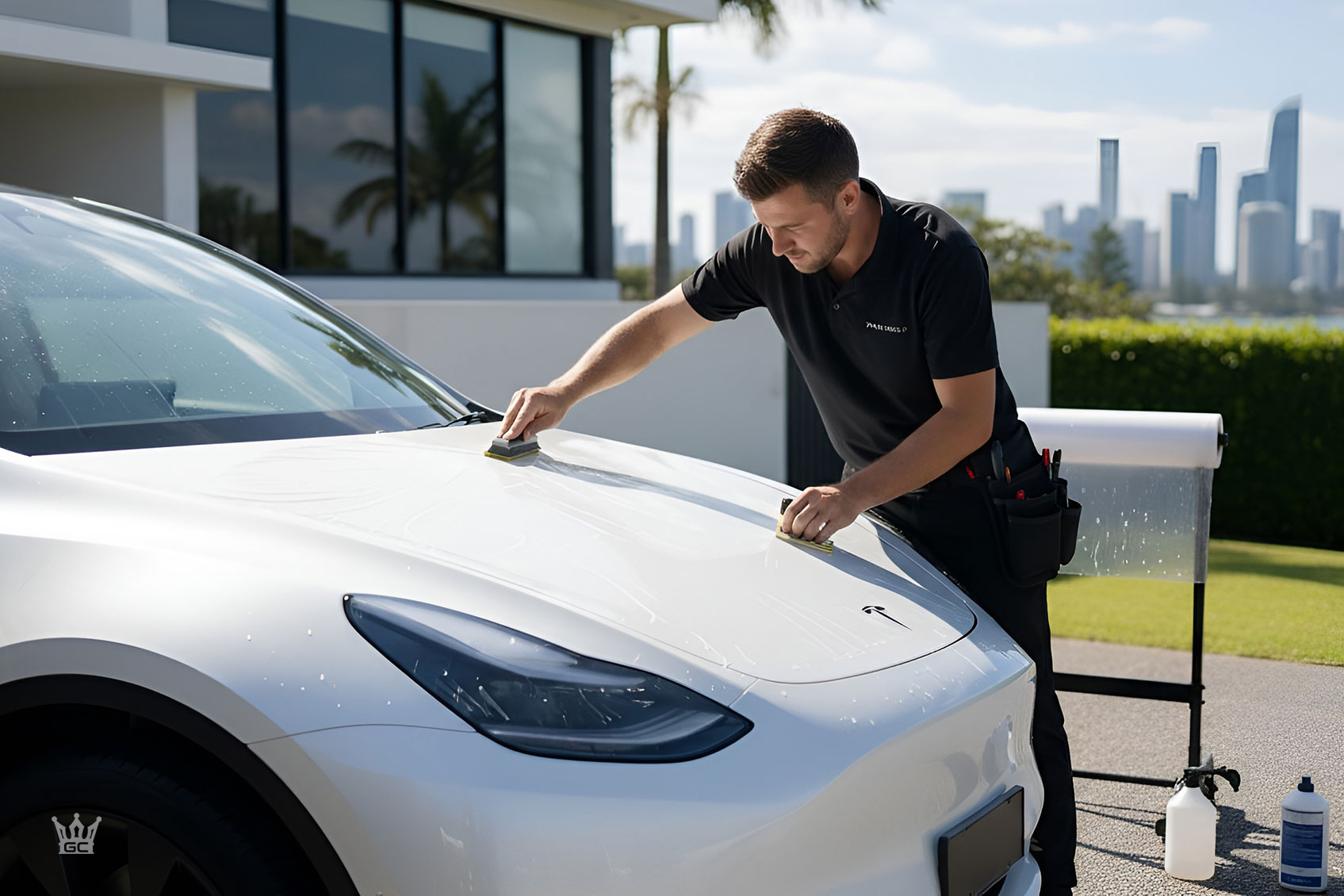
PPF stands for paint protection film. You might also hear it called “clear bra” or simply “clear film.” It’s a thermoplastic polyurethane (TPU) sheet, typically 150 to 200 microns thick, applied directly over your car’s painted surfaces.
The film’s standout feature is self-healing. The top coat of quality PPF has a molecular “memory.” When minor scratches or swirl marks appear, heat from sunlight or warm water causes those molecules to reorganise and return to their original smooth alignment. The scratch fills itself in, often within minutes on a warm Gold Coast day.
PPF protects against:
-
Stone chips and road debris
-
Light scratches and scuffs
-
UV-induced paint fade and clear coat breakdown
-
Bird and bat droppings (which are acidic enough to etch paint permanently)
-
Tree sap, bug splatter, and salt deposits
Think of PPF as a physical barrier between the world and your paint. It absorbs the hit so your clear coat doesn’t have to. For a deeper technical breakdown, our complete paint protection film guide covers how the film is manufactured, applied, and maintained.
Why the Gold Coast Is Especially Hard on Car Paint
Asking “do I need PPF on a new car on the Gold Coast” is a different question from asking it in Melbourne or Hobart. The Gold Coast throws a combination of environmental factors at your paint that few other regions in Australia can match.
UV Radiation
Queensland regularly records UV index readings between 10 and 14 during summer, classified as “extreme” by the Bureau of Meteorology. For comparison, the UK and Canada typically sit between 2 and 6 on the same scale. That UV doesn’t just burn skin. It breaks down the polymer chains in automotive clear coat, causing oxidation, fading, and a chalky, dull finish over time.
Salt Air
Living anywhere from Southport to Coolangatta means salt mist settles on your vehicle constantly. You don’t need to park on the beach for it to happen. Salt accelerates oxidation and attacks exposed metal, trim, and paint edges. It’s invisible and relentless.
M1 Motorway Debris
If you commute on the M1 (and most Gold Coast residents do), your front end is pelted with sand, gravel, and small rocks daily. Unprotected bonnets and bumpers develop a constellation of tiny chips within months of delivery.
Bird and Bat Droppings
The Gold Coast’s abundant fruit bat population produces highly acidic droppings that can etch permanent craters into clear coat on a hot day. When the paint surface is already heated by 35-degree sunshine, those droppings begin etching within minutes, not hours.
Humidity
High humidity traps contaminants against the paint surface for longer, giving them more time to cause damage. Combined with UV and salt, it creates a triple threat that accelerates paint degradation significantly compared to drier climates.
Dealer “Paint Protection” vs. Real PPF: They Are Not the Same Thing
This is the single biggest point of confusion for new car buyers on the Gold Coast, and it costs people money.
When the finance manager at the dealership offers you a “paint protection package” for $1,000 to $2,000, they are almost certainly not talking about paint protection film. Dealership paint protection is typically a spray-on sealant or polymer coating applied by an in-house detailer (or outsourced to a third party without telling you). These products bead water for a few months and then fade.
Gold Coast detailing professionals have a colourful name for this: the “Ming Mop,” referring to the speed and lack of care involved in dealership applications. The issues are consistent:
-
Volume pressure. Dealership detailers are paid per car and need to turn vehicles fast. Proper PPF installation requires hours of surface preparation and controlled conditions.
-
Inferior products. Bulk-purchased sealants that provide surface gloss but zero chip or scratch protection.
-
Markup. A significant portion of the price goes to the salesperson’s commission, not the product or application quality.
Specialist PPF installers, by contrast, use precision plotter-cut patterns (called DAP, or Design Access Program files) in climate-controlled workshops. Hand-cutting film on the vehicle is risky because it can slice through your clear coat.
If you’re weighing your options, our breakdown of the best paint protection options for new cars on the Gold Coast explains the differences in detail.
PPF Coverage Tiers: What Should You Actually Protect?
Not every car needs full-body PPF. The right coverage tier depends on your vehicle, how you drive it, and what you’re willing to spend.
Full Front (Most Popular)
Covers the bonnet, front bumper, front guards/fenders, side mirrors, and headlights. This is the most common choice because the front end absorbs roughly 80% of all stone chip and road debris damage. For daily drivers who commute on the M1 or Pacific Motorway, a full front kit is the sweet spot between cost and protection.
Full Body
Every painted panel gets covered. This is the go-to for luxury vehicles, performance cars, and collectibles where resale value matters enormously, or where the owner simply wants total protection. Think Ferraris, AMG G-Wagons, or a new Corvette headed to track days.
Track Pack
Targeted at performance and sports cars, covering high-impact zones that see the most abuse during spirited driving. Rocker panels, lower doors, rear bumper edges, and A-pillars.
High-Impact Zones Only (Budget Option)
Just the bumper bar, leading edge of the bonnet, mirrors, and door edges. A sensible starting point for budget-conscious buyers who want chip protection where it matters most.
Satin and Matte PPF
A growing number of Gold Coast owners are choosing satin PPF, which converts a gloss factory finish to a matte or satin look while simultaneously protecting it. It’s particularly popular on Teslas, Land Rover Defenders, and EVs. If you’re curious about that option, the satin vs. gloss PPF decision guide for Tesla Model Y walks through the visual and practical differences.
What Does PPF Cost in Australia?
Let’s talk real numbers. Australian PPF pricing varies by vehicle size, film brand, panel complexity, and installer skill, but here are the ballpark figures from Solarblock’s Australian cost guide:
|
Coverage Level |
Starting Price (AUD) |
|---|---|
|
Full front kit (bonnet, bumper, guards, mirrors, headlights) |
From ~$2,500 |
|
Full body (every painted panel) |
From ~$6,000 |
Larger vehicles (utes, SUVs, 4x4s) cost more due to additional panel area. Complex body lines (think Lamborghini air intakes or Defender’s flat panels that show every imperfection) also add time and cost.
These prices are for professional installation with quality film. If someone quotes you significantly less, ask what brand of film they use and whether they hand-cut or use plotter-cut patterns. The cheapest quote is rarely the best value when you’re protecting a $50,000+ vehicle.
For an accurate quote on your specific car, get in touch with the Gold Coast Wrap Kings team for a custom assessment.
How Long Does PPF Last?
Quality PPF typically lasts between 5 and 10 years, with premium brands pushing past the 10-year mark when properly maintained. Several factors influence lifespan:
-
Film brand and quality. Premium films with thicker top coats resist yellowing and degradation longer.
-
Installation quality. Poor installation leads to lifting edges, which let moisture and dirt underneath.
-
UV exposure. This matters especially on the Gold Coast, where UV is extreme year-round.
-
Parking habits. Vehicles kept in garages see up to 30% longer PPF life compared to those parked outdoors daily.
-
Maintenance routine. Regular washing with pH-neutral soap and avoiding abrasive cleaners keeps the film performing.
Most premium PPF brands carry manufacturer warranties of 10 to 12 years against yellowing, cracking, and peeling. Always confirm warranty details with your installer.
PPF vs. Ceramic Coating: A Quick Comparison
These two products get confused constantly, but they do fundamentally different things.
|
Feature |
PPF |
Ceramic Coating |
|---|---|---|
|
Stone chip protection |
Yes, excellent |
No |
|
Scratch resistance |
Yes, self-healing |
Minimal |
|
UV protection |
Yes |
Yes |
|
Gloss enhancement |
Moderate |
High |
|
Hydrophobic (water beading) |
Yes |
Yes |
|
Lifespan |
5 to 10+ years |
2 to 5 years |
PPF is a physical shield. Ceramic coating is a chemical surface treatment that adds gloss, makes cleaning easier, and provides some UV resistance, but it cannot stop a rock chip.
The best approach, and what many Gold Coast car owners choose, is both: PPF on high-impact areas and ceramic coating over the rest of the vehicle. Our PPF vs. ceramic coating comparison breaks this down further.
Who Should Get PPF on a New Car? A Decision Framework
Rather than just listing benefits, here’s a practical framework for deciding whether PPF makes sense for your situation on the Gold Coast.
Definitely Get PPF
-
New luxury, performance, or collectible vehicles. The cost of PPF is a fraction of the cost of repainting a Ferrari bonnet or replacing a BMW M4 bumper bar.
-
Highway commuters. If the M1, Pacific Motorway, or any highway is part of your daily drive, your front end is under constant bombardment.
-
4×4 and adventure vehicles. Gravel roads, bush tracks, and off-road debris demand physical protection. Our Toyota Hilux PPF guide shows what coverage looks like on a working ute.
-
EVs, especially Teslas. Practitioners on forums like Tesla Motors Club and Bimmerpost consistently report that Tesla’s factory paint is notoriously thin. PPF is almost standard practice among Tesla owners.
-
Anyone planning to keep the car 5+ years. The cumulative damage from five Gold Coast summers without protection is substantial.
Strongly Consider PPF
-
Any new vehicle valued over ~$50,000 (the threshold where PPF’s ROI becomes very compelling, according to discussions across multiple Australian forums).
-
Vehicles parked outdoors on the Gold Coast regularly.
-
Cars driven on unsealed or gravel roads, even occasionally.
Consider Partial Coverage
-
Budget-conscious buyers who still want front-end protection.
-
Vehicles driven infrequently or only in the city.
-
Buyers who want to protect the bonnet and bumper now and add more coverage later.
You Might Skip PPF If…
-
You plan to sell the vehicle within 12 months (the film won’t have time to earn back its cost).
-
The paint is already heavily damaged (you’d need a full paint correction first, adding significant cost).
-
The vehicle genuinely never leaves a garage.
-
The budget simply isn’t there, and the money serves you better elsewhere. That’s an honest answer, and there’s no shame in it.
The Resale Value Argument
A 2025 survey of 300 U.S. dealership professionals commissioned by XPEL found that 96% of respondents believe PPF applied to all painted surfaces helps a vehicle retain more of its value. Among those, 70% cited value-retention gains of up to 15%.
That same survey found 92% of dealers said vehicles with PPF would fetch a higher price as pre-owned inventory. And 9 in 10 recommended protecting all exterior surfaces rather than just the front end.
While those numbers come from a U.S. context, the principle applies equally on the Gold Coast. A five-year-old car with mint paint and documented PPF protection will always command a premium over one covered in chips and UV damage. On a $60,000 vehicle, even a 10% value retention gain represents $6,000, which is right around the cost of full-body PPF.
When to Install PPF on a New Car
The best time to apply PPF is immediately at delivery, before the car sees its first road. Every kilometre driven without protection adds micro-damage: tiny chips, scratches, and contaminant marks that become permanent.
This is sometimes called the “virgin paint window.” Once scratches and swirl marks accumulate, you’ll need a full paint correction (machine polishing) before PPF can be applied. That adds cost and, in the case of aggressive correction, removes a thin layer of already-thin modern clear coat.
Modern factory clear coats are thinner than they were 20 years ago due to environmental regulations on solvent content. There’s less material to work with, which makes early protection even more important.
If you’re picking up a new car on the Gold Coast and you’ve already decided on PPF, arrange the installation for delivery week. Some buyers even have the dealer deliver the car directly to the PPF installer.
PPF Maintenance Basics
PPF is low-maintenance, but not zero-maintenance. A few simple habits will keep the film looking and performing its best in Gold Coast conditions:
-
Hand wash only with pH-neutral car wash soap. Avoid dish soap and household cleaners.
-
Skip automatic car washes. The brushes can damage the film’s surface, and high-pressure water jets aimed at film edges can cause lifting.
-
Don’t use standard wax or polish on PPF. Use products specifically formulated for paint protection film.
-
Remove bird and bat droppings quickly. Even with PPF, acidic droppings left baking in the sun for days can leave marks on the film’s top coat.
-
Rinse salt residue regularly. A quick rinse after beach trips prevents salt from building up on the film.
For a full maintenance routine, our guide to cleaning paint protection film covers the products and techniques that work best.
PPF Types and Finishes
PPF isn’t just one product. There are three main finishes:
Clear/Gloss PPF is the most popular choice. It’s virtually invisible once applied and doesn’t change your car’s appearance at all. This is what most people mean when they say “PPF.”
Satin/Matte PPF transforms a gloss factory finish into a muted satin look while providing the same physical protection. It’s increasingly popular on the Gold Coast for Teslas, Defenders, and modern EVs. Our Land Rover Defender satin PPF project shows the result on a real vehicle.
Coloured PPF combines a colour change with physical protection in a single layer. It’s a newer option that’s gaining traction for buyers who want both style and substance without running separate wrap and PPF layers.
Common Misconceptions
“PPF turns yellow.” Early-generation films from 10+ years ago were prone to yellowing. Modern premium films use UV-stabilised top coats that resist discolouration for the life of the product. This problem has been largely solved.
“PPF is only for expensive cars.” The question isn’t really about the car’s price tag, it’s about how much you care about its appearance and what paint damage would cost to fix. A bumper respray on a Mazda 3 still costs $800 to $1,200.
“Ceramic coating does the same thing.” It doesn’t. Ceramic coating protects against UV and makes cleaning easier, but it cannot stop a rock chip. They’re complementary products, not substitutes.
“I can just get the dealer to do it.” As covered above, dealership “paint protection” and specialist PPF are entirely different products with entirely different results.
So, Do You Need PPF on a New Car on the Gold Coast?
For most new car owners here, the answer is yes, at least on the front end. The Gold Coast’s UV, salt, highway debris, and wildlife droppings create conditions that will damage unprotected paint faster than most places in Australia. A full front PPF kit protects against 80% of road debris damage at a fraction of full-body cost.
If you drive a luxury vehicle, an EV with thin factory paint, a ute that sees gravel, or any car you plan to keep for more than a few years, PPF pays for itself through preserved appearance and higher resale value.
The community sentiment backs this up. Across Australian forums like Whirlpool and international communities like Bimmerpost and Tesla Motors Club, the pattern is consistent: owners who installed PPF are satisfied, and the most common regret is not covering enough of the vehicle or not doing it soon enough.
Ready to protect your new car? Explore our PPF options or contact Gold Coast Wrap Kings for a custom quote on your specific vehicle.
FAQ
Yes, if you care about keeping the paint in good condition. The $50,000 figure often cited in forums is a rough threshold where the ROI becomes obvious, but paint damage is expensive to fix on any vehicle. A bumper respray costs $800+ regardless of whether the car is a Corolla or a Cayenne. If you plan to keep the car for several years and it does regular highway driving on the Gold Coast, a full front PPF kit is a sensible investment at any price point.
Yes. Quality PPF is designed to be removable. When professionally removed (using heat to soften the adhesive), it comes off cleanly without pulling paint or clear coat. This is one of the key advantages over a respray or permanent coating.
They serve different purposes. PPF physically stops stone chips and scratches. Ceramic coating adds gloss, UV resistance, and hydrophobic properties but cannot prevent physical damage. The ideal setup for Gold Coast conditions is PPF on high-impact areas (front end at minimum) with ceramic coating on the remaining panels. Our PPF vs. ceramic coating guide explains the differences in full.
As soon as possible, ideally within the first week of ownership. Every drive without protection adds micro-damage. Some buyers arrange for the car to go directly from the dealership to the PPF installer on delivery day. The sooner PPF goes on, the less paint correction (if any) is needed beforehand.
Clear/gloss PPF is virtually invisible once applied. Most people cannot tell it’s there. Satin PPF will change the finish from gloss to a matte or satin look, which is a deliberate style choice. Coloured PPF changes both the finish and the colour.
Small sections like door cups and mirror caps are manageable for a patient DIYer. Full panels (bonnets, bumpers, guards) are extremely difficult without professional tools, training, and a controlled environment. Air bubbles, dust contamination, misalignment, and film stretching are common problems with amateur installation. For anything beyond small accent pieces, professional installation is strongly recommended.
PPF creates a sealed barrier over the paint surface, preventing salt from reaching the clear coat and underlying layers. It’s one of the strongest arguments for PPF in coastal areas like the Gold Coast. You’ll still want to rinse salt deposits off the film regularly, but the paint underneath stays completely protected.
Look for a shop that uses plotter-cut (DAP) patterns rather than hand-cutting on the vehicle, works in a climate-controlled environment, and can show you a portfolio of completed work across different vehicle types. Ask what film brands they use and what warranty comes with the installation. A shop that has experience with complex vehicles (EVs, luxury cars, performance cars) is a good indicator of skill level.