
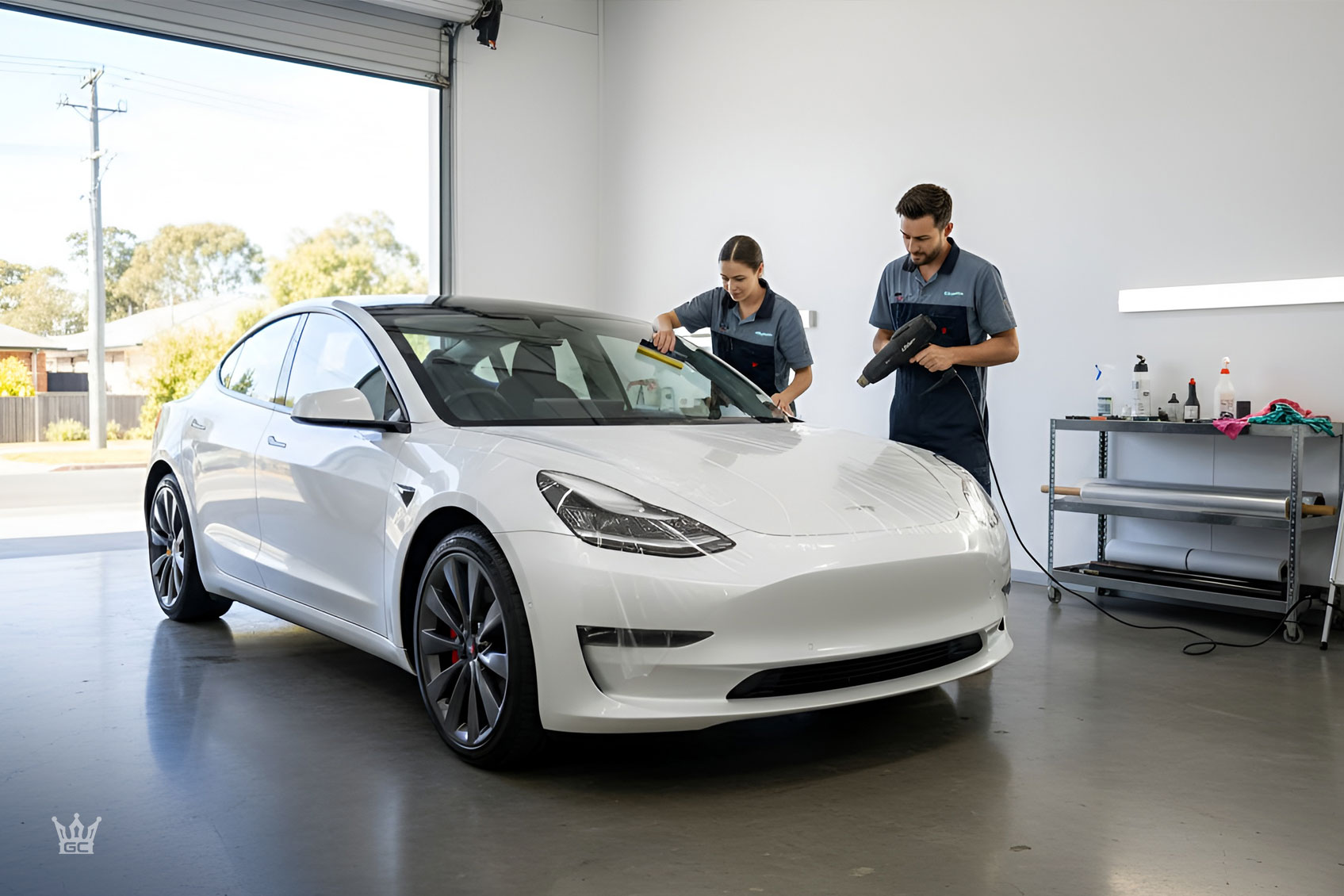
TL;DR
The average full car PPF cost in Australia sits between $6,000 and $9,000 AUD for a standard sedan, while large SUVs, 4x4s, and exotics push into the $7,000 to $12,000+ range. Satin or stealth finishes typically add 10 to 15 percent on top of that. The majority of what you pay covers skilled labor (40 to 60+ hours for a genuine full-body install), not just the film itself, which is why quotes vary so dramatically between shops.
What “Full Car PPF” Actually Means
Before talking numbers, it helps to agree on the scope. “Full car PPF” means covering every exterior painted panel with self-healing polyurethane film. That includes the bonnet, bumpers, guards, doors, roof, boot, and typically A-pillars and rockers.
What it does not include: glass, wheels, and (usually) interior door jambs. Gloss black trim pieces and piano black pillars might be wrapped or billed separately depending on the installer. Some shops wrap door jambs as standard, others treat it as an add-on. This inconsistency is one reason quotes confuse people.
If you want a deeper explanation of how PPF works and what coverage levels look like, our guide to paint protection film, coverage, and care breaks it all down.
The Quick Answer: Average Full Car PPF Cost in Australia (2026)
Here are real price ranges published by reputable Australian installers:
-
Gold Coast: $5,500 to $10,000+ depending on vehicle size source
-
Brisbane: Full wrap from $5,800+ source
-
Perth: $3,800 to $5,500 source
-
National (Australia-wide): A full installation can typically run around $10,000 source
Synthesizing these numbers into something practical:
|
Vehicle Type |
Average Full Car PPF Cost (AUD) |
|---|---|
|
Small car / hatch |
$5,500 to $7,500 |
|
Standard sedan |
$6,000 to $9,000 |
|
SUV / 4×4 / ute |
$7,000 to $10,000+ |
|
Exotic / supercar |
$8,000 to $12,000+ |
|
Satin or stealth finish |
Add 10 to 15% to above |
For international readers, US full-body PPF commonly runs $6,000 to $10,000+ USD, with professional installers citing 40 to 60+ labor hours for a proper job source.
If you’re ready to get a quote tailored to your vehicle, reach out to our team for a custom PPF estimate.
Why PPF Quotes Are All Over the Place
Getting three quotes and seeing a $4,000 spread between them is not unusual. It does not necessarily mean someone is ripping you off. Here is what actually moves the number.
Vehicle Size and Panel Complexity
A Mazda 3 has far fewer panels and simpler curves than a Mercedes G-Wagon. But it is not just panel count. One Gold Coast detailer documented 38 individual pieces in a single Golf R Mk8.5 bumper alone source. Intricate vents, sensors, and sculpted bodywork multiply the hours needed to cut, position, and finish each section.
You can see the kind of complexity involved in full-body installs on vehicles like the Toyota GR Hilux clear PPF project or the Tesla Model X, where gull-wing doors and integrated sensors make every panel a challenge.
Coverage Scope
“Full car” is the top tier. Below it, you will find full-front packages, “track packs” (front end plus rocker panels and rear bumper), and partial coverage options. Practitioners on Reddit report that full-body PPF costs roughly 4.5 times as much as a full-front package source. That ratio is useful when sanity-checking quotes.
Film Brand and Finish
Premium films like XPEL Ultimate Plus (total construction around 8 mil, or 200 microns, without liner) and LLumar Platinum (base thickness around 6 mil, or 152 microns) carry different wholesale costs. Satin and stealth finishes typically run 10 to 15 percent more than standard gloss because the material is more expensive and less forgiving to install source.
Coloured PPF commands an even higher premium. For a real-world example of satin PPF on a local vehicle, take a look at this BYD Seal EV satin PPF full wrap.
Installer Skill and Time
This is the big one. The majority of the average full car PPF cost is labor, not material. A respected thread on r/AutoDetailing makes this point bluntly: materials are a fraction of what you pay, and any shop quoting 6 to 10 hours for a full-body wrap is cutting serious corners source. Professional installers cite 40 to 60+ hours as normal for a true full-body job with edge wrapping and hybrid template modifications source.
What separates a quality install from a cheap one is not the film brand on the box. It is whether the installer modifies pre-cut templates for your specific vehicle, wraps edges so seams are invisible, removes and reinstalls trim and badges, and cures the film in a climate-controlled environment.
Paint Prep and Condition
If your paint has swirl marks, contamination, or minor defects, a good installer will perform decontamination and light paint correction before laying film. This is non-negotiable for a clean result, and it adds time. Vehicles with poor paint or heavy contamination can add hours to prep work alone.
Location and Market Demand
Prestige markets and big-city shops charge more. This is true in Australia and overseas. Multiple practitioner posts highlight geographic pricing differences, with coastal and capital city shops sitting at the higher end of the scale source.
What “Full Body” Typically Includes (and What It Doesn’t)
Setting expectations here saves headaches later. A standard full-body PPF install covers:
-
Bonnet, front bumper, rear bumper
-
All four guards (fenders)
-
All doors
-
Roof
-
Boot lid / tailgate
-
A-pillars and rocker panels (usually)
Common exclusions or add-ons:
-
Glass and windows (always excluded)
-
Wheels (always excluded)
-
Door jambs and inside edges (installer-dependent, sometimes standard, sometimes extra)
-
Gloss black / piano black trim (may be included or quoted separately)
-
Side mirrors (usually included, but confirm)
-
Badges and emblems (removal and reinstallation often included in premium installs)
Gold Coast installer guides break full car PPF cost into size tiers, with small cars starting around $5,500, sedans at $6,000 to $8,500, and SUVs or 4x4s at $7,000 to $10,000+ source. This laddering helps you place your vehicle in the right ballpark before you even pick up the phone.
When Full-Body PPF Is Not the Right Call
Full-body PPF is brilliant protection, but it is not always the smartest financial move. A useful rule of thumb circulating in Australian car communities: if the full-body PPF cost exceeds 10 percent of your vehicle’s value and you don’t plan on long-term ownership, the math gets hard to justify source.
For a $30,000 hatchback, spending $6,000 or more on full PPF is a significant percentage. In that scenario, consider these alternatives:
Full-Front PPF
Covers the bonnet, front bumper, headlights, front guards, and mirrors. This is where most stone chip damage occurs, especially for highway commuters. In Perth, full-front packages run $1,200 to $2,000 source, making it a fraction of the full-body price.
Track Pack
Extends the full-front coverage to include rocker panels and the rear bumper. Good for anyone who regularly uses their car in situations where rear impact zones are exposed.
Hybrid PPF Plus Ceramic Coating
This is increasingly popular in Southeast Queensland. You get PPF on the high-impact zones (front end, rockers, possibly rear bumper) and ceramic coating on every other panel for UV protection and hydrophobic properties. Brisbane installers report hybrid packages starting from around $3,300 for partial PPF combined with ceramic coating source.
If you are weighing PPF against ceramic coating (or combining both), our comparison guide to ceramic coating vs PPF walks through the trade-offs.
Film Specs That Actually Matter (in Plain English)
You don’t need to become a polymer scientist, but a few numbers help you evaluate what you are buying.
Thickness: Mainstream automotive PPF runs about 6 to 8 mil thick (roughly 150 to 200 microns). For reference, XPEL Ultimate Plus totals about 8 mil without its release liner, while LLumar Platinum sits around 6 mil at the base layer. Thicker is not automatically better, but very thin films offer less impact protection and may not self-heal as effectively.
Self-healing: Quality films use a thermoplastic polyurethane topcoat that softens with heat (sun exposure or warm water), allowing light scratches to disappear. This is standard on premium films but varies in effectiveness across brands.
Finish options: Gloss (clear, invisible protection), satin/stealth (gives the paint a matte or factory-matte look), and coloured PPF (changes the colour while protecting). Satin costs more because the material is pricier and installation tolerances are tighter since any imperfection is more visible.
Warranty: Most premium PPF brands offer 5 to 10 year warranties against yellowing, cracking, and peeling source. Read the fine print. Some warranties require professional installation and specific maintenance routines.
For aftercare tips that help your PPF last the full warranty period, check out our guide to cleaning and maintaining PPF.
How to Sanity-Check a PPF Quote: 7 Questions to Ask
Not all quotes are equal, even when the bottom-line number looks similar. Before committing, ask:
-
What film brand and product are you using, and what is the mil thickness? If the installer cannot or will not answer this, walk away.
-
How many panels are included, and will edges be wrapped? Wrapped edges (tucking the film under panel edges) are a sign of quality. Exposed edges lift and peel faster.
-
Do you modify pre-cut templates or use them as-is? Hybrid template modifications (adjusting computer-cut patterns to fit your specific vehicle’s tolerances) separate premium installs from commodity ones source.
-
What prep work is included? Decontamination is minimum. Light paint correction should be offered if needed. Ask what happens if the paint has existing chips or damage.
-
What gets removed and reinstalled? Badges, emblems, mirror caps, and sometimes headlights or taillights need to come off for a seamless wrap. If nothing gets removed, coverage will have gaps.
-
How many days will my car be in the shop, and is the bay climate-controlled? A proper full-body install takes multiple days. Dust and humidity are the enemy of clean film application.
-
What does the warranty cover, and what is excluded? Film manufacturer warranty is separate from installer warranty. Both matter.
These are the details that explain why the average full car PPF cost varies so much between shops. The cheap quote is cheap for a reason, almost always because it skips several items on this list.
Gold Coast Specific Considerations
Living on the Gold Coast puts your vehicle through a unique combination of stresses that most inland owners do not face.
Coastal UV exposure. Queensland sun is relentless. PPF blocks UV from degrading and yellowing your clear coat, which matters more here than almost anywhere else in Australia.
Salt spray. If you are beachside in Burleigh, Currumbin, or anywhere near the coast, airborne salt accelerates paint degradation. PPF creates a physical barrier that a ceramic coating alone cannot match.
M1 highway chip risk. The daily commute between the Gold Coast and Brisbane on the M1 is a gauntlet of loose gravel, truck debris, and construction zones. The front end of your vehicle cops the worst of it. For highway commuters who cannot justify full-body pricing, a full-front PPF package is the minimum worth considering.
Hinterland and off-road use. 4×4 owners heading into Springbrook, Lamington, or beyond face branch scratches and trail debris. Full-body PPF or at least extended coverage makes real sense here.
For a local example of what full protection looks like on a vehicle built for exactly these conditions, browse the Ferrari 488 GTB PPF case study, which shows how a high-value vehicle gets comprehensive coverage from a Gold Coast shop.
Average Full Car PPF Cost: Is It Worth It?
This comes down to three factors: what you drive, how long you plan to keep it, and what kind of driver you are.
For a vehicle worth $80,000 or more that you plan to own for five-plus years, spending $7,000 to $9,000 on full-body PPF is likely to pay for itself in preserved paint condition and resale value. The film lasts 5 to 10 years with proper care, and it prevents the kind of stone chip and scratch damage that costs thousands to repaint.
For a $25,000 daily driver you will trade in three years from now, partial coverage or a hybrid PPF-plus-ceramic approach makes more financial sense.
Practitioners on r/Porsche911 report paying $6,000 to $8,000+ USD for full-body PPF on enthusiast cars, with bundled packages (tint, ceramic) pushing past $10,000 source. These owners almost universally say the cost was worth it, because it is far cheaper than repainting a Porsche bumper.
If you are considering full or partial PPF for your vehicle, explore our PPF service options or get in touch for a tailored quote.
Frequently Asked Questions
For a standard sedan in 2026, the average full car PPF cost in Australia falls between $6,000 and $9,000 AUD. SUVs, 4x4s, and exotics range from $7,000 to $12,000+ AUD. Regional pricing varies: Brisbane starts around $5,800+ for a full wrap, Perth ranges from $3,800 to $5,500, and Gold Coast installers quote $5,500 to $10,000+ depending on vehicle size.
The cost is overwhelmingly labor. A professional full-body install takes 40 to 60+ hours of skilled work, including paint preparation, template cutting and modification, precise application, edge wrapping, trim removal and reinstallation, and multi-day curing. The film material itself is a relatively small portion of the total price.
Yes. Satin and stealth finishes typically add 10 to 15 percent to the cost of a gloss install. The film is more expensive to manufacture, and installation requires greater precision because imperfections are more visible against a matte finish.
Full-front covers the bonnet, front bumper, headlights, front guards, and mirrors. Full-body covers every painted exterior panel. Community pricing data suggests full-body runs roughly 4.5 times the cost of full-front. Full-front makes sense for budget-conscious owners or those with lower-value vehicles. Full-body is the choice for maximum protection on high-value or long-term vehicles.
Most premium PPF brands offer warranties of 5 to 10 years against yellowing, cracking, and peeling. Real-world longevity depends on climate exposure, maintenance habits, and film quality. In Queensland’s harsh UV environment, using a high-quality film and following proper aftercare routines is essential to reaching the upper end of that lifespan.
Absolutely. Hybrid packages (PPF on high-impact zones plus ceramic coating on remaining panels) are one of the most popular choices in Southeast Queensland. Brisbane shops offer combined packages starting from around $3,300 for partial PPF plus full ceramic coating, which is significantly less than full-body PPF alone.
If a full-body quote comes in well below $5,000 for a sedan in a major Australian city, ask hard questions about film brand, edge wrapping, template modifications, and total install time. A quote that seems too good to be true usually reflects cut-rate film, rushed application, or skipped prep work. The seven-question checklist above is a good starting point for evaluating any quote.
It depends on the vehicle’s value and your ownership timeline. A practical community guideline: if the PPF cost exceeds roughly 10 percent of the vehicle’s current value and you plan to sell within a few years, partial coverage or a hybrid approach offers better value. For long-term ownership of vehicles worth $60,000 or more, full-body PPF almost always makes financial sense when you factor in prevented damage and preserved resale value.