
TL;DR
Clear bra and clear coat are not the same thing. Clear coat is the transparent paint layer already on your car, part of the factory paint system. Clear bra is paint protection film (PPF), a removable transparent film installed over the clear coat to shield it from stone chips, scuffs, and road debris. They sit in different positions in the protection stack: clear coat is paint, clear bra protects paint.
These two terms get mixed up constantly, and it is easy to see why. Both have “clear” in the name. Both involve your car’s exterior. Both sound like they protect something. But when people search for clear bra vs clear coat, they are usually trying to untangle a confusing set of terms that the automotive industry has not done a great job of explaining.
Here is the short version: clear coat is the transparent paint layer sitting over your car’s colour coat right now. A clear bra is paint protection film (PPF), a removable polyurethane film installed on top of that painted surface to protect it from chips, scratches, road grime, and daily wear.
Clear coat is part of the paint. Clear bra is removable armour over the paint.
That distinction matters because these are not competing products. The clear bra protects the clear coat. Understanding how they work together (and when each one fails) is the difference between keeping your paint looking new and dealing with expensive repairs down the road.
Quick Glossary
Clear coat: The transparent top layer in a modern automotive paint system. It sits above the colour/base coat and provides gloss, depth, scratch resistance, chemical resistance, and weathering protection. BASF describes it as the top layer of the automotive paint system, giving the car its shine while protecting against outside influences.
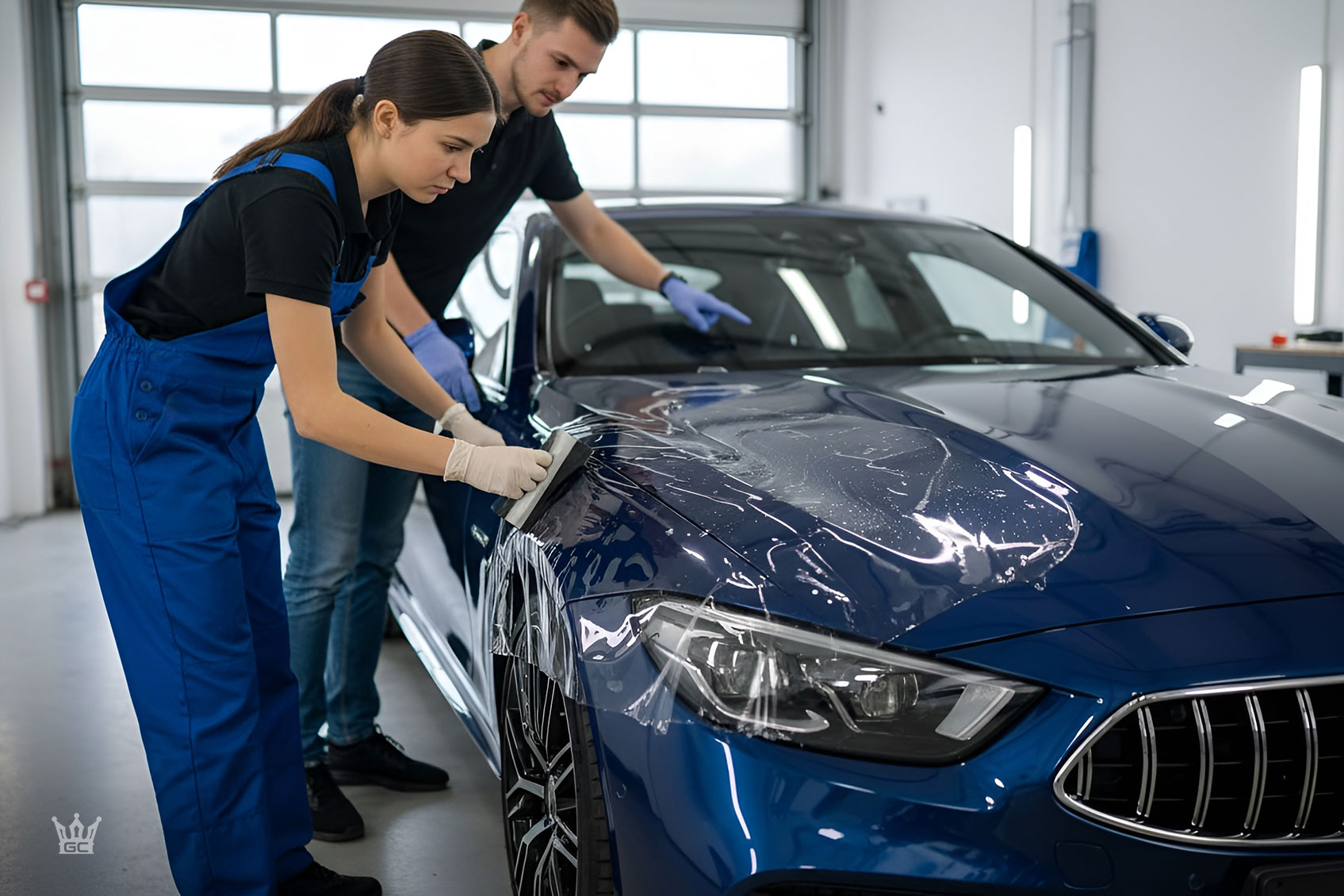
Clear bra: Another name for paint protection film, or PPF. It is a transparent thermoplastic polyurethane film applied over painted panels to absorb stone chips, abrasion, bug damage, and road tar before they reach the paint. 3M explicitly uses “clear bra” as an alternate name for paint protection film.
Ceramic coating: A liquid polymer coating applied over paint or PPF to improve water beading, gloss, and cleaning. It is not the same as factory clear coat, despite the similar-sounding names. More on this below.
If you want a deeper explanation of how PPF works, coverage options, and aftercare, the guide on what paint protection film is and how it works covers the full picture.
The Simplest Way to Understand Clear Bra vs Clear Coat
Think of it like a phone screen:
-
Clear coat is the glass screen itself.
-
Clear bra / PPF is the screen protector you stick on top.
-
Ceramic coating is a slick coating that makes the screen easier to wipe, but does not absorb impacts like a thick protector would.
You would never say “screen protector vs screen glass, which should I pick?” They do different jobs. The screen protector exists to take the hits so the glass does not have to. That is exactly the relationship between clear bra and clear coat.
A stone hits your front bumper on the highway. If all you have is clear coat, the stone may chip through it and into the colour coat underneath. With PPF installed, the stone hits the film first. The film absorbs or reduces the damage. A hard enough impact can still mark or puncture the film, but the paint underneath stays intact.
How the Paint Protection Layers Stack Up
Every modern painted vehicle has layers. From the metal outward:
-
Panel (metal, aluminium, plastic, or carbon fibre)
-
Primer (adhesion and corrosion protection)
-
Base coat / colour coat (the actual colour you see)
-
Clear coat (transparent paint layer for gloss and weathering resistance)
-
Optional: PPF / clear bra (transparent polyurethane film over the clear coat)
-
Optional: Ceramic coating (slick hydrophobic treatment over PPF or exposed paint)
The question is not “clear bra or clear coat?” The better question is: do you want a sacrificial film sitting over your clear coat to take the punishment that daily driving dishes out?
For Gold Coast drivers dealing with UV, salt air, highway debris on the M1, or 4×4 tracks, paint preservation is a practical concern. Clear coat is the factory paint’s first line of defence. PPF adds a sacrificial layer over the areas most likely to take damage.
What Clear Coat Does Well
Clear coat is essential to every modern painted vehicle. It does several important jobs:
-
Gives the car its gloss, depth, and colour richness
-
Protects the colour coat from UV exposure, weathering, and oxidation
-
Provides scratch resistance against light contact
-
Offers chemical resistance against contaminants like bird droppings, tree sap, and road oils
BASF notes that clearcoat performance includes scratch resistance, chemical resistance, and weathering resistance.
But clear coat is still paint. It can chip from road debris. It can scratch from poor washing technique. It can oxidise and peel from prolonged sun exposure. It can be burned through by over-polishing. On the Gold Coast, where the Bureau of Meteorology regularly classifies the UV index as very high to extreme, paint degradation over time is a real consideration.
Clear coat is necessary, but it is not armour. It is the paint system’s glossy protective top layer, not a thick removable impact film.
What Clear Bra / PPF Does Well
PPF is the layer you add when you want the road to beat up the film instead of the clear coat.
Modern paint protection film is a thermoplastic polyurethane film roughly 8 mil (203 microns) thick, with a pressure-sensitive adhesive on one side and a protective topcoat on the other. That is substantially thicker than any paint layer, which is why it absorbs impacts that clear coat alone cannot handle.
Key features of modern PPF:
-
Stone chip and abrasion protection across high-impact areas like bumpers, bonnets, guards, mirrors, door edges, door handle cups, and rocker panels
-
Self-healing technology that allows light surface scratches to disappear with heat or sunlight
-
Hydrophobic surfaces that repel water and make washing easier
-
Gloss and satin/matte finish options, so the film can match or change your vehicle’s look
-
UV protection for the paint underneath, helping slow the effects of sun exposure
-
Long warranties, with some premium films offering 10-year limited warranties against film defects like yellowing, bubbling, and cracking
Practitioners on forums like AutoGeek consistently describe PPF as a “sacrificial barrier” between the environment and paint. That framing is accurate. The film takes the damage so the paint does not have to. When the film eventually wears out or gets too marked up, you replace the film, not the paint.
For drivers who want to explore PPF options on the Gold Coast, coverage typically starts with high-impact front panels and can extend to a full-body wrap depending on the vehicle and how it is used.
Clear Bra vs Clear Coat: Side-by-Side Comparison
|
Feature |
Clear Bra / PPF |
Clear Coat |
|---|---|---|
|
What it is |
Transparent polyurethane film installed over paint |
Transparent paint layer applied as part of the vehicle paint system |
|
Where it sits |
On top of the clear coat |
On top of the colour/base coat |
|
Main job |
Sacrificial impact and abrasion protection |
Gloss, depth, weathering resistance, chemical resistance |
|
Removable? |
Yes, by a trained installer |
No. Repairing failed clear coat means refinishing or repainting |
|
Protects against stone chips? |
Yes, significantly better than clear coat alone |
Limited. Clear coat can still chip from road debris |
|
Self-healing? |
Many modern films self-heal light marks with heat |
Standard automotive clear coat does not self-heal |
|
Finish options |
Gloss, satin/matte, sometimes coloured |
Usually gloss; some OEM matte clear coats exist |
|
Common failure modes |
Edge lifting, punctures, yellowing on old/cheap film, bad installation |
Oxidation, peeling, cracking, chemical etching, over-polishing damage |
|
Best for |
New/high-value vehicles, highway commuters, 4x4s, sports cars, EVs |
Every painted vehicle already relies on it |
Does Clear Bra Damage Clear Coat?
This is one of the most common concerns when people compare clear bra vs clear coat, and the answer deserves honesty rather than marketing spin.
Short answer: Quality PPF installed and removed correctly over stable OEM paint is designed to protect the paint, not damage it. But risk exists under certain conditions.
A Porsche technical bulletin filed with NHTSA states that third-party PPF application can result in stresses on clearcoat finishes, and if those stresses exceed the bond adhesion between the clearcoat and the substrate, damage can result. Porsche specifically notes extra caution on complex geometries and panels with different painted materials.
3M’s installation guidelines confirm that actual film performance life is affected by substrate condition, surface preparation, application methods, and environmental conditions.
Risk factors that increase the chance of damage:
-
Old or failing clear coat (peeling, oxidised, cracking)
-
Repainted panels where paint adhesion may be weaker
-
Poorly cured paint on recent bodywork
-
Plastic bumpers or complex surfaces with weaker paint bonds
-
Old film left too long in harsh sun
-
Aggressive or improper removal technique
-
Installer over-stretching, overheating, or cutting directly on the vehicle
Practitioners on car forums report mixed experiences with removal. In a Mustang6G thread, one owner removed 13-year-old film with a steamer and had no damage, while another reported paint pulling off only on a repainted plastic bumper. The common thread: OEM paint handled removal well, repainted panels did not.
For removal, 3M recommends using a steamer and pulling the film at a 30 to 60 degree angle from the surface. This is a skilled service, not something to rush through with a heat gun and brute force.
Practical takeaway: If your car has stable factory paint, PPF is safe. If panels have been repainted, or if the clear coat is already showing signs of failure, have the paint inspected before installing film.
When Clear Bra Is Worth Considering
Not every car needs PPF. Here is a straightforward decision framework:
|
Situation |
Recommendation |
|---|---|
|
New car, want to keep front panels clean |
Consider front-end PPF |
|
Highway commuting (Gold Coast to Brisbane M1) |
Consider full front PPF |
|
4×4, ute, beach, gravel, bush tracks |
Consider high-impact PPF coverage |
|
Luxury, sports, supercar, or EV |
Consider full front or full-body PPF |
|
Want a matte/satin look without repainting |
Consider satin PPF |
|
Existing clear coat is peeling or failing |
Fix the paint first. Do not use PPF as a bandage |
|
Only want easier washing and more gloss |
Consider ceramic coating instead |
Reddit users consistently recommend starting with PPF on high-impact front surfaces and applying ceramic coating or wax on the rest, especially for daily drivers. In one r/cars thread, a user shared that they regretted choosing ceramic coating alone because the front bumper filled with rock damage, and they wished they had gone with PPF instead.
For EVs with large painted front panels (like Teslas or BYDs), PPF makes particular sense because those flat surfaces catch everything the highway throws at them. You can see examples of EV wrap and PPF projects that show how film works on these vehicles. For Tesla owners deciding between finishes, the satin vs gloss PPF guide for Tesla Model Y breaks down the visual and practical differences.
Track and performance cars are another strong case. A full-body self-healing PPF setup, like the Corvette Stingray project, protects paint from track debris, insect impacts at speed, and the general punishment of spirited driving.
Did You Mean Ceramic Coating?
This section exists because many people searching for clear bra vs clear coat are actually thinking about ceramic coating. The terms get tangled up online, and Google’s search results reflect the confusion by showing “PPF vs ceramic coating” pages for this keyword.
Here is the distinction:
|
Term |
What It Is |
Best For |
Not For |
|---|---|---|---|
|
Clear coat |
Factory transparent paint layer |
Gloss, weathering resistance, colour protection |
Added stone-chip protection |
|
Clear bra / PPF |
Transparent film over paint |
Rock chips, road rash, scuffs, high-impact zones |
Fixing failed paint |
|
Ceramic coating |
Liquid coating over paint or PPF |
Hydrophobic cleaning, gloss, chemical resistance |
Serious rock-chip protection |
Gtechniq defines ceramic coating as a liquid polymer solution that creates a hydrophobic surface repelling water, dirt, and environmental elements. That is a fundamentally different product from clear coat (which is paint) and from clear bra (which is film).
Many owners combine PPF on high-impact panels with ceramic coating over the rest of the vehicle, or even ceramic coating on top of the PPF itself. It is not an either/or decision.
For a detailed comparison, the PPF vs ceramic coating guide explains where each product excels and where they overlap.
A Confusing Detail: PPF Has Its Own “Clear Coat”
This catches people off guard and adds to the confusion around clear bra vs clear coat terminology.
Modern paint protection film often has a clear-coated top surface of its own. 3M’s installation guidelines note that the surface of the paint protection film is coated with a clear coat that protects the film surface against environmental influences and mechanical stress.
That topcoat on the film is not the same as your vehicle’s factory clear coat. It is a protective layer for the film, not for the car’s paint system. But it explains why the terminology gets so muddled. You can have a clear coat on your paint, a clear bra over the paint, and a clear coat on top of the clear bra, all at the same time. Three different layers, three different materials, one very confusing naming convention.
PPF Care and Maintenance
Because clear bra sits on top of the clear coat, maintaining it properly matters for both the film’s longevity and the paint underneath.
After installation: 3M recommends waiting at least 72 hours before washing a vehicle after PPF application.
Washing: Avoid aggressive pressure washing, especially near film edges. 3M warns that excessive pressure can force water underneath the film, weaken adhesion, and cause lifting or curling.
Cleaning products: Strong alkaline, acidic, or alcohol-based cleaners should be avoided. 3M states that permanent damage to the film cannot be excluded when using harsh cleaning agents.
Edge maintenance: Owner discussions on Reddit and forums frequently mention that dirty edges and visible edge lines are common complaints, not because the film failed, but because the coverage or install was not planned carefully. Full-front or wrapped-edge installations tend to look cleaner than partial bonnet kits, but they cost more and require more skill.
For specific cleaning advice, the guide on how to clean paint protection film covers products, technique, and common mistakes to avoid.
Common Myths About Clear Bra and Clear Coat
Myth: Clear bra and clear coat are the same thing.
They are not. Clear coat is part of the paint system. Clear bra is a removable film installed over the paint.
Myth: If my car has clear coat, I do not need PPF.
Clear coat helps protect paint from weathering and contaminants, but it does not give the same impact protection as a thick polyurethane film. If stone chips and road rash concern you, clear coat alone is not enough.
Myth: PPF makes paint bulletproof.
No. PPF is sacrificial protection, not indestructible armour. Hard impacts can still mark or puncture film. Forum users note that PPF can receive punctures over time, especially in high-impact areas, although the paint underneath is usually protected.
Myth: Ceramic coating is the same as clear coat.
No. Ceramic coating is an applied liquid surface treatment. Clear coat is a paint layer baked on at the factory. They do different things and sit in different positions.
Myth: PPF always damages paint when removed.
Proper removal on stable paint is generally safe. Risk rises on failing, repainted, old, or poorly bonded clear coat. Removal should be treated as a skilled service, not an afterthought.
Myth: Modern PPF is the same stuff from 15 years ago.
Practitioners on AutoGeek and detailing forums repeatedly distinguish modern films from older products that yellowed, cracked, and looked obvious. Today’s premium PPF includes self-healing topcoats, hydrophobic surfaces, and extended warranties. The biggest variable is not the film brand but the installer’s skill.
What to Do If Your Clear Coat Is Already Failing
If your clear coat is peeling, oxidised, cracking, or delaminating, PPF is not the fix. Film depends on a stable substrate. Applying PPF over failing clear coat can trap the problem visually and create serious removal issues later, since installation stresses may exceed the weakened bond between the clear coat and the surface beneath it.
The right order: repair or repaint the damaged panels first, let the paint fully cure, then consider PPF if you want ongoing protection.
Not sure whether your car needs PPF, paint correction, or something else first? The safest starting point is a proper inspection. Get in touch with the Nerang team to discuss your vehicle’s condition and figure out the right protection plan.
Frequently Asked Questions
Yes. Clear bra is an older, widely used name for paint protection film. Modern installers typically say PPF, but many car owners still search for “clear bra.” 3M lists “clear bra” as an alternate name for paint protection film on their product pages.
No. Clear coat is the transparent paint layer on the vehicle, applied at the factory as part of the paint system. Clear bra is a transparent film installed over that layer to protect it. They are completely different products that sit in different positions on the car.
Yes. That is exactly how PPF is designed to be used. It is installed over painted surfaces to protect them from chips, scratches, and road debris. The paint should be stable, clean, and properly prepared before installation.
On stable factory paint with proper installation and removal, PPF is safe. Risk increases on repainted panels, failing clear coat, old sun-baked film, or when removal is done aggressively. A Porsche technical bulletin notes that PPF application stresses can damage clearcoat if they exceed the bond adhesion between the clearcoat and substrate.
Most modern vehicles use paint systems with a transparent clear coat layer on top. Paint systems vary by manufacturer and finish type, but if your car has a glossy painted finish, it almost certainly has clear coat.
They do different things. For stone chips and road rash, PPF is far superior. For easier washing, enhanced gloss, and water beading, ceramic coating has advantages. Many owners combine PPF on high-impact front panels with ceramic coating over the rest of the vehicle.
It depends on film quality, installation, environment, care, and sun exposure. Some premium films carry 10-year limited warranties against defects like yellowing, bubbling, and cracking. Actual lifespan varies, and warranties cover film defects rather than every possible impact.
For most daily drivers concerned about stone chips from highway commuting or coastal driving, start with PPF on high-impact panels: front bumper, bonnet, front guards, mirrors, door cups, door edges, and rocker areas. For easier cleaning and gloss, add a compatible ceramic coating over exposed paint or film. For a coverage recommendation based on your specific vehicle, book a paint protection consultation with the team in Nerang.