
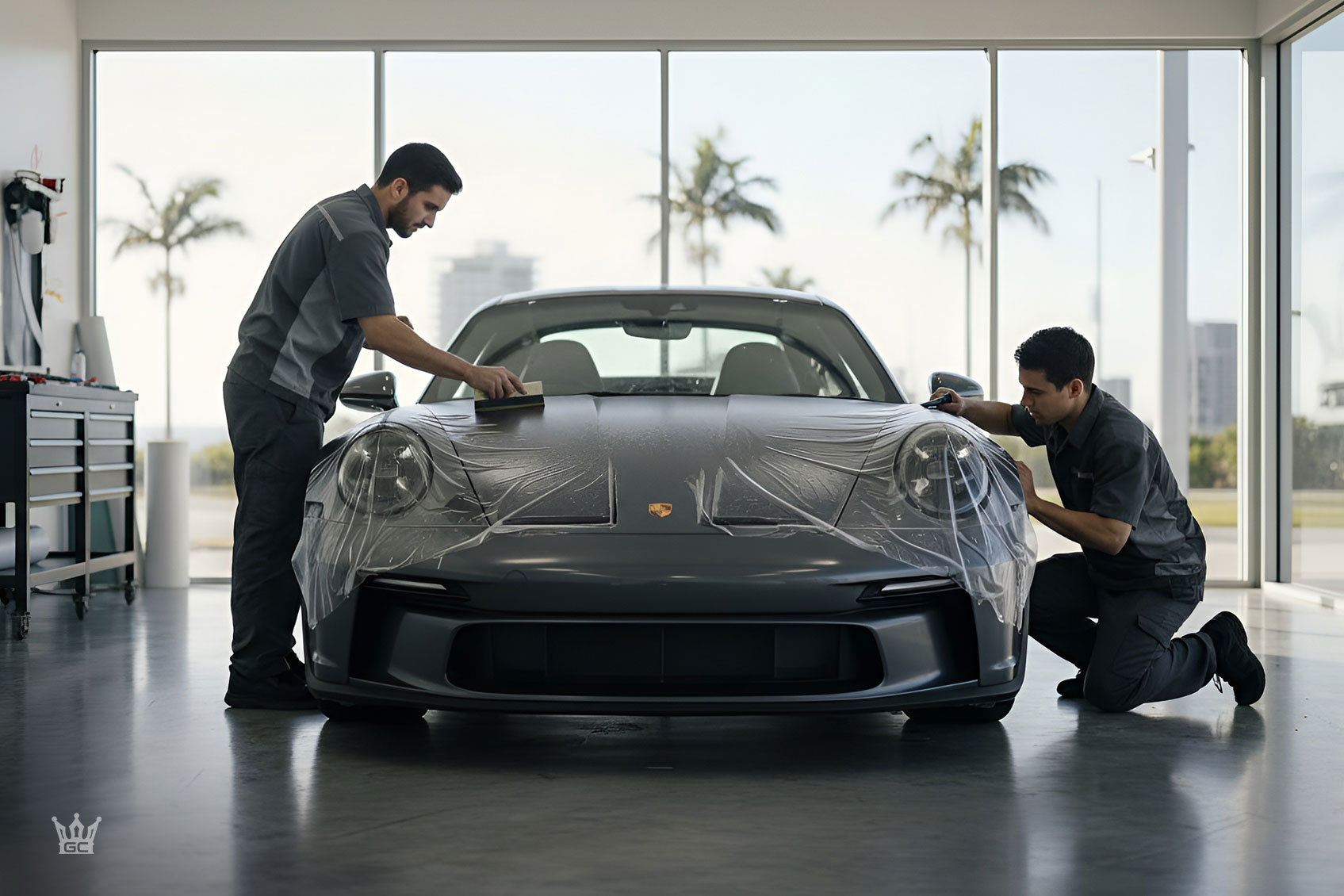
TLDR: Satin PPF is a low-sheen paint protection film that guards against stone chips and scratches while giving your vehicle a satin or stealth finish. Market pricing in Australia typically starts around $2,000 to $2,500 for partial or full-front coverage and $6,000 or more for a full-body install, with large SUVs, utes, and supercars pushing well past $8,500. The final cost depends on coverage area, vehicle complexity, film brand, prep work, and installer quality, not just the film itself.
Satin PPF cost is the installed price of applying satin-finish paint protection film to a vehicle. The film is a clear or tinted polyurethane layer with a soft, low-sheen surface. It protects paint from stone chips, scratches, bug acids, and UV exposure while converting a gloss finish into a satin “stealth” look, or preserving factory matte paint.
If you came here looking for a number: Australian market benchmarks place quality satin PPF from around $2,000 to $2,500 for partial or full-front packages and $6,000 or more for full-body coverage. Large SUVs, 4x4s, and supercars regularly land between $8,500 and $10,000 or higher. These figures come from published installer pricing across SEQ and broader Australia, not from any single shop. Your actual quote will shift based on the vehicle, coverage, prep, film system, and the standard of installation.
The rest of this page explains why those numbers vary so much and how to compare quotes without getting burned.
What Does Satin PPF Mean?
Satin PPF is paint protection film engineered with a low-sheen clearcoat instead of the high-gloss finish found on standard clear PPF. The result sits between a flat matte and a full gloss, creating the “stealth” aesthetic that has become popular on Teslas, Land Rover Defenders, and dark-coloured luxury vehicles.
XPEL labels its satin product STEALTH, describing it as a satin clear-coated aliphatic polyurethane film designed to protect automotive paint from stone chips and abrasion. The film is nominally 200 µm (about 7.9 mil) thick, with a self-healing clearcoat that can eliminate fine scratches and swirl marks when exposed to heat.
A few terms get used interchangeably, so here is a quick breakdown:
-
Satin PPF has a soft sheen, like brushed metal or satin paint.
-
Matte PPF typically has even less shine, though many people (and some brands) use “satin” and “matte” loosely.
-
Stealth PPF is often a product name, most commonly associated with XPEL STEALTH.
-
Gloss PPF is the standard clear film that keeps your factory gloss finish looking unchanged.
Satin PPF is not a vinyl wrap and it is not a ceramic coating. It physically absorbs stone impacts and abrasion. For a broader explanation, the complete guide to paint protection film covers how PPF works, what it protects against, and what it cannot do.
How Much Does Satin PPF Cost?
Satin PPF cost scales primarily with how much of the vehicle you cover. Here are market benchmarks drawn from published Australian installer pages and industry guides:
|
Coverage scope |
Typical market range (AUD) |
What is usually included |
|---|---|---|
|
Small wear areas (door cups, edges, boot lip) |
Hundreds to low thousands |
Individual high-contact panels only |
|
Partial or full front |
$2,000 to $3,500+ |
Bonnet, front bumper, guards/fenders, mirrors, headlights |
|
Full body, sedan/hatch/small SUV |
$6,000 to $8,000+ |
Every painted panel, bumpers, mirrors, headlights |
|
Full body, large SUV/ute/4×4 |
$8,500 to $11,500+ |
Larger panels, more material, more complex curves |
|
Full body, supercar or exotic |
$10,000+ |
Complex bodywork, vents, sharp lines, exposed edges |
Sources: Auto Protective Brisbane PPF cost guide, Solarblock Australia PPF cost guide, Kaizen Motorsports Gold Coast PPF packages.
These numbers reflect installed pricing, meaning film plus labour plus workshop time. They are market benchmarks, not Gold Coast Wrap Kings prices. Because satin PPF cost depends heavily on your specific vehicle and coverage goals, the only way to get an accurate figure is to request a tailored quote.
Real-world price reports from owners
Practitioners on Reddit confirm that real-world satin PPF cost varies enormously. In a New Defender thread, Australian owners reported paying around AUD $11,000 for full body/roof/fenders with satin film on painted panels and clear film on black plastic parts, while another paid AUD $11,500 for full-car XPEL plus window tinting. Meanwhile, a Tesla Model Y owner shared that their XPEL Stealth full-body install cost $6,500 USD in Houston and took 32 to 36 work-hours over five business days.
The spread makes sense once you understand what drives the price.
Why Does Satin PPF Cost So Much?
Satin PPF is expensive because it is a skilled installation job, not because the film alone is expensive. The buyer pays for material, panel prep, installer time, edge work, patterning, risk management, controlled workshop space, and warranty-backed materials.
Here is where the money goes:
Film material. Premium satin PPF from XPEL, 3M, SunTek, or LLumar costs more per metre than budget alternatives. A full-body job uses three to four times the film of a full-front kit.
Labour. This is the biggest line item. Industry sources estimate that labour accounts for 50 to 60 percent of total PPF installation cost. A quality full-body install on a sedan commonly takes three to five working days. Large SUVs and supercars can push to six or seven days.
Vehicle complexity. Two versions of the same model can differ by $1,000 to $1,500 because one has more colour-coded plastics or extra trim panels requiring coverage. A simple hatchback and a Land Rover Defender with roof rails, vents, and cladding are entirely different jobs. For an example of what full satin PPF on a Defender involves, see Gold Coast Wrap Kings’ Defender satin PPF project.
Surface prep. PPF locks in whatever is underneath it. If the paint has swirl marks, contamination, or minor defects, those need to be corrected before film goes on. Paint correction adds time and cost, but skipping it means imperfections are sealed under the film.
Pattern cutting and edge work. Precision-cut patterns from plotters reduce the need for razor blades on the vehicle. Hand-cutting carries risk, as a blade can cut through clear coat. Wrapped edges (where the film tucks around panel edges) look cleaner but require more labour.
Warranty-backed materials. Premium film from reputable brands carries manufacturer warranties. XPEL Australia covers STEALTH PPF for 10 years against yellowing, cracking, blistering, and delaminating. That warranty support is baked into the cost of the film.
Satin PPF Cost vs Gloss PPF Cost
The price gap between satin and gloss PPF is smaller than most people expect. Some shops price them identically, while others charge a modest premium for satin. Nathan’s Detailing reports the difference is often only $200 to $500 for a full vehicle, while Kaizen Motorsports on the Gold Coast lists gloss and satin/stealth at the same price across its full-body packages.
The real difference is not price. It is coverage logic.
Gloss PPF disappears on a gloss car. You can protect just the bonnet, bumper, and guards with gloss film and nobody will notice the transition. Satin PPF changes how a panel reflects light. If only your front panels are satin and the doors remain gloss, the mismatch is obvious, and usually not in a good way.
That is why satin PPF is almost always quoted as a full-body conversion, while gloss PPF works well for partial or front-end-only packages. This distinction is the single most important thing to understand about satin PPF cost: the coverage commitment is typically higher, which pushes the total price up regardless of the per-metre film cost.
For Tesla owners weighing these two options, the satin PPF vs gloss PPF decision guide for Model Y walks through the specific considerations for EV panels and sensors.
Satin PPF vs Vinyl Wrap vs Ceramic Coating
Many people researching satin PPF cost are also weighing cheaper alternatives. Here is how they compare:
|
Option |
Purpose |
Chip protection |
Typical cost logic |
|---|---|---|---|
|
Satin PPF |
Protection plus satin appearance |
High |
Highest, thicker film, intensive labour |
|
Gloss PPF |
Protection, preserves factory gloss |
High |
Similar to satin PPF, better for partial packages |
|
Vinyl wrap |
Colour or finish change |
Low |
Often cheaper than PPF, styling film not impact film |
|
Ceramic coating |
Easier cleaning, chemical resistance, UV help |
None against stone impacts |
Lower than PPF, often paired with PPF |
Ceramic coatings create a hydrophobic layer that makes washing easier and provides some chemical resistance, but they do not provide the same physical impact protection as PPF. Vinyl wraps change colour and finish, but the material is thinner and not designed to absorb stone strikes.
A common hybrid approach is PPF on high-impact areas paired with ceramic coating on the rest of the vehicle. For a full breakdown of how these two options work together and where they differ, the PPF vs ceramic coating comparison covers the specifics.
Is Full-Body Satin PPF Worth It?
This depends on your situation, not on a blanket yes or no.
Satin PPF makes strong sense when:
-
You own a new, high-value, or luxury vehicle and plan to keep it for several years.
-
Your car has factory matte or frozen paint, which satin PPF is specifically designed to protect. XPEL says STEALTH is made for matte, magno, frozen, and frosted finishes.
-
You drive dark colours that show every chip and swirl.
-
You want the stealth look as an aesthetic choice, not just protection.
-
The vehicle sees highway driving, gravel roads, or 4×4 use regularly.
Satin PPF is harder to justify when:
-
You plan to trade the vehicle within a year or two.
-
Budget is the primary constraint and you would be stretching to afford it.
-
You only need front-end chip protection on a gloss car (gloss PPF is the better fit).
The resale value debate is genuinely unsettled. In a Reddit discussion about Defenders, one owner argued that paying roughly 10% of the vehicle’s purchase price for PPF may not make financial sense if the car is traded after a few years. Another countered that full PPF eliminated the stress of rock chips and kept the car looking new for the entire ownership period. Both positions are reasonable. Satin PPF is best treated as a protection and appearance investment, not a guaranteed financial return.
How to Compare Satin PPF Quotes
Not all quotes are built the same. Two shops can quote the same dollar figure and deliver wildly different outcomes. Before committing, ask each installer:
-
What film brand and product are you using? (XPEL STEALTH, 3M Pro Series Matte, SunTek Ultra Matte, etc.)
-
Exactly which panels are covered? “Full front” and “full body” mean different things at different shops.
-
Are edges wrapped where possible? Wrapped edges look cleaner but take more time.
-
Are patterns pre-cut or hand-trimmed on the car? Ask where blades will touch the vehicle.
-
What surface prep is included? Wash, clay, decontamination, paint correction?
-
What is excluded? Existing chips, repainted panels, old film removal, ceramic coating, tint, black plastics, roof, door jambs.
-
How long will it take? Quality full-body installs typically take around five days and sometimes longer for large or complex vehicles. A shop promising full-body satin PPF in one or two days should raise questions.
-
What does the manufacturer warranty cover? Usually film defects like yellowing, cracking, and delamination.
-
What does the installer workmanship warranty cover? Lifting edges, contamination under film, bubbles, alignment issues, and rework.
-
Is there a post-install inspection? Water pockets, small bubbles, and edges may need correction as the film settles.
Why this checklist matters
A Tesla Model X owner on Reddit paid $6,449 for satin PPF, $1,299 for ceramic coating, and $295 for tint, then reported visible bubbles, contamination under the film, poor edge work, and cuts in the paint. The price was in line with market rates. The execution was not. The lesson: satin PPF cost alone tells you nothing about quality. The questions above help you evaluate what you are actually getting.
One more important distinction: manufacturer warranties cover film defects, not necessarily installation problems. Practitioners on Reddit’s auto detailing forums confirm that edge lifting or contamination issues may not fall under the film warranty. Ask your installer what their separate workmanship guarantee covers and for how long. In Australia, manufacturer and installer warranties also sit alongside your Australian Consumer Law rights, which cannot be overridden by warranty terms.
Can You DIY Satin PPF to Save Money?
The temptation is real. A Model Y owner on Reddit shared that professional quotes came in around $6,500, while a pre-cut XPEL Stealth kit was quoted at $3,500, prompting the question of whether DIY was viable. Commenters were blunt: DIY is harder than YouTube makes it look. One user admitted they tried and ended up paying a professional to redo the work. Another noted the professional install took over 30 hours across five business days.
Small, sacrificial areas like door cups and door edges are manageable for a careful DIYer. Full-body satin PPF is a different story. Satin film shows every fingerprint, stretch mark, and contamination speck more readily than gloss. Mistakes waste expensive film and can force a costly professional redo. For most people, DIY full-body satin PPF is a false economy.
Satin PPF Aftercare and Ongoing Costs
Once the film is installed, maintenance is straightforward but specific to satin finishes:
-
Avoid standard wax and polish. Nathan’s Detailing warns that wax or polish can create shiny spots on satin PPF. Only use products your installer confirms are safe for satin or matte film.
-
Hand wash with pH-neutral soap. Avoid abrasive sponges, brushes, or automatic car washes.
-
Follow the installer’s wait period before the first wash. Adhesion needs time to build.
-
Ceramic coating over satin PPF is optional. It can improve water beading and make cleaning easier, but it must be a satin-compatible formula so it does not add unwanted gloss.
-
Self-healing works with heat. The film’s clearcoat can release fine scratches and swirl marks when warmed by sunlight or warm water. It will not repair deep cuts or gouges.
For detailed wash instructions, the guide to cleaning paint protection film covers products, techniques, and common mistakes.
Get a Satin PPF Quote on the Gold Coast
If you are comparing satin PPF cost on the Gold Coast, the most useful step is getting a quote specific to your vehicle. Gold Coast Wrap Kings is a vehicle styling and protection shop in Nerang offering paint protection film, including satin PPF, alongside full car wraps, custom graphics, and commercial vehicle graphics. The workshop has completed satin PPF projects across Teslas, Land Rover Defenders, Ford Rangers, and other high-end vehicles.
To get an accurate price, send through your vehicle make, model, year, colour, paint condition, and the coverage you want. Mention whether you are after a full satin conversion, protection only, or a combination with ceramic coating. Get in touch here to start the conversation.
Frequently Asked Questions
Market benchmarks suggest installed satin PPF commonly starts around $2,000 to $2,500 for partial or full-front protection and $6,000 or more for full-body coverage. Large SUVs, utes, 4x4s, and supercars often cost $8,500 to $10,000 or higher. Your quote will vary with vehicle size, coverage, prep requirements, film brand, and installer quality.
Sometimes, but not by as much as people assume. Some installers price gloss and satin identically for full-body work. Others charge a premium of $200 to $500 for satin due to film choice and the precision required during installation. Vehicle size, coverage area, and installer expertise have a bigger impact on total cost than the gloss-vs-satin film difference.
You can, but it often looks mismatched on a gloss vehicle. Satin PPF changes how panels reflect light, so protected panels will have a noticeably different sheen from unprotected ones. For partial protection on a gloss car, gloss PPF is usually more visually seamless. Satin PPF makes the most sense for full-body conversions, factory matte paint, or intentional accent areas.
Yes. Premium satin PPF is built for impact resistance. XPEL’s technical data sheet describes STEALTH as a satin clear-coated polyurethane film designed to protect automotive paint from stone chips and abrasion. The protection level is comparable to gloss PPF from the same product line.
Premium PPF warranties commonly cover 10 years. XPEL Australia covers its STEALTH and ULTIMATE PLUS products for 10 years against manufacturer defects including yellowing, cracking, blistering, and delaminating. Real-world lifespan depends on climate exposure, maintenance, and how the vehicle is used.
Not necessarily. Ceramic coating over satin PPF adds slickness and makes cleaning easier, but it must be a satin-compatible formula to avoid adding unwanted shine. Ceramic coating does not provide the physical impact protection that PPF delivers. It is a helpful add-on for maintenance, not a substitute for the film itself.
Avoid standard waxes and polishes unless your installer specifically confirms they are safe for satin film. Regular wax or polish can create shiny spots that ruin the uniform satin finish. Use matte-specific or PPF-safe cleaning products instead.
Usually not. Manufacturer warranties cover film defects. Installation issues like lifting edges, trapped contamination, or alignment problems depend on the installer’s separate workmanship guarantee. Always ask what the installer covers, how long the coverage lasts, and what the rework process looks like before you commit to a quote.