
TL;DR
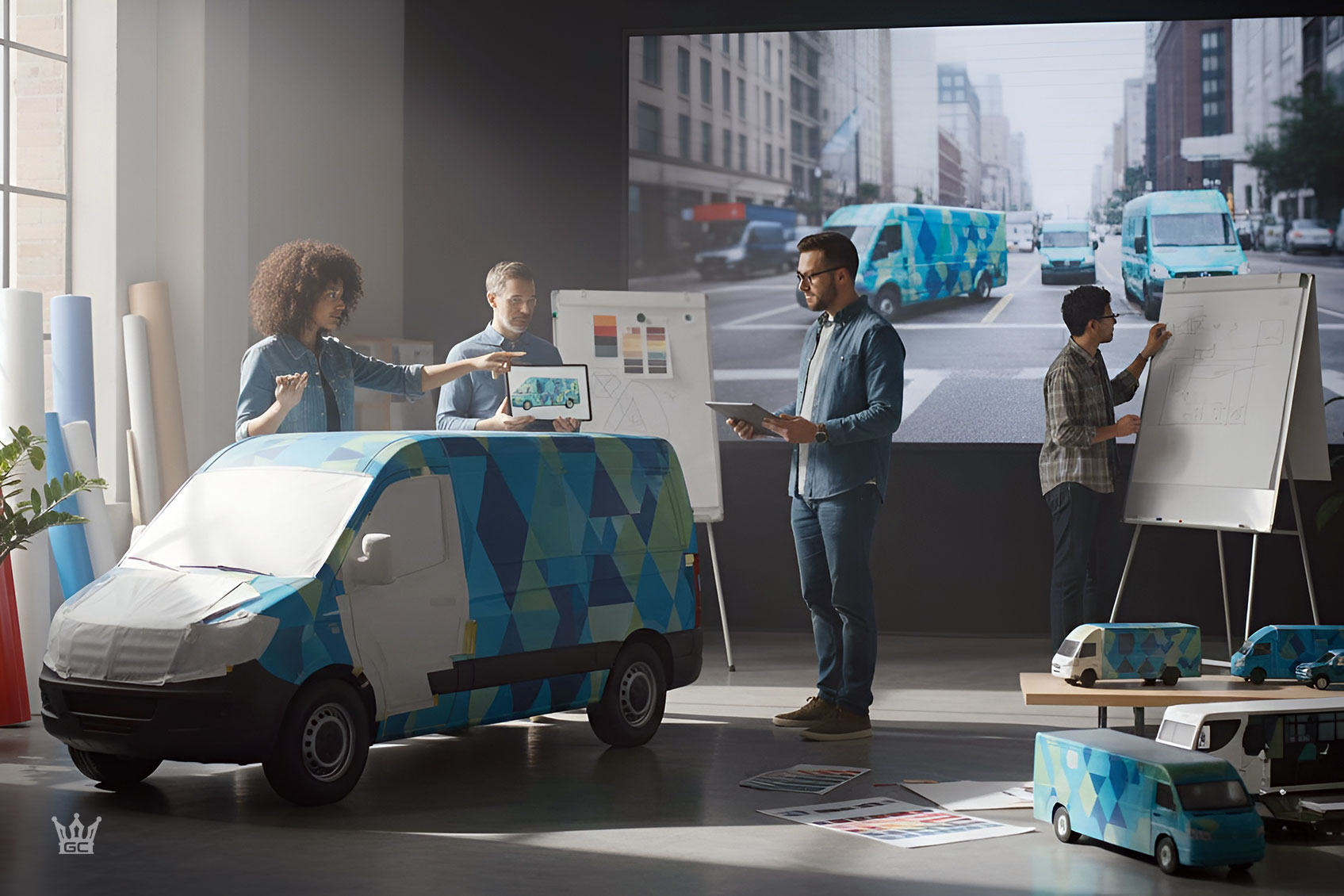
A fleet livery is the branded visual system applied across a company’s vehicles. Designing effective fleet liveries means creating graphics that pass a three-second test: a stranger should be able to identify the brand, understand the service, and know how to make contact, all at a glance. The best liveries prioritise message hierarchy over decoration, respect the physical shape of each vehicle, and reproduce consistently whether the fleet has two utes or twenty vans. This guide covers the definition, core design principles, glossary of production terms, common mistakes, Queensland compliance considerations, and practical testing checklists for getting fleet graphics right before they go to print.
A fleet livery is your company uniform for vehicles. It is the branded design, the colours, the logo placement, the phone number on the rear, the consistent look that tells everyone on the road and at the job site that this vehicle belongs to your business.
But there is a wide gap between a livery that looks good in a design proof and one that actually works on the road. According to 3M, viewers have just 3 to 5 seconds to direct attention to the most important part of a vehicle graphic. That is the entire window. If the design cannot communicate within that window, the impression is wasted.
This guide explains what fleet livery means, what makes the design effective rather than just attractive, and what Gold Coast and Queensland businesses need to know before wrapping a fleet.
What Is a Fleet Livery?
Fleet livery is the branded visual design applied across a company’s vehicles. It can be executed through vinyl wraps, printed graphics, cut lettering, decals, or a combination of methods. The livery is the design system. The wrap, the decal, or the signwriting is the method used to apply it.
A plumbing company might use a full wrap on its main van, partial graphics on a second ute, and cut vinyl decals on a trailer. All three vehicles can share the same fleet livery as long as the brand, colours, layout logic, and message hierarchy stay consistent.
Here are the key terms people often confuse:
-
Fleet livery is the overall brand system for vehicles.
-
Vehicle wrap is vinyl film applied over panels, either printed or colour-change.
-
Full wrap covers most visible exterior surfaces.
-
Partial wrap covers selected areas like sides, rear, or doors.
-
Spot graphics / decals are individual logos or lettering placed on specific panels.
-
Signwriting is the traditional term for vehicle lettering and branding, now often used interchangeably with vehicle graphics.
Craftsmen Industries distinguishes between full fleet wraps and smaller fleet graphics, noting that the scope of coverage affects both cost and visual impact. What matters most is not the coverage method but whether the livery communicates clearly across every vehicle.
For businesses exploring the range of graphic and wrap options available for commercial vehicles, understanding these distinctions helps when briefing a designer or requesting a quote.
Why Effective Fleet Livery Design Matters
Fleet vehicles are mobile brand assets. They move through suburbs, sit in traffic, park at job sites, and wait in car parks, all while being seen by potential customers.
3M reports that a survey found 64% of respondents noticed vehicle graphics, and separate research suggests vehicle advertising can generate 30,000 to 70,000 daily vehicular impressions. Unlike digital ads, fleet graphics are not blocked by ad blockers or commercial-free streaming.
But exposure is not the same as effectiveness. A wrap only becomes advertising when people can identify the brand, understand the service, and know what to do next. A busy, cluttered, or unreadable livery wastes every one of those impressions.
Practitioners on Reddit offer a more grounded perspective. In r/smallbusiness, some business owners report direct calls from people driving behind their branded vans, while others say wraps did not generate trackable leads but made their business look more legitimate. In r/handyman, one commenter said branding made the vehicle look significantly more professional and gave customers comfort that the business would not disappear.
The honest position: fleet liveries are best understood as brand trust builders, local recognition assets, and job-site legitimacy signals. They generate passive enquiries and support your other marketing. They are not magic lead machines, and anyone promising guaranteed call volumes from a wrap is overselling.
The Three-Second Rule for Fleet Liveries
Designing effective fleet liveries starts with accepting a hard constraint: you have about three seconds.
3M’s fleet graphics guidance says designers have 3 to 5 seconds to direct viewer attention to the most important part of the design. A LinkedIn article from The Sign Pack frames it even tighter, arguing the real test is whether the message is understandable within about 2.5 seconds.
In three seconds, a viewer should get:
-
Who is this? Brand name and logo must be dominant.
-
What do they do? Business category or service promise must be obvious.
-
How do I act later? Phone number, short URL, or memorable brand name must be readable.
Everything else is secondary. If the design tries to communicate more than these three things to a moving audience, it will likely communicate none of them well.
The Brand, Service, Action Hierarchy
KickCharge, a branding firm that specialises in service-business vehicle design, recommends a strict hierarchy: brand first, then tagline, then website URL, then phone number. It argues against long service lists, unnecessary legal suffixes, and social media clutter.
For most Gold Coast service fleets, the practical hierarchy looks like this:
-
Brand: Logo and business name, largest and most prominent.
-
Category: “Electrical,” “Real Estate Photography,” “Air Conditioning,” “Mobile Detailing,” or whatever the business does.
-
Proof or promise: “24/7 Emergency,” “Licensed & Insured,” “Gold Coast & Tweed,” or “5-Star Local Reviews.”
-
Action: Phone number or short URL, placed where it can be read by following traffic.
What to cut first: long service menus, multiple URLs, social media icons (unless the platform is core to the sale), Pty Ltd suffixes, tiny licence numbers treated as marketing messages, decorative textures that hurt readability, and stock photos that do not strengthen brand memory.
Key Design Terms in Fleet Livery
Buyers hear a lot of production jargon during the quoting process. Here is what the important terms actually mean.
|
Term |
What It Means |
Why It Matters |
|---|---|---|
|
Fleet livery |
The branded visual system applied to company vehicles |
The “uniform” for the fleet |
|
Vehicle wrap |
Vinyl film applied over panels, printed or colour-change |
One method of creating a livery |
|
Full wrap |
Graphics covering most visible exterior surfaces |
Maximum impact, more cost and downtime |
|
Partial wrap |
Graphics on selected areas (sides, rear, bonnet, doors) |
Often strong ROI when designed well |
|
Spot graphics |
Individual logos, text, or graphics on chosen panels |
Lower-cost fleet branding option |
|
Vector artwork |
Scalable artwork built from paths, not pixels |
Prevents logos from pixelating at vehicle size |
|
Bleed |
Extra artwork printed beyond the trim edge |
Allows clean wrapping around edges |
|
Safe zone |
Area kept clear of seams, handles, edges, sensors |
Protects key messages from distortion |
|
Paneling |
Splitting a large design into printable, installable sections |
Essential for vans, trucks, and trailers |
|
Seam |
Where two vinyl pieces overlap or meet |
Should be planned in the design, not accidental |
|
Overlaminate |
Clear protective film applied over printed graphics |
Shields print from UV, abrasion, and wash damage |
|
Cast vinyl |
Premium conformable vinyl that suits curves and recesses |
Better for complex vehicle wraps than cheaper films |
|
Perforated window film |
Printed film with small holes for one-way visibility |
Useful on some windows but must not compromise driver sight |
|
Reflective film |
Film that reflects light for night visibility |
Must be checked against Queensland vehicle rules |
|
Fleet standard |
Rules for repeating the design consistently across vehicles |
Prevents each new vehicle looking different |
|
Proof |
Artwork preview for approval before production |
Should be checked on the actual vehicle, not just a flat mockup |
Avery Dennison’s fleet graphics range covers full wraps, partial wraps, reflective branding, spot graphics, cast vinyl, and digital overlaminates, all emphasising colour consistency across a fleet. Understanding these terms helps when evaluating quotes and comparing what different shops are offering.
Core Design Principles for Effective Fleet Liveries
Readability Rules
Craftsmen Industries recommends large sans-serif fonts, strong contrast, and prioritising essential information. It cites an industry guideline: 3 inches of letter height for every 50 feet of viewing distance. That means text intended to be read from 200 feet away needs to be at least 12 inches tall.
But the USSC Foundation’s sign standards add important context: real-world driver workload can reduce legibility compared with ideal test conditions. Glare, traffic clutter, vehicle speed, and sun angle all eat into readability.
The practical rule: “minimum readable” is not enough for traffic. The target is “comfortably readable at a glance.” Bigger, bolder, and simpler almost always wins.
In r/CarWraps, one commenter critiqued a fleet wrap by noting the rear fender text was “way too small” to read at speed or from a lane over. This is one of the most common real-world failures. If the service list only looks readable in the proof PDF, it is too small.
Colour and Contrast
High contrast beats favourite colours. A dark logo on a white van reads from far away. Light grey text on a silver vehicle does not. Brand colours may need adaptation if they create low contrast against the vehicle’s panels.
Use enough negative space. Blank area is not wasted area on a vehicle. It gives the eye a place to land and makes the message elements stand out.
Typography
Bold, legible fonts. Avoid thin scripts, condensed typefaces, elaborate effects, and tiny all-caps service lists. If the font choice needs to be justified with “it matches our brand,” but it cannot be read from 30 metres, the font is wrong for this application.
What to Include on a Fleet Vehicle
The must-have shortlist:
-
Brand name and logo
-
Business category (what you do)
-
One memorable value proposition or short service line
-
Phone number or short URL
-
Service area if it helps conversion (“Gold Coast & Northern NSW”)
-
Licence or trade details if required or trust-building
Optional, context-dependent:
-
QR code (only for vehicles that park at job sites, inspections, or events)
-
Social handle (only if the platform genuinely drives sales)
Strong stance: the vehicle wrap is not the website. Do not try to list every service. KickCharge specifically critiques long service lists as one of the most common fleet livery mistakes.
Designing for Different Vehicle Surfaces
Each surface on a vehicle has a different job.
Side Panels
The largest high-visibility area. Best for brand recognition: large logo, business category, and brand colours. Keep key text away from sliding-door breaks, handles, hinges, and fuel caps. Side panels are what most people see at intersections and in car parks.
Rear Panel
The rear is prime real estate in traffic. Drivers sitting behind the vehicle at red lights have dwell time. This is the best placement for a phone number, short URL, or service-area line. Keep the phone number on a plain, high-contrast background, not buried in a busy image.
Bonnet / Hood
Useful when the vehicle is parked or viewed from above. Not ideal for long messages, but a clean logo works well for job-site visibility.
Windows
Perforated film allows branding on glass while maintaining outward visibility from inside. But it should never compromise driver safety. Queensland regulations are specific about not restricting the driver’s field of view. If essential text is placed on glass, it can be obscured by tint, wipers, demisters, or reflections.
Roof
Low priority for most service fleets. Only relevant if vehicles are regularly viewed from buildings, car parks, or elevated positions.
Fast-Trac identifies side panels, rear panels, and windows as key placement areas and emphasises that window branding must maintain visibility. The placement decision should be driven by where and how people actually see the vehicle, not by how much surface area is available.
Designing for Vehicle Shape
This is where many fleet liveries fall apart. A vehicle is not a flat page. It has contours, panel gaps, door handles, fuel caps, sliding doors, window rubbers, body moulds, sensors, and (on modern EVs) cameras and charge ports.
Wrapmate warns that vehicle graphics require specialised design because ignoring contours, curves, handles, and seams can distort logos, interrupt text, or obscure key messages.
Practitioners on Reddit echo this strongly. In r/CarWraps, experienced commercial wrap users warn that flat vehicle layouts are not 100% accurate and that critical elements need extra room so they are not cut off at panel edges. Another practitioner explains that wrap-experienced designers know where to avoid placing key elements, where to add extra artwork, where seams will fall, and how to make seams more subtle.
A separate r/CarWraps poster looking for a professional business wrap designer specifically asked for someone who understands scaling, paneling, how designs translate from screen to the actual vehicle, contours, handles, seams, print specs, wrap templates, and bleed areas. This tells you what buyers are learning to demand.
Why Your Logo Designer May Not Be Your Wrap Designer
A skilled logo designer or social media graphic designer does not necessarily understand vehicle wrap production. Wrap design requires knowledge of panel breaks, seam placement, bleed requirements, vinyl behaviour on curves, template limitations, and how printed colours shift under laminate. If the designer has not worked with vehicle templates and actual vehicle surveys before, the proof may look perfect on screen and fail on the vehicle.
For businesses running EVs in the fleet, the complexity increases. Modern vehicles like Teslas and BYDs have cameras, ultrasonic sensors, charge ports, and flush door handles that require careful masking and planning. Gold Coast Wrap Kings has completed commercial fleet graphic wraps on Tesla Model Y vehicles and maintains an EV-specific portfolio reflecting familiarity with these challenges.
The Pre-Design Vehicle Survey Checklist
Before final art approval, the designer should confirm:
-
Exact make, model, year, and body style
-
Variants: high roof, low roof, dual cab, canopy, tray, rear barn doors, sliding door
-
Aftermarket accessories: bull bar, roof rack, snorkel, canopy, ladder rack, toolboxes
-
Sensors, cameras, and charging ports (especially on EVs)
-
Existing paint condition
-
Where seams and overlaps will sit
-
Which panels are safe for key text and logos
Designing Across a Fleet
Designing effective fleet liveries for one vehicle is a start. Designing for a fleet of mixed vehicles is the real test.
If a business runs utes, vans, trailers, and sedans, the livery needs to adapt without breaking. The logo placement, colour system, CTA style, and overall brand feel should remain consistent even though the layouts change for each vehicle shape.
This requires a fleet standards document. For any business wrapping more than one vehicle, a one-page standard should specify:
-
Logo size range and placement by vehicle type
-
Primary and secondary colour values (exact colour codes, not “close enough”)
-
Approved font family
-
Phone/URL placement
-
Minimum text size
-
CTA format
-
QR code rules (if applicable)
-
Panel safe zones
-
Approved wrap materials and laminate finish (gloss, satin, matte)
-
Maintenance schedule
-
File naming and version control
Avery Dennison emphasises colour consistency across fleet graphics and the ability to update designs over time. Without a standards document, every new vehicle becomes a one-off project, and the fleet gradually loses visual coherence.
Businesses planning a multi-vehicle rollout should also factor in scheduling and downtime. A related guide on turnaround times for fleet wrapping projects on the Gold Coast covers the logistics of getting vehicles in and out of the workshop without disrupting operations.
Queensland Compliance Considerations
Most fleet livery advice online comes from US-based companies and ignores Australian and Queensland-specific rules. Here are the key points Gold Coast and SEQ businesses need to know.
Do Not Obstruct Lights, Vision, Sensors, or Cameras
Queensland Transport and Main Roads states that advertising display units on vehicles must not obscure mandatory lighting or restrict the driver’s field of view. The display unit must also be securely attached and free of sharp edges or projections.
Check Reflective and Chrome-Effect Materials Carefully
The same Queensland guidance says highly reflective material must not be used in advertising or destination signs. The Queensland Light Vehicle Inspection Manual also lists reflective or chrome-effect wraps applied to external body panels as a rejection reason during vehicle inspection.
3M notes that reflective graphics can increase impressions by up to 40% compared with traditional graphics. That may be true in other markets, but Queensland businesses should avoid highly reflective or chrome-effect advertising wraps unless the material and placement are confirmed compliant. This is not something to guess on.
Do Not Park a Vehicle Solely as a Roadside Advertisement
Queensland’s Roadside Advertising Manual states that where a registered vehicle or trailer is parked on a state-controlled road solely for advertising purposes, Queensland Police Service should be requested to remove it. If the branded vehicle is being used for normal business transport, that is a different situation. But deliberately parking a wrapped trailer on a highway shoulder as a billboard substitute creates a compliance risk.
Account for Gold Coast Sun and UV Exposure
Queensland’s UV levels are punishing. Colours fade, vinyl degrades, and overlaminates earn their keep. Printed graphics should use UV-protective lamination for durability, and maintenance matters more in this climate than in cooler regions. Gold Coast Wrap Kings offers full-colour printed graphics with matte and gloss UV lamination options, and their guide to cleaning vinyl wraps covers the aftercare side.
Note: this section provides general guidance, not legal advice. Always check current Queensland Transport and Main Roads requirements for your specific vehicle type and intended use.
Common Mistakes in Fleet Livery Design
Too Much Text
A wrap with 14 services, three phone numbers, a QR code, six icons, and a background photo may look busy and expensive, but it performs worse than a simple brand-led livery. No one reads a moving brochure.
Text Too Small
If the font size only works when you zoom into the PDF, it will fail in traffic. The industry guideline of 3 inches of letter height per 50 feet of viewing distance is a starting point, not a ceiling.
Weak Contrast
Sunlight, glare, road grime, and motion all reduce readability. If the design relies on subtle colour differences to separate text from background, it will wash out in real conditions.
Designing Only on a Flat Screen
Vehicles are three-dimensional objects with unpredictable surface details. Practitioners in r/CarWraps consistently warn that flat templates can be inaccurate and that real-world panel variation catches people off guard.
Putting Key Information Over Handles, Seams, or Sliding Doors
A phone number split by a door handle. A logo distorted by a body crease. A tagline interrupted by a sliding door track. These are preventable with a proper vehicle survey.
Making Every Vehicle Different
If each vehicle was designed at a different time by a different person, the fleet loses its visual identity. People cannot recognise the brand from a distance because there is no pattern to recognise.
Using Photos as the Main Brand Asset
Photos can show a service category (a nice kitchen, a clean pool, a sunset), but they rarely make the brand itself memorable. KickCharge takes a strong position against photo-heavy wraps for small businesses, arguing that a distinctive brand mark with strong colours and clean type outperforms a stock-photo-dominated wrap.
Ignoring Maintenance
3M says poorly maintained graphics can create a negative brand perception and recommends tracking the graphics life cycle. Faded, peeling, or dirty wraps tell potential customers the business does not care about details. 3M’s care guidance recommends washing graphics when dirty, using non-abrasive detergent and a soft cloth, avoiding brush-style car washes that can dull or scratch the surface, and waiting at least a week after installation before the first wash.
For ongoing maintenance guidance, how to maintain a car wrap covers practical aftercare steps.
How to Test a Fleet Livery Before Printing
Printing and installing a fleet wrap is expensive. Testing before production catches problems that cost nothing to fix on screen and hundreds or thousands of dollars to fix on the vehicle.
The Three-Second Screen Test
Show the mockup to someone unfamiliar with the business for three seconds, then close it. Ask: What company was that? What do they do? How would you contact them? If they cannot answer all three, the hierarchy needs work.
The Distance Test
Print the main logo and CTA block at actual size. Tape it to a wall. Walk to the other side of a car park. Can you read it?
The Rear-View Test
Simulate a driver sitting one to two car lengths behind the vehicle. Can the phone number or URL be read from that distance? On a high-contrast background?
The Phone Photo Test
Take a quick photo of the mockup (or the vehicle if a test print is available) from 20 to 30 metres away. If the brand and phone number cannot be read in the photo, they will fail in traffic.
The Black-and-White Contrast Test
Remove colour from the proof. Convert it to greyscale. If the message hierarchy disappears, the design relies too heavily on colour and the contrast is too weak.
The Door-Open Test
Check what disappears when doors, tailgate, tray, or canopy are open. At a job site, doors may be open most of the time.
The Dirty Vehicle Test
Consider whether the design still works when the lower panels are dusty, muddy, or wet. Placing critical text below the door line on a tradie ute that goes off-road is a mistake.
The Night and Low-Light Test
Check the rear CTA and overall contrast under streetlights or dim car park lighting. A design that relies on bright sunlight to read properly has a night-time blind spot.
How to Measure Whether a Fleet Livery Is Working
The old approach to fleet branding was “just get the name out there.” A better approach treats the livery as a measurable marketing asset.
Practical metrics for small and mid-sized fleets:
-
Call tracking: Ask callers how they heard about the business. Note “I saw your vehicle” responses.
-
Unique phone number: Use a dedicated number on the fleet that routes to the same line but is tracked separately.
-
Vanity URL or short landing page: Print a short, memorable URL on the vehicle and track visits.
-
QR scans: If QR codes are used on vehicles that park at job sites or events, track scan volume and conversion.
-
Branded search volume: Monitor Google Search Console for increases in brand-name searches after fleet rollout.
-
Google Business Profile direct searches: Track whether more people search for the business by name in the service area.
-
CRM lead source notes: Train staff to record lead sources at enquiry.
-
Before/after enquiry volume: Compare quote requests from areas where the vehicles operate, before and after wrapping.
AdQuick describes GPS-verified impression tracking, route mapping, and CPM analysis as campaign measurement methods for car wrap advertising. Most small local fleets will not need that level of sophistication, but even basic call tracking and URL monitoring turn a fleet livery from brand awareness guesswork into a trackable local marketing channel.
Before You Wrap: Practical Considerations
Reddit discussions surface concerns that vendor content usually skips.
In r/smallbusiness, users raised insurance implications, privacy, theft risk, and competitors seeing job locations as real concerns. Others pointed out that branded vehicles mean staff driving behaviour reflects on the business. If an employee cuts someone off in traffic, the company name is right there.
In r/sweatystartup, some business owners debated whether wraps generate enough direct calls to justify the cost, while others argued professional graphics make a business look more legitimate than magnetic signs.
These are worth thinking through:
-
Insurance: Check whether your insurer needs to know about vehicle modifications, including wraps.
-
Privacy: If the vehicle doubles as a personal car, a branded vehicle is always “on.”
-
Driver conduct: Every staff member becomes a brand ambassador in traffic, for better or worse.
-
Security: Competitors or opportunists may note where branded vehicles park frequently.
-
Leased vehicles: Confirm whether the lease allows wrapping and whether removal is required at lease end.
None of these are reasons to avoid wrapping a fleet. They are reasons to plan the rollout properly.
How to Brief a Fleet Livery Designer
A good brief saves time, reduces revision rounds, and produces a better result. Provide:
-
Business name and logo files (vector format preferred)
-
Brand colours and fonts
-
Exact vehicle make, model, year, and body style for each vehicle
-
Photos of each vehicle from all sides
-
Number of vehicles in the fleet and planned future additions
-
Primary service or business category
-
One key message or offer
-
Phone number, URL, or booking method
-
Service area
-
Licence or trade registration requirements
-
Any “must avoid” design elements
-
Existing brand assets: website, uniforms, shop signage, social media
-
Where the vehicles are mostly seen: highways, suburbs, car parks, job sites, delivery routes
-
Whether vehicles are owned, leased, or changing soon
-
Maintenance expectations and replacement cycle
For creative inspiration before briefing, car wrap ideas and design trends can help clarify what direction appeals, and a review of completed commercial vehicle projects shows how different businesses have approached fleet branding.
Effective Fleet Livery Checklist
A fleet livery design is ready for production when:
-
[ ] The brand is recognisable in three seconds
-
[ ] The business category is obvious
-
[ ] There is one clear CTA (phone or URL)
-
[ ] Phone/URL is large enough for real traffic viewing
-
[ ] Text has strong contrast against the background
-
[ ] Key information avoids handles, seams, sliding doors, fuel caps, cameras, sensors, and panel gaps
-
[ ] The design has been checked on the exact vehicle model, not just a generic template
-
[ ] The design works on the rear, not only the side
-
[ ] The design can scale across future fleet vehicles
-
[ ] Artwork files are production-ready (vector logos, correct colour profiles, proper bleed)
-
[ ] Printed graphics include suitable UV-protective laminate
-
[ ] Maintenance instructions have been provided
-
[ ] Tracking is planned: call source, URL, QR, or CRM notes
-
[ ] Queensland safety and compliance have been reviewed
Need Commercial Fleet Graphics on the Gold Coast?
Gold Coast Wrap Kings is based in Nerang and offers in-house graphic design, full-colour printed graphics with UV lamination, and professional installation for commercial vehicle wraps and fleet graphics. The team has completed fleet livery projects including a Tesla Model Y commercial fleet graphic full wrap for the Open2view Franchise.
Whether the fleet is two utes or twenty vans, the process starts with a conversation about the brand, the vehicles, and the goals.
Get in touch to discuss your fleet livery project, or view completed commercial vehicle graphics to see how other Gold Coast businesses have approached their fleet branding.
Frequently Asked Questions
A fleet livery is the overall branded design system for a company’s vehicles, including logo placement, colours, message hierarchy, and layout rules. A vehicle wrap is one method of applying that livery using vinyl film. Other methods include cut decals, spot graphics, and printed panels. The livery is the design; the wrap is the installation technique.
As few as possible. The brand name, a short service descriptor (two to five words), and one contact method are usually enough for moving traffic. Detailed service lists, multiple phone numbers, and paragraphs of text reduce readability. If someone has three seconds to absorb the message, every extra word dilutes the ones that matter.
QR codes work when the vehicle is parked and people can walk up, stop, and scan. Job sites, property inspections, trade shows, and food trucks are good contexts. On vehicles moving through traffic, QR codes are not useful and can create safety issues if people try to scan while driving. If a QR code is used, pair it with a readable short URL as a fallback and use a trackable destination to measure scans.
Caution is needed. Queensland Transport and Main Roads states that highly reflective material must not be used in advertising signs on vehicles. The Light Vehicle Inspection Manual lists reflective or chrome-effect wraps on external body panels as a rejection reason. Check compliance before specifying any reflective or chrome-effect material for a commercial fleet vehicle in Queensland.
Durability depends on the vinyl quality, laminate, UV exposure, surface orientation, and maintenance. 3M states that its Wrap Film Series 2080 warranty varies from up to 3 years for horizontal surfaces to up to 8 years for vertical applications, depending on the product tier. In Queensland’s climate, regular cleaning, UV-protective lamination, and avoiding brush car washes will extend the wrap’s life and appearance.
Use a dedicated phone number on the fleet vehicles, a short vanity URL that points to a tracked landing page, QR scan analytics for parked contexts, and CRM notes asking new enquiries how they found the business. Monitor branded search volume in Google Search Console and Google Business Profile direct searches before and after rollout. Even basic tracking turns the livery from a guessing game into measurable marketing.
It depends on the budget, vehicle type, and desired impact. A full wrap provides maximum visual presence and protects paint, but costs more and requires more downtime. Partial wraps and spot graphics can be highly effective when designed with strong brand hierarchy, often delivering excellent ROI at a lower investment. The key is that whatever coverage level is chosen, the livery should be designed as a system, not an afterthought.
Because flat design templates do not perfectly represent the real vehicle. Door handles, body creases, sensors, aftermarket accessories, panel gaps, and mounting hardware all affect where graphics sit. Experienced practitioners consistently warn that designs approved on a generic template can fail on the actual vehicle. A physical or photographic survey of each vehicle model prevents expensive surprises during installation.