
TL;DR
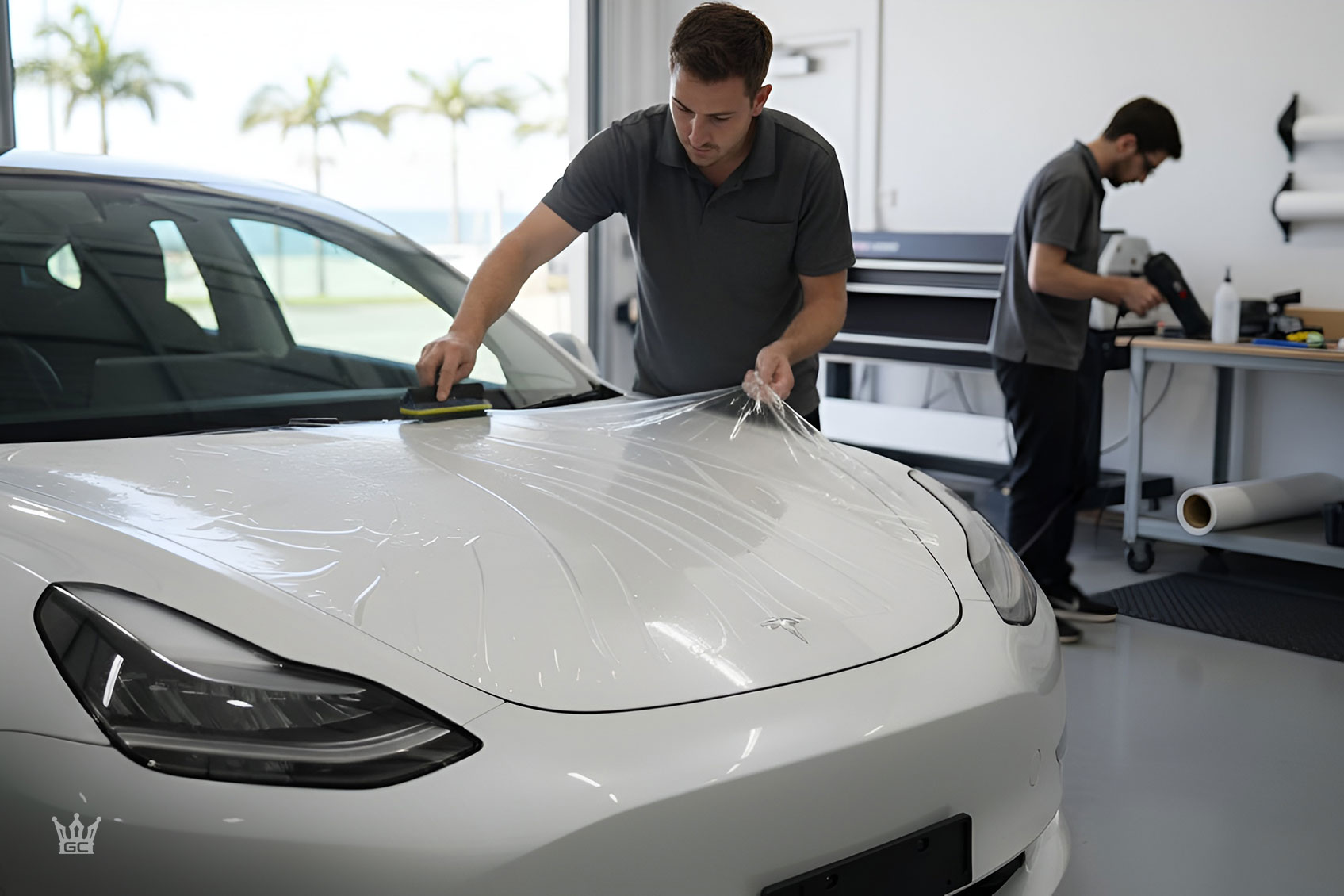
Full bonnet PPF on a Tesla typically costs between $2,000 and $3,000 AUD on the Gold Coast when bundled into a full front end package, which is how most professional shops sell it. Tesla’s thin, chip-prone paint makes the bonnet particularly vulnerable, and Gold Coast conditions (M1 motorway debris, intense UV, salt air) accelerate the damage. Most installers don’t offer bonnet-only PPF as a standalone service because the full front package, covering the bumper, bonnet, fenders, headlights and mirrors, represents far better value and eliminates the visible film edge that cheaper partial coverage leaves behind.
If you own a Tesla on the Gold Coast and you’ve been searching for “full bonnet PPF Tesla cost Gold Coast,” you’re already past the basics. You know PPF exists. You know your bonnet needs it. Now you want numbers, clarity on what you’re actually buying, and confidence that you’re not overpaying.
This guide breaks down every term in that search query, explains the coverage tiers that Gold Coast installers actually sell, provides real Australian dollar pricing, and covers why Tesla bonnets specifically need protection in southeast Queensland’s harsh environment.
What “Full Bonnet PPF” Actually Means
“Bonnet” is Australian English for what Americans call the hood. “Full bonnet PPF” means paint protection film covering the entire bonnet surface, from the front leading edge all the way back to the windshield cowl. This is different from a “partial bonnet” (also called a bikini cut), which covers only the first 300 to 450 mm from the front lip.
Here’s the important bit most people miss: virtually no professional shop on the Gold Coast sells full bonnet PPF as a standalone service. The bonnet is almost always bundled into what the industry calls a “full front end” or “drivers package.” This package includes the full bonnet plus the front bumper, headlights, front fenders (guards), and mirror caps.
There’s a good reason for this. If you protect the bonnet but leave the bumper exposed, stones will destroy the bumper first. And if you only protect the bumper, the bonnet catches everything the bumper misses. Practitioners on Tesla Motors Club forums are blunt about it: “there is no point to just wrap the front bumper. The hood is just as vulnerable to rock chips.” Others note that stones “have this magic way of finding unprotected parts.”
If you’re researching full bonnet PPF Tesla cost on the Gold Coast, what you actually want to ask your installer about is the full front end package. For a deeper explanation of how PPF works and what it protects, read our complete guide to paint protection film coverage and care.
PPF Coverage Tiers Explained
Gold Coast installers typically offer four or five coverage tiers. Understanding these will save you time when requesting quotes.
Bumper Only
Just the front bumper bar. This is the cheapest option and catches the worst of the stone chips, but leaves the bonnet, fenders and headlights exposed. Expect to pay roughly $600 to $1,000 AUD.
Partial Front (Bikini Cut)
Covers the front bumper, partial bonnet (roughly 300 to 450 mm back from the leading edge), partial fenders, and mirror caps. It’s cheaper than a full front, but community forums widely criticise this approach. The film edge running across your bonnet is visible, especially in certain light, and debris still hits the unprotected portion behind the cut line.
Full Front End (Includes Full Bonnet)
This is the package most Tesla owners on the Gold Coast should be looking at. It covers the entire front bumper, full bonnet, full fenders, headlights, and mirror caps. No visible edge across the bonnet. Clean, nearly invisible protection across every surface that faces oncoming road debris. Published Gold Coast pricing for this tier on a Tesla Model 3 or Model Y runs from approximately $2,000 to $3,000 AUD depending on film brand and installer.
Track Package
Everything in the full front end plus rocker panels (side skirts) and sometimes A-pillars. Designed for highway commuters and track day enthusiasts who want extra side protection. Gold Coast pricing starts around $3,150 AUD.
Full Body Wrap
Every painted surface gets film. Maximum protection, but significantly more expensive. For a Tesla Model 3, full body PPF on the Gold Coast ranges from roughly $6,000 to $7,500 AUD depending on the film and finish chosen. Our Tesla Model X satin PPF project shows what a full body application looks like in practice.
|
Coverage Tier |
What’s Covered |
Gold Coast Price Range (Tesla Model 3/Y) |
|---|---|---|
|
Bumper only |
Front bumper |
$600 to $1,000 |
|
Partial front (bikini cut) |
Bumper, partial bonnet, partial fenders, mirrors |
$1,200 to $1,800 |
|
Full front end |
Bumper, full bonnet, full fenders, headlights, mirrors |
$2,000 to $3,000 |
|
Track package |
Full front + side skirts, A-pillars |
$3,000 to $3,500 |
|
Full body |
All painted surfaces |
$6,000 to $7,500+ |
Prices are approximate and vary by film brand, installer, and specific Tesla model. Always request a tailored quote.
What Full Bonnet PPF Costs on the Gold Coast for Tesla
Let’s get specific. When Gold Coast Tesla owners ask about full bonnet PPF cost, they’re really asking about the full front end package. Here’s what published Australian installer pricing looks like:
|
Installer |
Coverage |
Tesla Model 3 Price |
Tesla Model Y Price |
Film Brand |
|---|---|---|---|---|
|
Gold Coast installer (Radikal Wraps) |
Drivers Package (full front including bonnet) |
From $2,750 |
From $2,750 |
STEK |
|
North QLD installer (Attention to Detail) |
Full Front PPF |
XPEL Ultimate Plus |
||
|
National installer (Immaculate PPF) |
Full Front, Premium tier |
$2,500 |
$2,500 |
SunTek Reaction (12-yr) |
|
National installer (Immaculate PPF) |
Full Front, Standard tier |
$2,100 |
$2,100 |
SunTek Ultra (10-yr) |
|
National installer (Immaculate PPF) |
Full Front, Economy tier |
$1,799 |
$1,799 |
SunTek PPF-C (5-yr) |
Several factors shift the price within that $2,000 to $3,000 range:
Film brand. XPEL Ultimate Plus sits at the top of the market, commanding a 15 to 25% premium over competitors. SunTek Ultra and STEK DYNOshield offer comparable specs for less.
Tesla model. The Model Y costs slightly more than the Model 3 due to its larger bonnet and fender area. The Model X and Model S cost more again.
Finish type. Satin (stealth) PPF typically costs $500 to $700 more than standard gloss film. If you’re weighing those options, our satin PPF vs gloss PPF decision guide for Tesla Model Y breaks down the trade-offs.
Warranty tier. Economy films with 5-year warranties cost less. Premium films with 10 or 12-year warranties cost more but offer better self-healing performance and yellowing resistance.
If you want an accurate number for your specific Tesla, get in touch for a personalised quote.
Why Tesla Bonnets Are Particularly Vulnerable
Tesla’s paint has a well-documented reputation for being thin and chip-prone compared to most legacy automakers. This isn’t just internet folklore. Australian installers confirm it directly. One North Queensland PPF specialist notes that “Tesla’s do tend to chip their paint quite easily,” adding that the solid black paintwork is especially problematic because “the soft paint shows scratches and swirls incredibly easy.”
Combine thin paint with Tesla’s design characteristics (wide, flat bonnets and relatively low ride heights, especially on the Model 3 and Performance trims) and you have a vehicle that catches road debris like a catcher’s mitt.
The numbers make the case for prevention straightforward. A proper respray of a Tesla bonnet or bumper at a quality body shop runs $1,000 or more. A full front PPF package at $2,000 to $3,000 protects both the bonnet and bumper for 5 to 10 years. Over a typical ownership period, PPF pays for itself by avoiding even a single major respray.
There’s also resale value to consider. According to data cited by the Paint Protection Film Manufacturers Association, vehicles with PPF maintain 10 to 15% more resale value than unprotected counterparts.
For Tesla owners specifically, a well-maintained PPF wrap signals to the next buyer that the paint underneath is pristine. That matters when the car’s paint was fragile to begin with. If you’re curious about how experienced installers handle Tesla-specific challenges like sensors and cameras, see our page on Gold Coast Tesla wraps and sensor-safe installations.
Gold Coast Conditions That Make PPF Essential
The Gold Coast isn’t gentle on car paint. Four specific environmental factors make PPF (particularly on the bonnet) more of a necessity here than in milder climates.
M1 Motorway and highway debris. If you commute on the Pacific Motorway, your bonnet faces a daily barrage of stones, gravel, and sand kicked up by traffic. High speeds amplify the impact force. This is the single biggest reason Gold Coast Tesla owners seek full bonnet PPF.
Extreme UV exposure. Queensland receives some of the strongest ultraviolet radiation on the planet. UV degrades clear coat, causes oxidation, and accelerates paint fading. PPF acts as a UV barrier, but cheap films without proper stabilisers can yellow under this intensity. Premium films with anti-yellowing properties are worth the extra cost in this climate.
Salt air. Coastal suburbs from Tweed Heads through Burleigh, Mermaid Beach, and Surfers Paradise face constant salt exposure. Salt accelerates corrosion and pitting in unprotected paint, particularly around stone chip wounds where bare metal is exposed.
Environmental contaminants. Insects, bird droppings, tree sap, and industrial fallout are year-round problems. PPF’s hydrophobic top coat makes these contaminants easier to wash off before they etch into the paint.
Kaizen Motorsports, a Gold Coast automotive specialist, identifies all four of these factors as primary threats to vehicle paint in the region. The takeaway: if you’re paying $2,000+ for full front PPF on your Tesla, the Gold Coast climate will test every dollar of that investment. Choose a premium film and an installer who knows the local conditions.
For ongoing maintenance in this climate, our guide to cleaning paint protection film covers wash frequency, products to avoid, and how to keep the film performing in coastal conditions.
Key PPF Terms You Should Know
When comparing quotes from Gold Coast installers, you’ll encounter technical language. Here’s what it all means.
PPF (Paint Protection Film)
A clear, high-performance thermoplastic film applied to painted surfaces to protect against scratches, rock chips, oxidation, and corrosion. Also called “clear bra” (an American term you’ll see online but rarely hear in Australian shops). The film is typically applied to the most vulnerable areas: bonnet, bumper, fenders, mirrors, headlights, and door edges.
TPU (Thermoplastic Polyurethane)
The base material of modern PPF. TPU is a flexible, impact-absorbing polymer that gives the film its stretch, self-healing capability, and optical clarity. All premium films use TPU. Standard thickness for professional-grade film is approximately 8 mil (0.2 mm).
Self-Healing
The defining feature of premium PPF. The film’s polymer top coat softens under heat (sunlight, warm water, even engine heat), allowing minor scratches and swirl marks to disappear. On the Gold Coast, ambient temperatures and direct sun mean self-healing happens quickly, often within 5 to 15 seconds for premium films.
Hydrophobic Top Coat
A water-repelling surface layer that causes water to bead and sheet off the film. This reduces water spots, makes the car easier to wash, and helps contaminants slide off before they bond to the surface. Some films include this top coat as standard; others require a separate ceramic coating application.
Pre-Cut Patterns / CAD Templates
Computer-designed templates cut to match specific vehicle panels with millimetre precision. Major brands maintain pattern databases covering nearly all vehicles, including every Tesla model. Pre-cut patterns reduce installation time and improve edge accuracy compared to hand-trimming film directly on the car.
Gloss PPF vs Satin (Stealth) PPF
Standard PPF is optically clear with a gloss finish that’s virtually invisible on gloss paint. Satin PPF (sometimes called “stealth”) has a frosted finish that transforms gloss paint to a satin or semi-gloss appearance. XPEL’s Stealth film is the most well-known example. Satin PPF costs more and is popular on dark-coloured Teslas for a factory-matte look without repainting.
Warranty Tiers
PPF warranties range from 5 years (economy films) to 10 years (standard premium) to 12 years (top-tier premium). Warranties typically cover yellowing, bubbling, cracking, and delamination. They do not cover installation errors, which is why installer choice matters as much as film choice.
PPF Brand Comparison
Four brands dominate the Australian PPF market. Here’s how they compare based on analysis from a 33-year installation shop:
|
Brand |
Flagship Film |
Self-Healing Speed |
Warranty |
Hydrophobic |
Price Position |
|---|---|---|---|---|---|
|
XPEL Ultimate Plus |
Premium gloss |
5 to 10 seconds |
10 years |
Extra cost (Fusion coating) |
Highest (15 to 25% premium) |
|
SunTek Ultra |
Best value premium |
5 to 10 seconds |
10 years |
Included |
15 to 20% less than XPEL |
|
STEK DYNOshield |
Easiest maintenance |
10 to 15 seconds |
10 years |
Built-in (industry-leading) |
10 to 15% less than XPEL |
|
3M Pro Series |
Budget premium |
Good |
7+ years |
Basic |
Lowest of the four |
The most important takeaway from experienced installers: all premium TPU films use similar polyurethane technology at similar thickness. Installer skill matters more than brand. A perfectly installed mid-tier film will outperform a poorly installed premium film every time. When evaluating full bonnet PPF Tesla cost on the Gold Coast, focus on the installer’s portfolio and experience with your specific vehicle rather than fixating on brand names alone.
DIY PPF Kits vs Professional Installation
Pre-cut PPF kits for Tesla panels are available online from around $85 to $300 AUD. Professional installation of a full front end runs $2,000 to $3,000+. That’s a big gap, and it’s worth understanding why.
Where DIY works. Small, flat panels like door handle cups or door edge guards. Single-panel touch-ups on areas you’ve already chipped. Situations where you’re in a remote area far from a professional installer. Budget constraints where some protection is better than none.
Where professional installation is worth every dollar. The full bonnet is one of the most challenging panels on any car. It’s large, curved, and any dust particle, air bubble, or fluid pocket trapped during installation will be visible every time you open the garage. Tesla bonnets have compound curves around the edges and near the windshield cowl that require heat guns, stretch technique, and experience to wrap cleanly.
Then there are the Tesla-specific complications. Autopilot cameras, parking sensors, and radar modules need careful masking or trimming. An inexperienced installer can obstruct sensors or leave gaps that let debris in.
Community discussions on OzBargain and Tesla forums consistently reflect this divide. One user reported spending “less than $500 of polishing” to address scratches, but others counter that polishing removes clear coat each time, which is a losing strategy on Tesla’s already-thin paint. The consensus among owners who went professional: the cost is justified for the bonnet, bumper, and fenders.
Is Full Front PPF Worth It for Tesla Owners?
This question comes up constantly in owner forums. The short answer for Gold Coast Tesla owners: yes, particularly for the full front end.
As one 2026 editorial assessment from Recharged puts it: “For most Tesla owners who daily-drive, especially on highways or in harsh climates, front-end PPF is usually worth it.” They note that full body PPF is “more of a luxury choice” that only pencils out financially over very long ownership periods.
On OzBargain, the debate gets lively. One sceptic called PPF “the latest fad scam” and suggested putting the money into a term deposit instead. But another user countered that “a badly scratched and chipped car would lose more than $2k value,” which is hard to argue with when you consider Tesla’s soft paint and Gold Coast driving conditions.
The math is straightforward for a full front package. At $2,500 for 10 years of bonnet, bumper, fender, and headlight protection, you’re paying $250 per year. A single bonnet respray costs $1,000+. One bumper respray costs about the same. Avoid one of each over a decade and the PPF has paid for itself twice over.
Explore our full range of PPF packages on the Gold Coast to see what coverage options suit your situation.
PPF vs Ceramic Coating: A Quick Clarification
Many Tesla owners researching full bonnet PPF also wonder about ceramic coating as an alternative. They are not the same thing, and they’re not interchangeable.
PPF is a physical film that absorbs impacts. It stops stone chips, prevents scratches, and self-heals minor damage. Ceramic coating is a liquid polymer that bonds to paint (or to PPF) creating a hydrophobic, UV-resistant surface layer. It makes the car easier to wash and adds gloss, but it provides zero chip protection.
The best approach for most Gold Coast Tesla owners: PPF on the high-impact front end, ceramic coating on the rest of the car. Some installers offer hybrid packages that combine both. For a detailed comparison, read our PPF vs ceramic coating breakdown.
Quick-Reference Glossary
|
Term |
Definition |
|---|---|
|
Bikini cut |
Partial front PPF covering only the leading edges of the bonnet and fenders. Cheaper but leaves a visible film edge. |
|
CAD template |
Computer-designed cutting pattern matched to a specific vehicle’s panel dimensions. |
|
Clear bra |
American slang for PPF. Same product, different name. |
|
Full bonnet |
PPF covering the entire bonnet from front edge to windshield cowl. |
|
Full front end |
Package covering bumper, full bonnet, fenders, headlights, and mirrors. The standard professional package. |
|
Gloss PPF |
Optically clear film that’s virtually invisible on gloss paint. |
|
Hydrophobic |
Water-repelling surface property that causes beading and sheeting. |
|
PPF |
Paint protection film. A clear thermoplastic urethane film applied to protect paint. |
|
Pre-cut pattern |
Film cut to exact panel dimensions before installation, using digital vehicle data. |
|
Satin / Stealth PPF |
Frosted-finish film that converts gloss paint to a satin appearance. |
|
Self-healing |
The film’s ability to repair minor scratches when exposed to heat. |
|
TPU |
Thermoplastic polyurethane. The flexible, impact-absorbing base material of modern PPF. |
|
Track package |
Full front end PPF plus rocker panels and sometimes A-pillars. |
Frequently Asked Questions
As a standalone service, bonnet-only PPF is rarely offered by professional installers. The full front end package (which includes the full bonnet, bumper, fenders, headlights, and mirrors) costs between $2,000 and $3,000 AUD on the Gold Coast for a Tesla Model 3 or Model Y. The exact price depends on film brand, warranty tier, and whether you choose gloss or satin finish.
Because the bonnet isn’t the only vulnerable panel. The front bumper, fenders, and headlights face the same stone chip exposure. Wrapping the bonnet alone leaves the bumper unprotected, and vice versa. The full front package covers every surface that faces oncoming debris, and the per-panel cost drops significantly when bundled.
Tesla paint has a consistent reputation among owners and installers for being thinner and more chip-prone than paint from most legacy automakers. Black Tesla paint is especially susceptible to showing scratches, swirls, and chips. Whether this constitutes “worse” paint or simply “paint that reveals damage more readily” is debatable, but the practical result is the same: Tesla bonnets chip more easily.
Queensland’s intense UV can cause cheap PPF to yellow over time. Premium films with anti-yellowing stabilisers and 10-year warranties are designed to withstand this. The warm Gold Coast temperatures actually benefit PPF by activating self-healing faster. Salt air won’t damage quality PPF, though regular washing (every two weeks, more if you’re near the beach) helps maintain the hydrophobic layer.
For most daily drivers, full front PPF is the sweet spot. It protects the panels that actually get hit by road debris at a fraction of the full body cost. Full body PPF ($6,000 to $7,500+ for a Tesla) makes sense if you plan to keep the car for many years, park outdoors regularly, or simply want every panel protected. Editorial assessments from automotive publications consistently describe full body PPF as a “luxury choice” rather than a necessity.
Premium films with 10-year warranties are designed to last a decade without yellowing, bubbling, or delaminating. Actual lifespan depends on maintenance, sun exposure, and how the film is cared for. Regular washing and avoiding abrasive chemicals will keep it performing well for the warranty period and often beyond.
Yes. Satin (stealth) PPF transforms gloss paint to a semi-gloss or matte appearance while providing the same chip and scratch protection as standard gloss film. It costs $500 to $700 more than gloss PPF for a full front end package. It’s particularly popular on dark-coloured Teslas where the satin finish creates a striking factory-matte look.
Ask which film brand they use and what warranty it carries. Ask to see photos of completed Tesla installs (bonnet edges, bumper corners, and headlight wraps are the hardest parts). Ask whether they use pre-cut CAD templates or hand-trim on the vehicle. And ask about their experience with Tesla sensors and cameras. These questions will tell you more about likely results than any price comparison alone.
Ready to protect your Tesla’s bonnet and front end? Request a quote from Gold Coast Wrap Kings for a tailored full front PPF package based on your specific model and finish preferences.