
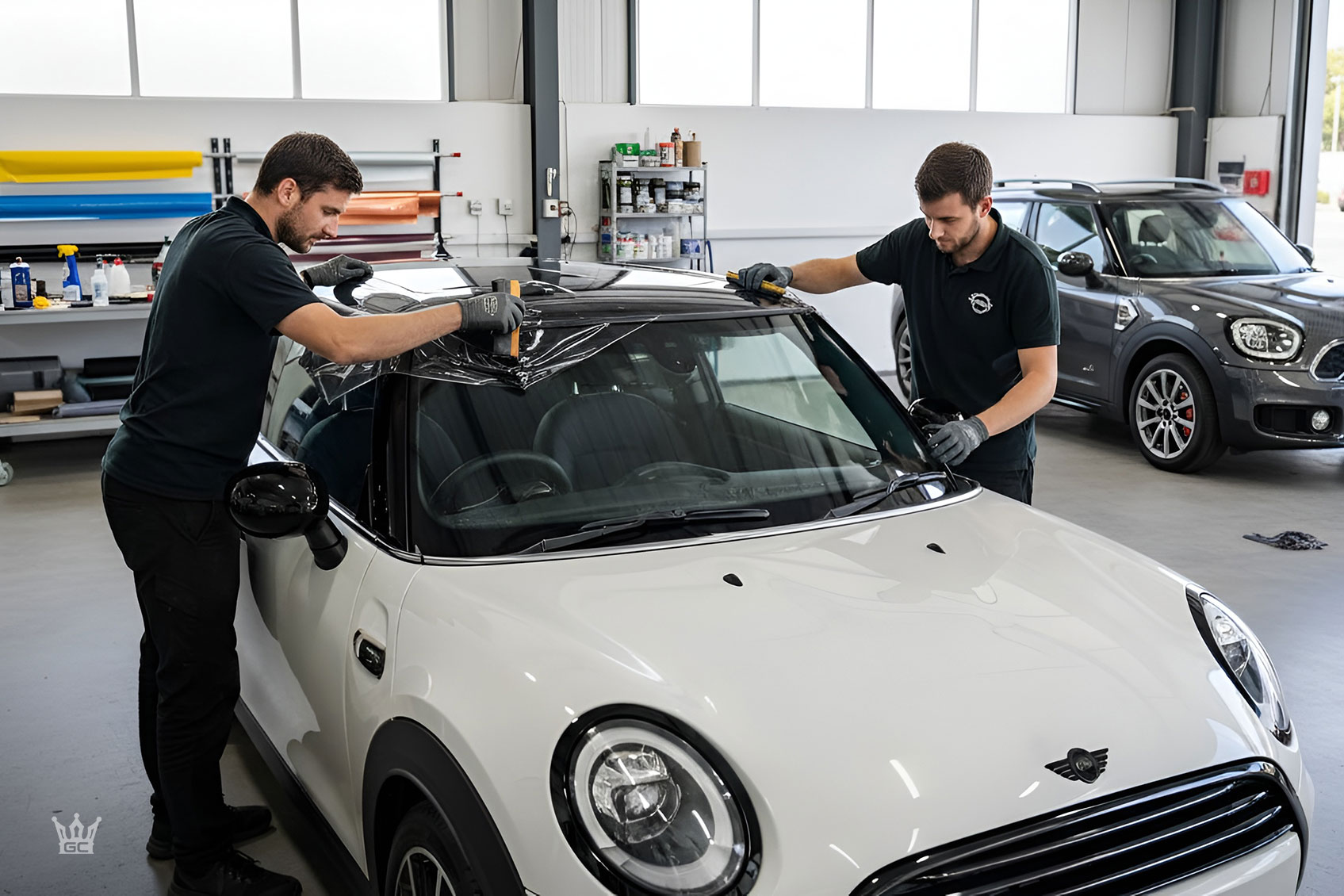
TL;DR
A full vinyl wrap on a Mini Cooper 3-door hatch costs between $2,500 and $4,500 AUD in Australia, depending on the vinyl finish and installer. Partial wraps (roof, bonnet, mirrors) range from $300 to $1,200 AUD. Larger models like the Countryman cost 25 to 40 percent more than the base hatch. Despite being a small car, Minis often cost more to wrap than owners expect because of their pronounced curves, badge density, and two-tone roofline complexity.
Quick Answer: Mini Cooper Wrap Costs at a Glance
Before getting into the detail, here is a summary table showing how much it costs to wrap a Mini Cooper across different models and coverage levels in Australia.
|
Mini Model |
Full Wrap (AUD) |
Partial Wrap (AUD) |
|---|---|---|
|
MINI Cooper 3-Door Hatch |
$2,500 – $4,500 |
$600 – $2,500 |
|
MINI Cooper 5-Door |
$2,700 – $4,800 |
$700 – $2,600 |
|
MINI Cooper Convertible |
$2,800 – $5,200 |
$700 – $2,800 |
|
MINI Countryman |
$3,200 – $5,800 |
$900 – $3,000 |
|
MINI Cooper Electric |
$2,600 – $4,700 |
$650 – $2,600 |
These figures reflect standard gloss or matte finishes from a professional installer. Premium finishes like chrome or colour-shift push costs higher.
The Australian car wrapping market puts average pricing around $2,975 for a standard vehicle, and the Mini’s compact size means it typically sits at or slightly below that average for a 3-door hatch.
What Is a Vinyl Wrap?
A vinyl wrap is a thin, adhesive-backed film applied directly over your car’s existing paintwork. It changes the colour and finish of your vehicle without any permanent modification. Unlike a respray, a wrap is fully reversible. You can remove it years later and reveal the original paint underneath, usually in better condition than when you started.
Wraps are not the same as paint protection film (PPF), which is transparent and designed purely to shield paint from stone chips and scratches. They are also different from simple decals or stickers, which cover only small areas. A full colour-change wrap covers every visible painted surface on the vehicle.
Minis are some of the most popular candidates for vinyl wraps in Australia. Owners love them because the car already has a playful, customisable personality. Factory options for unique colours are limited and expensive, so wrapping gives you access to finishes MINI doesn’t even offer, from deep matte military green to iridescent colour-shift films.
Mini Cooper Wrap Cost by Model
The Mini range spans everything from a tiny three-door hatch to a proper compact SUV. Body size is the single biggest factor in wrap cost because more surface area means more vinyl and more labour hours. Here is what each model typically costs to wrap in Australia.
MINI Cooper 3-Door Hatch (F56 / J01)
At just 3,876mm long, this is the smallest Mini and the cheapest to wrap. A full colour-change wrap runs $2,500 to $4,500 AUD. Industry data for compact cars and hatchbacks supports this range, with sources placing small car wraps at $2,000 to $4,000 for a compact car.
MINI Cooper 5-Door
The five-door adds two extra door panels and a slightly longer body. Expect to pay 5 to 10 percent more than the three-door, putting the range at roughly $2,700 to $4,800 AUD. The extra doors are straightforward panels, so the increase is modest.
MINI Cooper Convertible
This one surprises people. The soft-top itself cannot be wrapped (it is fabric), but the complex transition zone between body panels and the convertible mechanism adds real difficulty. Installers need extra time working around the folding roof edges, and there is more disassembly involved. Budget 10 to 20 percent more than the base hatch, or approximately $2,800 to $5,200 AUD.
MINI Clubman
Though discontinued in the latest generation, plenty of Clubmans are still on the road. The estate body is significantly larger than the hatch, with its distinctive split rear doors adding complexity. Expect 15 to 25 percent more than the base hatch.
MINI Countryman
The Countryman is a compact SUV measuring over 4,446mm in length. It moves into mid-size SUV pricing territory, costing 25 to 40 percent more than the three-door hatch. A full wrap on a Countryman typically falls between $3,200 and $5,800 AUD.
MINI Cooper Electric (J01)
The new electric Mini shares its body shell dimensions with the standard three-door, so pricing is similar: $2,600 to $4,700 AUD. The slight premium comes from sensor placements and flush door handles that require careful work. Practitioners on the Mini Cooper EV Forum report that new electric Mini owners are increasingly wrapping their cars to personalise them without affecting paint warranties. If you are wrapping an EV, it is worth choosing an installer with experience working around sensors and cameras.
Full Wrap vs Partial Wrap: What Mini Owners Actually Choose
Not every Mini owner wants a full colour change. In fact, some of the most popular Mini wraps are partial, and there is a good reason for that.
Full Colour Change
A full wrap covers every painted exterior surface, transforming the car’s entire appearance. For a Mini 3-door, you are looking at $2,500 to $4,500 AUD as outlined above. This is what most people picture when they think about wrapping a car.
Roof and Mirror Wrap (The Classic Mini Two-Tone)
This is the single most requested partial wrap for Mini Coopers. Minis already come with a contrasting roof option from the factory, but vinyl gives you far more colour and finish choices. A roof wrap costs $300 to $600 AUD, and adding mirrors brings it to around $400 to $750.
Bonnet and Roof Combo
Wrapping the bonnet (hood) and roof together creates a dramatic look, especially in a contrasting matte or gloss black. Expect $600 to $1,200 AUD for this combination. It is a popular middle ground between a full wrap and a simple roof swap.
Accent Wraps (Stripes, Side Graphics, Scuttles)
Mini has a rich history of racing stripes and side graphics. Vinyl accent wraps let you add bonnet stripes, side scuttles, or lower body accents for a few hundred dollars. These are great entry points if you want personalisation on a budget.
Half Wrap or Two-Tone Body
A more extensive partial wrap covering roughly half the car, often splitting at a body line to create a two-tone effect, runs $1,500 to $2,500 AUD. Australian wrap shops like Wraptism list partial wraps for small cars from $1,950 plus GST.
For inspiration on what works well on compact cars, browse some creative wrap ideas and design trends.
Cost by Vinyl Finish
The type of vinyl finish you choose has a real impact on the final cost of wrapping a Mini Cooper. Here is how the main options compare.
|
Finish |
Price Impact |
Best Suited For |
|---|---|---|
|
Gloss |
Baseline (most affordable) |
Clean, factory-paint look in a new colour |
|
Matte |
10 – 15% above gloss |
Stealth look, military tones, understated style |
|
Satin |
Similar to matte |
Smooth, modern finish that splits the difference |
|
Metallic |
15 – 25% premium |
Eye-catching sparkle with depth |
|
Carbon fibre look |
20 – 30% premium |
Accent panels, sporty details |
|
Chrome |
Most expensive (up to $6,000+ for a Mini) |
Show cars, head-turning statement |
|
Colour-shift / flip |
25 – 40% above standard |
Unique, chameleon-like appearance |
For a Mini Cooper 3-door, a full gloss wrap might cost $2,500, while the same car in chrome could reach $5,500 to $6,000. Kelley Blue Book notes that hatchbacks in standard finishes typically fall in the $2,800 to $3,500 USD range, which aligns with Australian pricing once you account for the exchange rate and local labour costs.
Matte and satin finishes work particularly well on the Mini’s rounded body. The curves catch light beautifully with non-gloss films, which is one reason these finishes are so popular in the Mini community.
Why Mini Coopers Can Cost More Than You’d Expect
This is the section that matters most if you have received a quote and thought, “That seems high for such a small car.”
You are not alone. On the North American Motoring forum, a popular Mini enthusiast community, a thread titled “Is wrapping expensive? These quotes are crazy” shows multiple owners expressing surprise at the prices they were quoted. The thread reveals a common misconception: small car does not automatically mean cheap wrap.
Here is why.
Compound Curves and Wheel Arches
Minis have some of the most pronounced compound curves of any production car. The rounded bonnet, flared wheel arches, and bulging fenders all require the installer to stretch, heat, and carefully conform the vinyl around three-dimensional shapes. Flat panels like you find on a Toyota HiLux or a Tesla Model 3 are comparatively straightforward. A Mini’s curves demand more skill and time.
Badge and Trim Density
Minis are covered in trim pieces: chrome door handles, side scuttles, bonnet scoops (on the Cooper S), mirror caps, and various badges. For a clean finish, the installer typically needs to remove these components, wrap underneath, and reinstall everything. This disassembly and reassembly adds labour hours.
The Two-Tone Roof Seam
Many Minis have a factory colour break between the body and roof. Wrapping cleanly around that seam, where the body colour meets the roof colour, is fiddly work. If you are changing the entire car to one colour, the installer still needs to handle that transition zone carefully.
Convertible Soft-Top Transition
On convertible models, the area where painted body panels meet the fabric roof is one of the trickiest zones to wrap. The soft-top cannot be wrapped, but the installer has to create a perfect, durable edge right at that boundary.
Electric Mini Sensor Placements
The new MINI Cooper Electric has sensors and cameras integrated into the bodywork. These need to remain fully functional after wrapping, which means precise cutting and careful installation around each sensor location.
The bottom line: the cost to wrap a Mini Cooper reflects real complexity, not a markup for the brand badge.
Hidden Costs to Budget For
The quoted price for a Mini Cooper wrap does not always include everything. Several additional expenses can catch you off guard.
Surface preparation. If your paint has scratches, chips, or minor rust, the installer may need to do paint correction or repair work before applying vinyl. Wrapping over imperfections makes them more visible, not less.
Trim removal and reassembly. As mentioned above, badges, handles, and mirrors often need to come off. Some shops include this in the quote; others charge separately.
Design fees. If you want custom graphics, printed patterns, or a unique design, expect to pay $200 to $800 or more for the design work on top of the wrap cost.
Old wrap removal. Re-wrapping a Mini that already has vinyl? Removal of the old film typically costs $300 to $800, and some sources estimate up to $500 to $1,000 depending on the condition of the existing wrap.
Ceramic coating over the wrap. This is optional but worth considering, especially in Queensland. A ceramic coating over your wrap helps protect against bird droppings, tree sap, and UV fading. It can add $1,500 or more to the total.
Always ask your installer for an itemised quote so you know exactly what is and is not included.
DIY vs Professional: Is It Worth Wrapping a Mini Yourself?
Materials for a DIY Mini Cooper wrap run about $500 to $1,500 USD. For a small car, you will need roughly 50 to 60 feet of vinyl, and quality 3M or Avery Dennison film costs around $11 to $15 per linear foot at retail before accounting for waste.
But here is the honest truth: wrapping a Mini yourself is extremely difficult. The compound curves that give professionals trouble will be far harder without experience, proper tools, and a controlled environment. Kelley Blue Book explicitly notes that car wrapping is “not a do-it-yourself task”, and that assessment holds especially true for curvy cars like the Mini.
Members of the R53 MINI Facebook group have discussed vinyl quantities and DIY approaches, and the consensus leans toward professional installation for full wraps. Partial wraps on flat areas (bonnet stripes, for example) are more feasible as DIY projects, but anything involving complex curves is best left to a professional.
If you do go the DIY route, buy 20 to 25 percent more material than you think you need. Mistakes on compound curves are inevitable without experience.
Wrap vs Respray for a Mini Cooper
This is a common decision point for Mini owners considering a colour change. Here is how the two options compare.
|
Factor |
Vinyl Wrap |
Respray |
|---|---|---|
|
Cost (Mini Cooper) |
$2,500 – $4,500 AUD |
$3,000 – $6,000+ AUD |
|
Lifespan |
5 – 7 years |
10+ years |
|
Reversibility |
Fully reversible |
Permanent |
|
Customisation options |
Virtually unlimited finishes |
Limited to paint colours |
|
Paint protection |
Protects original paint underneath |
Replaces or covers original |
|
Resale impact |
Remove wrap to show original paint |
Colour change may reduce value |
|
Turnaround time |
3 – 5 days typically |
1 – 3 weeks |
For a deeper comparison, the guide on whether to wrap or respray for a colour change covers this topic in detail.
For Mini owners specifically, wraps make strong financial sense. Minis with factory heritage colours like British Racing Green, Pepper White, or Chili Red hold their value better with original paint intact. A wrap lets you enjoy a completely different look for years and then return to the factory colour when it is time to sell. Practitioners on Reddit’s r/CarsAustralia have noted that cheap resprays around $300 a panel are “usually a bit on the terrible side”, which reinforces that quality paint jobs cost real money, often more than a wrap.
How Long Does a Mini Cooper Wrap Last?
A professionally installed vinyl wrap typically lasts 5 to 7 years. In Australia’s climate, and particularly in Queensland where UV exposure is intense, you should plan for the lower end of that range unless you take active care of the wrap.
Three factors determine how long your Mini’s wrap will hold up:
-
Vinyl quality. Premium films from brands like 3M and Avery Dennison last longer than budget alternatives. The cost difference at the point of installation is modest compared to the lifespan gain.
-
Installation quality. Properly heated, stretched, and post-heated vinyl adheres better and resists lifting at edges. This is where a skilled installer earns their fee.
-
Maintenance. Regular hand washing, avoiding automatic car washes with harsh brushes, and parking in shade or a garage all extend wrap life. For practical maintenance tips, the guide on how to clean your vinyl wrap covers the basics, and the car wrap maintenance guide goes deeper.
How to Get an Accurate Quote
Getting a reliable quote for wrapping your Mini Cooper comes down to preparation. Here is what to have ready before contacting an installer.
Know your model and year. A 2024 MINI Cooper 3-door and a 2018 MINI Countryman are very different jobs. Be specific.
Decide on coverage. Full wrap? Roof and mirrors only? The more clearly you can describe what you want, the more accurate the quote.
Choose a finish category. You don’t need to pick the exact colour yet, but knowing whether you want gloss, matte, or something exotic helps the shop estimate materials.
Mention your car’s condition. Existing damage, previous wraps, or aftermarket body kits all affect pricing. Being upfront avoids surprises later.
Watch for red flags. If a quote seems dramatically cheaper than others, ask what vinyl brand is being used, whether trim removal is included, and what the warranty covers. A quote that is $1,000 below everyone else usually means corners are being cut.
If you are on the Gold Coast and ready to get pricing for your Mini, get in touch for a quote. Gold Coast Wrap Kings works on everything from compact hatchbacks to supercars and EVs, and you can browse completed projects to see the standard of work before committing.
Frequently Asked Questions
Is a Mini Cooper cheaper to wrap than a regular car?
Generally, yes. The Mini Cooper 3-door hatch is one of the smallest cars on the road, and less surface area means less vinyl and fewer labour hours. A full wrap on a Mini typically costs $2,500 to $4,500 AUD, compared to $3,500 to $6,000 or more for a mid-size sedan. That said, the Mini’s complex curves mean it is not as cheap as its size might suggest.
How much vinyl do I need to wrap a Mini Cooper?
For a full wrap on a small car like the Mini, you need approximately 50 to 60 linear feet of vinyl (roughly 15 to 18 metres). Buy an extra 20 to 25 percent to account for waste from cutting, mistakes, and working around curves.
Can you wrap a Mini Cooper Convertible?
Yes, but with a caveat. The soft-top fabric roof cannot be wrapped with standard vinyl. The body panels, bonnet, boot, and all painted surfaces can be wrapped as normal. The convertible typically costs 10 to 20 percent more than the hardtop hatch because of the complexity around the roof transition area.
How long does it take to wrap a Mini Cooper?
Most professional installers complete a full Mini Cooper wrap in 3 to 5 business days. Partial wraps (roof and mirrors, for example) can often be done in a single day. Complex custom designs or specialty finishes may take longer.
Does wrapping a Mini Cooper void the warranty?
No. A vinyl wrap does not affect your MINI manufacturer warranty. The wrap sits on top of the paint and can be removed without damage. In fact, wrapping protects the factory paint from UV exposure, minor scratches, and stone chips.
Is a wrap or respray better value for a Mini Cooper?
For most owners, a wrap offers better value. It costs less upfront ($2,500 to $4,500 vs $3,000 to $6,000+ for a quality respray), protects the original paint, and is fully reversible. The main trade-off is lifespan: wraps last 5 to 7 years versus 10+ years for paint.
Can I wrap just the roof of my Mini Cooper?
Absolutely, and it is one of the most popular modifications in the Mini community. A roof-only wrap costs $300 to $600 AUD and gives you the iconic Mini two-tone look with far more colour and finish options than the factory offers. Adding mirrors and side scuttles in a matching colour is a common upgrade.
Does the cost to wrap a Mini Cooper include GST?
This varies by shop. Some Australian installers quote inclusive of GST, while others add it on top. Always confirm whether your quote includes GST before comparing prices. The figures in this guide represent typical all-in pricing, but specific quotes may differ.
FAQ
Australian DIY kits start from approximately $295 AUD for a single panel (like a full bonnet kit) from suppliers like Paintgard. A full front kit ranges from roughly $500 to $1,200 USD depending on the brand and film tier. Full-body kits run $1,500 to $2,200 USD. Compare that to $4,000 to $7,000 USD for a professional full-body install.
No. The Highland has completely redesigned front and rear bumpers, different headlight shapes, and no fog lamp cutouts. Every major kit seller lists separate products for the Highland (2024+) and the pre-Highland (2017 to 2023). Always verify your model year before ordering.
A hair dryer works as a substitute but is less effective. It produces lower, less focused heat, which makes it harder to conform the film around compound curves like the front bumper. For flat panels and door cups, a hair dryer is adequate. For bumpers and fenders, a proper heat gun makes a noticeable difference.
The front bumper, without question. Its compound curves require aggressive heat and stretching, and most pre-cut kits split it into multiple pieces that create visible seam lines. Practitioners on Reddit consistently recommend starting with easier panels (hood, door cups) to build confidence before attempting the bumper.
Budget two to four hours per panel for a first-time installer. A full front (bumper, hood, fenders, mirrors) can easily take an entire weekend. YouTube walkthroughs from Drive Protected and others show that even experienced DIYers work methodically through each section.
Pre-cut kits for first-timers, every time. The consensus across Tesla forums and Reddit is unambiguous on this point. Bulk rolls offer better edge coverage and lower per-metre cost, but they require cutting on the car, which risks scoring Tesla’s thin paint. That damage is permanent and requires repainting.
Yes. Once the PPF has fully cured (at least 48 hours, ideally a week), you can apply a ceramic coating directly on top. The PPF’s clearcoat layer is designed to accept ceramic coatings. The combination provides impact protection (PPF) plus chemical and UV resistance (ceramic), which is the most complete paint protection setup available.
It depends on your goals. DIY PPF on a Model 3 saves roughly 60 to 70 percent compared to professional installation and delivers perfectly acceptable results on flat panels, door cups, and headlights. For compound-curve panels like the front bumper, full-body matte finishes, or if you want a labour warranty, professional installation is the better choice. Many owners take a hybrid approach: DIY the easy panels and pay a pro for the bumper.