
TLDR
A full vehicle satin PPF wrap typically costs more than clear PPF because satin changes the car’s finish and almost always requires full-body coverage to look right. Clear PPF can be installed on just the high-impact zones (bonnet, bumper, guards) for a fraction of the price. In Australia, full-body PPF generally starts around $6,000 and can reach $10,000 to $12,000 or more depending on vehicle size, film brand, and installer skill. The real cost gap between satin and clear often comes down to coverage scope, not just the film itself.
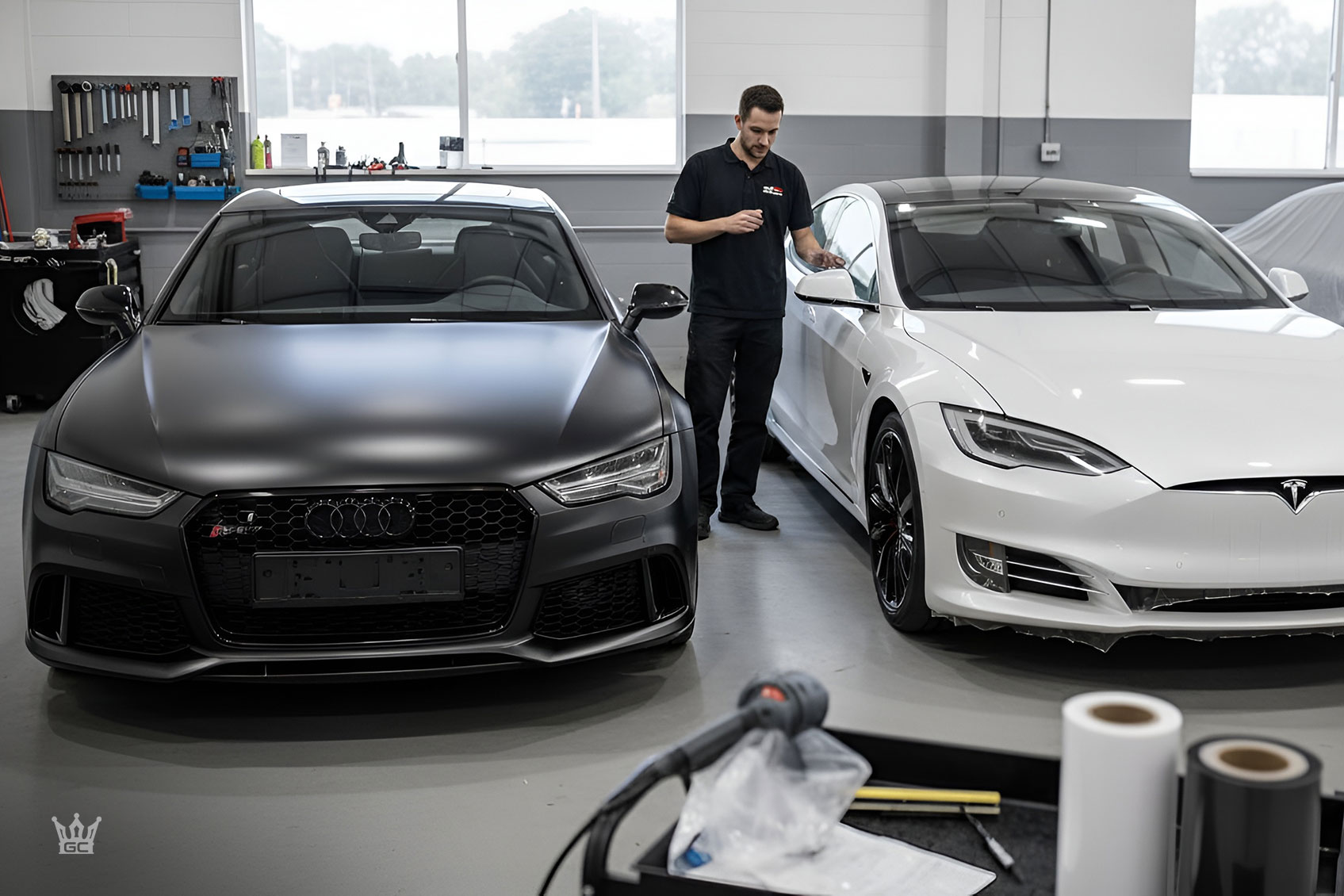
A full vehicle satin PPF wrap does two jobs at once: it protects the paint and it transforms the car’s finish from glossy to a low-sheen satin appearance. Clear PPF, by contrast, is designed to be invisible. It shields the paint without changing the way the car looks. That difference sounds simple, but it has a massive effect on pricing.
Most buyers comparing satin PPF and clear PPF costs are not making an apples-to-apples decision. Clear PPF is commonly installed as a full-front package covering the bonnet, bumper, guards, mirrors, and headlights. Satin PPF on a gloss car almost always needs full-body coverage because a satin front panel next to a glossy rear door looks wrong. So the real comparison for many buyers is not “satin film versus clear film.” It is “full-front protection versus full-vehicle finish conversion.”
In Australia, full-body PPF commonly starts around $6,000 and can climb toward $10,000 to $12,000+ depending on vehicle size, film, preparation, and installer quality (source). Satin PPF often sits in the upper half of that range because the finish needs to look uniform from every angle.
This guide breaks down exactly where the money goes, why satin costs more in practice, when clear PPF is the smarter investment, and what to ask before approving any quote.
What Does “Full Vehicle Satin PPF Wrap” Actually Mean?
A full vehicle satin PPF wrap means applying satin-finish paint protection film across every painted panel of the car: bonnet, bumper, guards, doors, roof, pillars, boot lid, rear bumper, sills, and all the small bits in between.
The film itself is still PPF, not vinyl. It is a polyurethane material designed to absorb stone chips, scratches, bug acid, road tar, and UV damage. 3M describes its Pro Series PPF as a 0.203mm (203-micron), self-healing polyurethane film available in both gloss and matte finishes (source). STEK’s DYNOmatte is an 8-mil satin-finish PPF with hydrophobic properties, stain resistance, and heat-activated self-healing (source).
The satin finish changes the way light reflects off the surface. Factory colour and metallic flake still show through the film, but the glossy sheen is replaced by a softer, flatter look. Some people call it “stealth.” Others call it matte. The terms overlap, though satin generally sits between dead-flat matte and high gloss.
For anyone new to the concept, our guide to what paint protection film is covers the fundamentals of film types, coverage options, and care basics.
What Is Clear PPF?
Clear PPF is transparent, gloss-finish paint protection film. Its job is to protect the factory paint without anyone noticing the film is there. On a well-installed clear PPF job, the car looks the same as it did from the factory, just with an invisible shield over the paint.
Clear PPF is the workhorse of paint protection. It is what most owners choose when they want to keep stone chips off the bonnet and bugs from etching the bumper. Because it is invisible, it can be installed on specific high-impact areas without creating a visible mismatch between protected and unprotected panels.
Common clear PPF coverage tiers include:
-
Partial front: bumper, partial bonnet, partial guards, mirrors
-
Full front: full bonnet, full bumper, guards, mirrors, headlights
-
Track pack or high-impact zones: full front plus rockers, lower doors, A-pillars, rear impact areas
-
Full body: every painted panel
In Australia, full-front clear PPF typically starts around $2,500, while Gold Coast estimates for full-front packages run approximately $1,800 to $3,500 (source). That flexibility to choose coverage tiers is one of clear PPF’s biggest financial advantages.
Satin PPF Versus Clear PPF Cost Comparison
Here is where the numbers get concrete. These are market benchmarks drawn from Australian pricing guides and industry sources, not shop-specific quotes.
|
Coverage and Finish |
Australian Market Range |
What It Means for Buyers |
|---|---|---|
|
Clear PPF, full front |
$1,800 to $3,500 (Gold Coast estimate); $2,500+ nationally |
Most cost-efficient option for protecting high-impact zones |
|
Clear PPF, full vehicle |
$5,500 to $10,000+ (Gold Coast estimate); $6,000 to $12,000+ nationally |
Full paint preservation without changing the car’s appearance |
|
Satin PPF, full vehicle |
$4,000 to $8,000 (broad guides); $6,000 to $10,000+ for SUVs and complex vehicles |
Protection plus finish transformation; usually in the upper half of full-body pricing |
|
Satin versus clear premium (like-for-like full body) |
Sometimes as little as $200 to $500 film-only difference |
The film cost gap can be modest; the real cost difference comes from coverage and labour |
Sources: Solarblock Australia, OzSignSupplies, RGBG Films, Nathan’s Detailing
The critical insight that most comparison articles miss: many buyers are not comparing full-body clear PPF against full-body satin PPF. They are comparing a $1,800 to $3,500 full-front clear PPF package against a $5,500 to $10,000+ full-body satin job. That is not a satin premium. That is a coverage jump.
If you are comparing satin and clear PPF on the same vehicle with the same full-body coverage, the difference at some shops may be a few hundred dollars. But satin PPF rarely makes sense as a partial install, which is why the real-world price gap feels so large.
Why Satin PPF Often Costs More: The Three-Layer Premium
The price difference between a full vehicle satin PPF wrap and clear PPF is not one thing. It is three separate premiums stacked on top of each other.
Layer 1: The Coverage Premium
Clear PPF works beautifully as a targeted shield. A full-front package covers the bonnet, bumper, guards, mirrors, and headlights, which are the panels that take the most road debris. The rest of the car stays unprotected but still looks fine because the film is invisible.
Satin PPF on a gloss car is different. If you apply satin film only to the front, the front panels look satin while the doors and rear stay glossy. The mismatch is obvious. One installer resource describes this as an “all-or-nothing” decision for satin on a gloss vehicle (source).
That means satin buyers are almost always committing to full-body coverage. And full-body PPF uses three to four times the film of a full-front kit, with installation time stretching to around five days (source).
Layer 2: The Finish-Uniformity Premium
Satin PPF changes the way light bounces off the car. Every exposed gloss edge, visible seam, or tight panel gap becomes a problem. With clear gloss PPF, a pre-cut pattern that stops slightly short of a panel edge still looks clean because the film and paint share a similar shiny appearance. With satin film, any tiny sliver of exposed gloss paint catches light and breaks the illusion.
Practitioners on the Land Cruiser Forum raised this exact concern. One owner pointed out that tight panel gaps on certain vehicles leave gloss paint visible at the edges, and buyers need to decide whether they can accept that. Another noted that grime tends to accumulate at untucked edges, which is more visible on a satin surface (source).
This means satin installations often require bulk custom cutting, hand-wrapping edges, and sometimes removing badges, handles, headlights, or trim pieces to achieve a clean look.
Layer 3: The Ownership-Care Premium
Satin PPF needs finish-aware maintenance. You cannot use wax, polish, or gloss-enhancing products on satin film because those products create shiny spots that ruin the uniform matte appearance. One maintenance guide specifically warns against wax and polish on satin, recommending pH-neutral soap, PPF-safe or matte-specific cleaners, and soft microfibre wash mitts instead (source).
3M’s care guidance similarly warns against waxes containing dyes, abrasive polishes, or rubbing compounds on PPF surfaces (source). This is not necessarily a cost at the point of installation, but it is a long-term ownership consideration that affects the total value equation.
For practical tips on keeping film in good condition, our PPF cleaning guide covers safe products and techniques.
What Drives the Quote Up (For Both Satin and Clear)
Whether you choose satin or clear, several factors will move your quote higher or lower.
Vehicle Size and Panel Area
A full-body PPF job on a sedan uses significantly less film than the same job on a Land Rover Defender or a Ford Ranger. Large SUVs, utes, and 4x4s have more panel area, bigger bumpers, and more complex body shapes. Practitioners on Reddit’s r/CarWraps pushed satin PPF cost expectations for a Toyota 4Runner (a mid-large SUV) to $6,000 to $8,000, with some commenters saying $8,000 to $10,000 was realistic for that size and bumper complexity (source).
For a real example of what goes into protecting a large 4×4, see our satin PPF project on a Land Rover Defender.
Vehicle Complexity
Sports cars, luxury vehicles, and EVs bring their own challenges: deep bumper curves, integrated sensors, camera housings, aerodynamic trim, tight panel gaps, and delicate factory paint. A CorvetteForum post about a C8 Corvette in XPEL Stealth listed full-body satin PPF ranging from $5,995 to $8,995 and up (source). A Bimmerpost user collected roughly eight quotes in the Bay Area for full XPEL Stealth on a BMW and found a spread from $4,900 to $10,500, more than double from cheapest to most expensive (source).
Film Brand and Warranty
Premium PPF brands include self-healing topcoats, hydrophobic properties, anti-yellowing UV inhibitors, and multi-year warranties. 3M’s Pro Series carries a 10-year warranty. STEK’s DYNOmatte carries a 10-year warranty against delamination, yellowing, bubbling, and cracking. LLumar’s gloss and matte PPF carry a 5-year limited warranty (source). Higher-spec film costs more per metre, and that adds up quickly on a full-body job.
Paint Preparation
Paint correction, clay bar decontamination, and deep cleaning before installation can add cost but are critical for a clean result. Any imperfection trapped under the film is locked in for years. Australian pricing guides note that poor prep leads to visible defects and reduced film lifespan (source).
Gold Coast Conditions
Gold Coast buyers have a practical reason to invest in protection. Queensland UV is intense, with the Bureau of Meteorology classifying UV index values of 8 to 10 as “very high” and 11+ as “extreme” (source). Coastal salt, humidity, M1 highway debris, and even car-park door dings are all part of daily ownership on the Gold Coast. These are the conditions that make PPF a functional investment rather than a luxury add-on.
When Clear PPF Is the Better Value
Clear PPF is the right choice for most daily drivers and budget-conscious buyers. It protects the panels that actually get hit by road debris, and it does so without changing the car’s appearance.
Clear PPF makes the most sense when:
-
You want to keep the factory gloss. The car looks exactly as it left the dealer, just protected.
-
You mainly need front-end protection. Highway driving, commuting on the M1, and country roads throw rocks at the bonnet and bumper. A full-front package covers those zones at a fraction of full-body cost.
-
Budget matters. A full-front clear PPF package at $1,800 to $3,500 is a very different conversation than a $6,000+ full-body satin job.
-
You want easier maintenance. Clear gloss PPF can be washed, waxed, and polished with the same products you already use on painted panels (within manufacturer guidelines).
-
You’re not chasing a specific look. If the goal is pure protection, clear delivers that without the aesthetic commitment.
If you are weighing PPF against ceramic coating or trying to decide between the two, our PPF vs ceramic coating guide breaks down the differences.
When Satin PPF Is Worth the Extra Spend
Satin PPF is not a budget product. It is a premium choice for buyers who want their car to look different and stay protected at the same time.
The extra cost makes sense when:
-
You want a stealth or satin version of your factory colour. Dark metallics, blacks, greys, and deep blues look striking in satin. The factory colour and metallic flake still show through, but the glossy sheen is gone.
-
You want protection stronger than vinyl. Vinyl wrap is primarily a styling product. PPF is engineered to absorb rock chips and scratches. If you want the satin look with genuine impact resistance, PPF is the answer.
-
You own a vehicle worth protecting long-term. Luxury cars, performance vehicles, EVs, and 4x4s are expensive to repaint. Satin PPF preserves the factory paint underneath while giving you a look that would otherwise require a full respray.
-
You accept satin-specific care. No wax, no polish, no abrasive cleaners. Satin owners need to use matte-safe products and generally hand-wash.
-
You understand that installer skill is everything. Edge finishing, seam placement, trim removal, and consistent satin sheen across every panel require experience. The cheapest quote is rarely the best quote.
A Tesla Model Y owner on Tesla Motors Club shared that spending roughly 10% of the car’s value on full XPEL Stealth PPF probably did not make strict financial sense, but they loved the result and were glad they did it (source). That is an honest take. Satin PPF is often as much an emotional and aesthetic choice as a financial one.
For Tesla and EV owners specifically, our satin PPF or gloss PPF decision guide for Tesla Model Y walks through the finish question in detail.
Satin PPF vs Satin Vinyl Wrap
This is one of the most common areas of confusion. When people say “satin wrap,” they might mean satin PPF, satin vinyl, or something in between. The products are fundamentally different.
|
Feature |
Satin PPF |
Satin Vinyl Wrap |
|---|---|---|
|
Primary purpose |
Paint protection plus finish change |
Styling and colour change |
|
Impact protection |
High (absorbs stone chips, scratches) |
Light surface protection only |
|
Film thickness |
Typically 6 to 8 mils (150 to 200+ microns) |
Typically thinner |
|
Self-healing |
Yes, on premium products |
No |
|
Colour options |
Usually clear satin over factory paint |
Widest range of colours, textures, and graphics |
|
Typical cost (full body) |
$6,000 to $12,000+ in Australia |
Generally lower than full-body PPF |
|
Best for |
Owners who want both protection and a satin finish |
Owners who want the cheapest colour change or bold graphics |
Vinyl wrap is the better choice if you want a dramatic colour shift, custom graphics, or commercial branding at a lower entry price. But vinyl does not absorb impacts the way PPF does. Rock chips can penetrate vinyl and damage the paint underneath (source). If chip protection matters, PPF is the product to choose.
For a deeper comparison of wrapping versus repainting, our wrap or respray guide covers both options.
What Real Owners and Installers Say
Community discussions paint a more nuanced picture than marketing pages ever will.
On cost expectations being too low: The original poster in a Reddit r/CarWraps thread expected $4,000 to $6,000 for full satin PPF on a 2021 Toyota 4Runner. Commenters quickly corrected the estimate, with multiple responses suggesting $6,000 to $8,000 and one pushing $8,000 to $10,000 due to the vehicle’s size and bumper complexity (source).
On long-term durability: A Land Cruiser Forum user with five years of XPEL Stealth on a Ford Raptor reported that the film still looked great in harsh Arizona conditions, self-healed in the sun, and washed easily. The caveats: grime built up at untucked edges, and the owner was uncertain what would happen beyond the five-year mark despite a 10-year warranty (source).
On installation quality at any price point: In a separate Reddit thread, a buyer who paid $6,449 for satin PPF posted photos showing contamination trapped under the film, visible flaws, and cuts in the paint. The lesson: a high four-figure quote does not guarantee quality. Buyers need to inspect the shop’s previous satin PPF work, understand the warranty process, and ask about remediation if something goes wrong.
On the quote spread being enormous: A BMW owner on Bimmerpost collected around eight quotes for full XPEL Stealth and saw prices range from $4,900 to $10,500 in the same region. Location, shop standards, disassembly practices, ceramic add-ons, and edge finishing all contributed to more than doubling the price from cheapest to most expensive.
What to Ask Before Approving a PPF Quote
Whether you are comparing full vehicle satin PPF wrap costs versus clear PPF or evaluating multiple shops, this checklist will help you understand what you are actually paying for.
-
Is the quote for full-front, track-pack, or full-body coverage?
-
Is the film clear gloss, satin clear, matte clear, colour PPF, or vinyl?
-
Which brand and exact film series is being used?
-
What warranty applies to the film, and what warranty applies to the labour?
-
Are edges wrapped or stopped short?
-
Will badges, trims, handles, headlights, or bumpers be removed for a cleaner finish?
-
Are sensors, cameras, parking sensors, and EV-specific panels accounted for?
-
Is paint correction or decontamination included in the price?
-
Is ceramic coating, tint, or trim blackout included or quoted separately?
-
How are seams handled on complex bumpers and curved panels?
-
What happens if dust, lift, bubbles, or contamination appear after curing?
-
What products are safe for satin PPF maintenance?
-
How soon can the car be washed after installation?
-
Can the installer show photos of satin PPF completed on similar vehicles?
Asking these questions puts you in a position to compare quotes on equal terms. A $5,500 quote with short edges, no paint correction, and no trim removal is a very different job than an $8,000 quote with full edge wrapping, panel disassembly, and paint correction included.
To see examples of completed PPF and wrap projects, browse recent work from Gold Coast Wrap Kings.
Quick Decision Matrix
|
Your Situation |
Better Choice |
Why |
|---|---|---|
|
Want chip protection for the lowest practical cost |
Clear PPF, full front |
Covers high-impact areas without full-body expense |
|
Want to keep factory gloss and protect every panel |
Clear PPF, full body |
Total paint preservation, invisible finish |
|
Want a satin/stealth version of your factory colour |
Satin PPF, full body |
Protection plus visible finish transformation |
|
Want satin only on bonnet, roof, or mirrors as an accent |
Satin accent PPF (intentional contrast) |
Works if the two-tone contrast is deliberate |
|
Want the cheapest possible colour change |
Vinyl wrap |
Lower upfront cost, but less impact protection |
|
Own a factory matte or frozen-finish vehicle |
Matte/satin PPF on exposed areas or full body |
Factory matte paint is difficult to correct once damaged; PPF acts as a sacrificial layer |
|
Daily M1 highway commuter on the Gold Coast |
Full-front clear PPF at minimum |
Road debris is constant; front-end protection is the priority |
|
Own a premium EV, 4×4, sports car, or luxury SUV |
Get quotes for both full-body clear and satin PPF |
Vehicle value and panel complexity may justify full-body coverage |
Glossary of Key Terms
Paint protection film (PPF): A polyurethane film applied to painted surfaces to protect against stone chips, scratches, bug damage, UV exposure, and chemical stains. Available in gloss, satin, matte, and colour finishes.
Clear PPF: Transparent, gloss-finish PPF designed to be invisible. Preserves the factory colour and sheen.
Satin PPF: PPF with a low-sheen satin topcoat that transforms gloss paint into a satin finish while still providing full PPF protection.
Matte PPF: Similar to satin PPF but with an even flatter, less reflective finish. The terms satin and matte are sometimes used interchangeably, though satin typically has a slight sheen.
Stealth PPF: A marketing term (popularized by XPEL Stealth) for satin or matte-finish PPF. Functionally the same category as satin PPF.
Colour PPF: Tinted or pigmented paint protection film that changes the vehicle’s colour while providing PPF-level impact resistance.
Vinyl wrap: A thinner, adhesive-backed film used primarily for colour change, graphics, or branding. Provides light surface protection but not the impact absorption of PPF.
Full front PPF: Coverage of the bonnet, front bumper, front guards, mirrors, and headlights. The most common PPF package.
Full vehicle PPF: Coverage of all painted exterior panels.
Bulk install: Cutting film from a roll directly on the vehicle rather than using pre-cut templates. Often required for satin PPF to achieve wrapped edges.
Pre-cut pattern: Film cut by a plotter using digital vehicle templates before it touches the car. Reduces blade-on-paint risk and speeds up installation.
Wrapped edges: Film folded around panel edges rather than stopped short on the face of the panel. Creates a cleaner look, especially on satin finishes.
Self-healing: A PPF property where minor scratches and swirl marks disappear when exposed to heat (sunlight or warm water).
Hydrophobic topcoat: A surface treatment on PPF that causes water to bead and roll off, making the film easier to clean.
Ceramic coating over PPF: A liquid coating applied on top of cured PPF to add additional hydrophobic properties and ease of maintenance.
Paint correction: Machine polishing to remove swirl marks, scratches, and oxidation from paint before PPF installation. Critical because imperfections get sealed under the film.
Frequently Asked Questions
In real-world quoting, yes. The film-only difference between satin and clear may be as little as $200 to $500 on a full-body job at some shops (source). But satin PPF almost always requires full-body coverage on a gloss car, while clear PPF can be targeted to high-impact zones only. That coverage difference is where the real cost gap comes from.
Technically yes, but it will create an obvious contrast between the satin front panels and the glossy sides and rear. This only works if the two-tone look is intentional. On a gloss vehicle, satin PPF is generally an all-or-nothing decision (source).
Premium satin PPF products are still genuine paint protection film with self-healing, hydrophobic, stain-resistant, and anti-yellowing properties. Protection performance is comparable. The difference is aesthetic, not structural. Product specs vary by brand and series, so confirm the exact film with your installer.
No. PPF is a thicker polyurethane film engineered for impact absorption. Vinyl wrap is thinner, primarily used for colour change and branding, and offers only light surface protection. Rock chips can penetrate vinyl and damage paint underneath (source).
Premium satin PPF products advertise multi-year warranties: 3M Pro Series offers 10 years, STEK DYNOmatte offers 10 years, and LLumar matte PPF offers 5 years. Real-world lifespan depends on UV exposure, care routine, installation quality, and local conditions. One Raptor owner on the Land Cruiser Forum reported his XPEL Stealth still looked good after five years in Arizona, though he acknowledged uncertainty beyond that point.
Many owners and installers apply ceramic coatings over cured PPF, but satin finishes require products specifically formulated for matte or satin surfaces. Standard ceramic coatings designed for gloss can alter the sheen and create an uneven appearance. Always confirm with your installer that the coating is satin-safe.
Quotes vary because of film brand, warranty tier, installer experience, vehicle complexity, edge wrapping standards, trim disassembly, paint correction, ceramic add-ons, and shop overhead. One BMW owner reported quotes ranging from $4,900 to $10,500 for the same full-body satin PPF job in the same region. The cheapest quote and the best quote are rarely the same.
Satin PPF preserves the factory paint underneath, which can help maintain resale value. But expecting to recoup the full cost of a $6,000 to $10,000 installation at sale time is unrealistic. Community discussions consistently show that most owners choose satin PPF because they enjoy the look and want the protection, not because they are calculating a strict return on investment.
The Bottom Line
When you compare full vehicle satin PPF wrap costs versus clear PPF, the price gap is real but often misunderstood. Clear PPF can be a targeted, cost-efficient shield for your bonnet and bumper. Satin PPF is a full-vehicle commitment that combines protection with a visible finish change. The difference is not just about paying more for a different-looking film. It is about paying for complete coverage, precision edge work, and a finish that demands consistency across every panel.
For Gold Coast buyers weighing both options, the best next step is to get quotes for both clear and satin PPF on the same vehicle, with the same coverage level and edge-finish standard. That way you are comparing real numbers, not assumptions.
Request a vehicle-specific PPF quote from Gold Coast Wrap Kings to compare clear and satin options for your car, and explore available PPF and vehicle wrap services to see what fits your needs.