
TL;DR
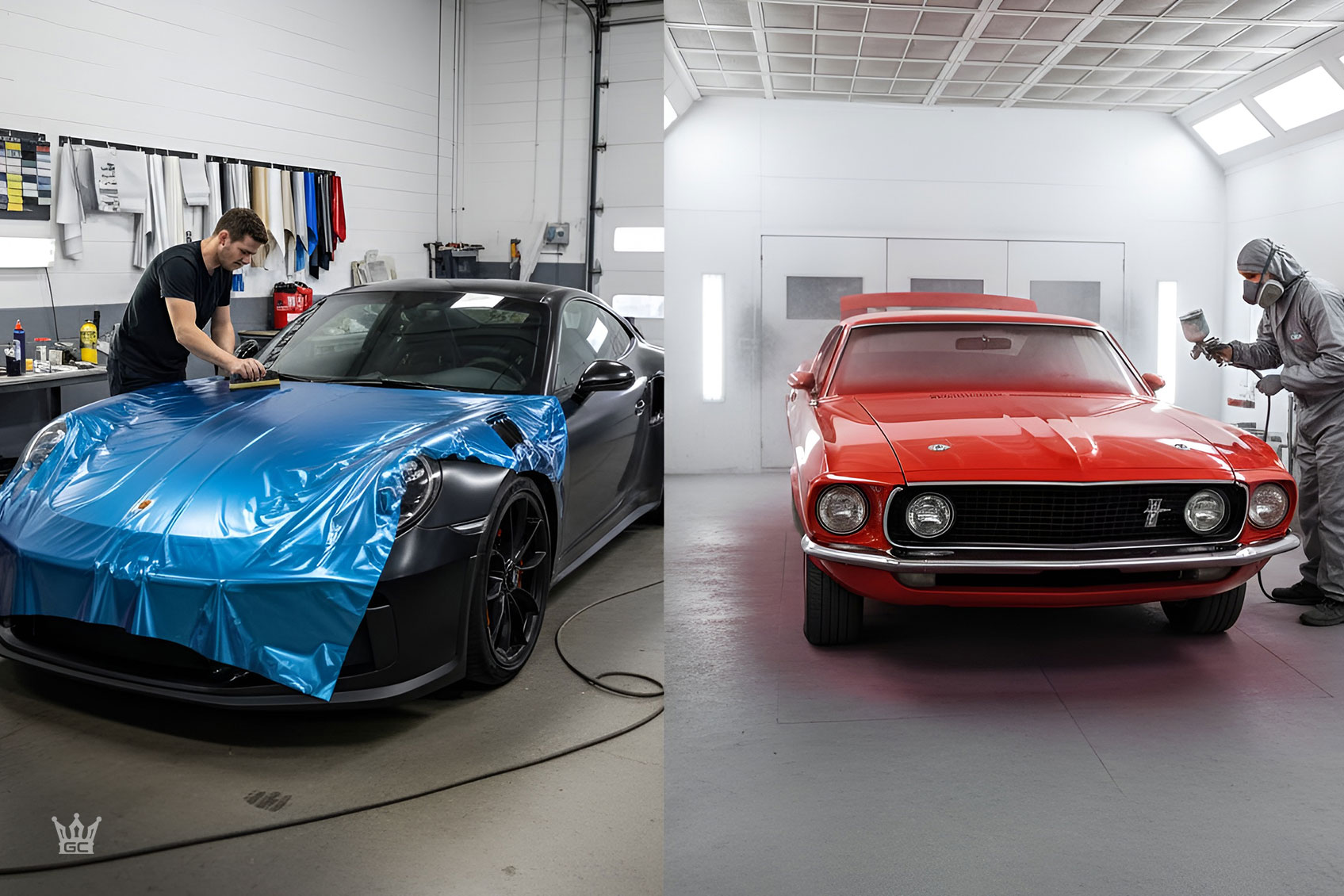
Car wrapping involves applying adhesive vinyl film over your existing paint to change your vehicle’s colour or finish, while car painting (respraying) permanently alters the surface through primer, base coat, and clear coat layers. Wrapping costs $2,500 to $6,000 in Australia and lasts 5 to 7 years, making it 30 to 50% cheaper than a factory-quality respray at $5,000 to $10,000 or more. Wraps are reversible and protect your original paint for resale, but painting is the better choice when dealing with rust, structural damage, or classic car restoration.
The decision between car wrapping vs painting comes down to a handful of practical questions: How much do you want to spend? How long should it last? Will you ever want to change it again? And what condition is your existing paint in?
Both methods achieve the same visual goal, a different colour on your car, but they get there through completely different processes with different trade-offs. This guide breaks down every term, cost, and consideration you need to make the right call, with specific attention to Australian pricing and Queensland regulations.
What Is Car Wrapping?
Car wrapping is the process of applying large sheets of adhesive vinyl film over a vehicle’s existing paintwork. The film is heated and stretched to conform to every curve, crease, and body line, then trimmed and sealed at the edges. When done properly, the result looks like paint.
The key difference from painting is that wrapping is non-permanent. A professional can remove the vinyl years later to reveal the original paint underneath, preserved in the condition it was in before the wrap was applied.
Wrapping comes in three main forms:
Full wrap covers every painted surface of the vehicle. This is what most people mean when they talk about a colour change wrap, and it typically runs $2,500 to $6,000 in Australia depending on vehicle size and film choice.
Partial wrap covers specific panels only, like the bonnet, roof, mirrors, or side skirts. Common for accent work or two-tone designs, with costs usually between $500 and $1,500.
Printed wrap uses large-format printing to apply custom graphics, branding, or artistic designs onto vinyl. These are laminated with a clear protective layer for UV resistance and durability. Fleet vehicles and commercial wraps fall into this category.
To see what full and partial wraps look like across different vehicle types, browse the wrap project gallery for real examples.
Vinyl Types That Matter
Not all vinyl is the same, and this is where many people get burned by cheap wrap jobs.
Cast vinyl is the premium standard for vehicle wraps. It’s manufactured by casting liquid PVC onto a sheet and baking it, which produces a thin, flexible film that conforms to complex curves without shrinking over time. Cast vinyl lasts 5 to 10 years and is the only type that professional installers recommend for full vehicle wraps.
Calendered vinyl is made by pressing PVC through rollers. It’s cheaper and stiffer, which makes it suitable for flat surfaces and short-term signage but a poor choice for wrapping around bumpers, mirrors, and recessed panels. Lifespan is 1 to 5 years. Practitioners on professional signage forums (Signs101) point out that most wrap failures blamed on “wraps being bad” actually come from using calendered film on curves or from poor installation technique. The film gets the blame when the installer made the mistake.
Air-release vinyl has micro-channels built into its adhesive layer that let trapped air escape during application. This prevents the bubbles you see on amateur wrap jobs. All quality cast wrap films now include this feature.
What Is Car Painting (Respray)?
A car respray is the traditional method of changing a vehicle’s colour. The process involves stripping or sanding the existing finish, applying primer, laying down base coat colour in multiple passes, then sealing everything with a clear coat for protection and gloss. Each layer needs proper curing time.
Unlike wrapping, painting is permanent. Once it’s done, changing the colour again means starting the entire process from scratch.
Paint Types and What They Cost
The type of paint you choose affects both the look and the price dramatically:
-
Solid paint is a standard single colour with no metallic or pearl effect. It’s the most affordable option at roughly $45 to $80 per litre for materials.
-
Metallic paint contains aluminium particles that create a sparkle effect. Materials run $100 to $260 per litre.
-
Pearlescent paint uses ceramic crystals to produce depth and colour shift depending on viewing angle. It’s the most expensive at $160 to $420 per litre.
-
Clear coat is the transparent top layer that protects the base colour from UV damage and gives the finish its gloss.
-
Matte or satin paint produces a flat, non-reflective finish. It looks stunning, but it cannot be buffed or polished, which makes maintenance a genuine headache (more on this below).
Wrap Finishes: A Quick Glossary
One of the strongest arguments for wrapping over painting is the sheer range of finishes available. Some of these finishes are either impossible or prohibitively expensive to achieve with paint.
Gloss mimics traditional automotive paint with a high-shine surface. The most popular choice for colour change wraps.
Matte delivers a flat, non-reflective look. This is where wraps genuinely dominate. Enthusiasts on car forums (Dodge Challenger Talk, Grassroots Motorsports) consistently report that matte paint is a maintenance nightmare: you can’t buff it, can’t polish out water spots, and every fingerprint shows. Matte wraps deliver the same look with none of that anxiety, and if a panel gets damaged, you replace that section rather than respraying the whole car.
Satin sits between gloss and matte, offering a soft sheen that’s become very popular on luxury and performance vehicles.
Metallic and colour-shift films contain metallic flake or prismatic layers that change colour depending on viewing angle. Achieving this effect with paint requires expensive pearlescent products and expert application.
Chrome produces a mirror-like reflective surface. It’s expensive as a wrap and, importantly, not legal as a full wrap in Queensland (more on this in the Australian regulations section).
Carbon fibre texture replicates the look of woven carbon fibre. It’s a textured film rather than a colour, often used for accents on bonnets, mirrors, and interior trim.
For inspiration on what these finishes look like on real vehicles, check out creative wrap designs and current trends.
Car Wrapping vs Painting: Side-by-Side Comparison
Here’s where the practical differences become clear.
|
Factor |
Vinyl Wrap |
Paint Job |
|---|---|---|
|
Cost (AUD) |
$2,500 to $6,000 for a full wrap |
$5,000 to $10,000 for factory-quality; $12,000 to $20,000+ for custom/show quality |
|
Budget option |
$1,800 to $2,500 (small car, standard film) |
$1,500 to $3,500 (basic same-colour respray) |
|
Lifespan |
5 to 7 years (premium cast vinyl) |
10 to 15+ years with proper care |
|
Application time |
2 to 5 days |
2 to 3 weeks or more |
|
Reversibility |
Fully removable; reveals preserved paint |
Permanent; requires full sand-back to change |
|
Maintenance |
Hand wash, no wax or polish needed |
Regular wash, wax, and occasional machine polishing |
|
Scratch repair |
Replace individual panel section ($200 to $1,000) |
Touch-up or respray affected area ($300 to $1,500+); colour matching is difficult |
|
Removal cost |
$500 to $1,000 professional removal |
Not applicable (permanent) |
|
Resale impact |
Protects original paint; positive for resale |
Non-standard colours narrow buyer pool |
|
Customisation range |
Hundreds of colours and finishes, custom prints |
Limited by paint availability and painter skill |
Sources: Australian wrap pricing from OZ Signs Supplies; respray pricing from Airtasker Australia; lifespan data from Wrap Studio AU.
The Cost Reality
The cost comparison between car wrapping vs painting is often misrepresented. Yes, a bare-minimum budget respray ($1,500 for a basic same-colour job on a small car) is cheaper than any professional full wrap. But that comparison isn’t apples to apples.
Once you demand a quality result, wrapping is consistently 30 to 50% cheaper than painting. A factory-level respray at $5,000 to $10,000 costs two to three times what a premium wrap does. And if you want a specialty finish like matte, satin, or colour-shift, the gap widens even further.
Don’t forget hidden costs either. A paint job that requires fixing rust or dents first adds thousands in prep work. A wrap removal down the road costs $500 to $1,000. And repainting a single panel to colour-match an existing respray is notoriously difficult, often requiring blending into adjacent panels.
For a deeper look at protection options that complement wraps, read the comparison of PPF and ceramic coating.
Maintenance Differences
Wrap care is simpler than paint care. Hand washing with a gentle automotive soap is all that’s needed. No waxing, no polishing, no clay bar treatment. Avoid high-pressure washing directly at edges where the vinyl is tucked, and your wrap will stay looking sharp for years.
Paint requires more ongoing effort: regular washing, periodic waxing or sealant application, and occasional machine polishing to remove swirl marks and restore gloss. Paint can be buffed out when it dulls. Wraps can’t be polished, but they also don’t develop the same kind of oxidation that paint does.
For specific care instructions, the vinyl wrap cleaning guide covers everything from wash technique to product recommendations.
Resale Value: The Often-Overlooked Factor
This is where wrapping has a structural advantage that painting simply cannot match.
A vinyl wrap acts as a protective shield over factory paint, guarding against stone chips, UV fading, and minor scratches for the entire time it’s on the car. When removed at sale time, the original paint is often in better condition than an equivalent unwrapped car of the same age. For many buyers, original factory paint in excellent condition is a significant positive, potentially increasing the car’s resale value.
A bold respray, on the other hand, narrows your buyer pool. Not everyone wants a lime green sedan. Worse, a poor-quality respray is easily spotted by dealers and informed buyers, and it damages perceived value more than leaving the original paint alone. Only concours-quality restoration painting genuinely adds value to a vehicle.
For leased vehicles, wrapping is the only sensible option. Lease agreements almost always prohibit permanent paint changes, but a wrap can be removed before return with no penalty.
Australian car owners on Whirlpool forums debating “vehicle wrap vs respray” generally agree: wraps are better for temporary changes and paint preservation, while resprays are more appropriate for cars that already have paint damage needing repair.
Australian and Queensland Considerations
Anyone comparing car wrapping vs painting in Australia needs to know about state-specific regulations, insurance requirements, and how the local climate affects both options.
Queensland Registration Rules
If your wrap substantially changes your vehicle’s colour, you must notify Queensland Transport and Main Roads. This applies whether you wrap or paint. It’s a simple administrative step, not a barrier, but skipping it can create problems.
Chrome and highly reflective wraps are not road-legal in Queensland. CarExpert Australia notes that Queensland makes it clear that reflective finishes, including wraps, are not legal for road use.
Car wrapping itself is legal across Australia as long as the wrap does not cover the Vehicle Identification Number (VIN), registration label, or manufacturing details.
Insurance Implications
You must inform your insurance company of any colour or appearance change, whether wrap or paint. Failing to disclose a wrap could void your policy if you need to make a claim. Most insurers treat wraps as a modification, and some will adjust your premium slightly. Call your insurer before getting the work done.
Gold Coast Climate Impact
The Gold Coast’s subtropical climate, with its high UV index, humidity, and coastal salt air, affects both wraps and paint. Neither option is immune.
For wraps, UV is the primary enemy. Prolonged direct sun exposure accelerates vinyl degradation, particularly on horizontal surfaces like the bonnet and roof. Parking in a garage or under shade can extend wrap life by years. Salt air near the coast can also affect wrap edges if they aren’t properly sealed during installation.
For paint, the same conditions cause oxidation, clear coat failure, and fading over time. The Gold Coast is hard on car exteriors regardless of which method you choose.
The practical takeaway: a well-installed premium wrap and a quality paint job will both hold up on the Gold Coast, but both benefit enormously from covered parking.
When a Wrap Is the Better Choice
Wrapping wins in these scenarios:
You want a colour change without permanent commitment. Maybe you love matte grey now but will want something different in three years. A wrap lets you change your mind.
You’re protecting the paint for resale. Wrapping a new car preserves the factory finish underneath, which matters when it’s time to sell.
You want a specialty finish. Matte, satin, colour-shift, and carbon fibre textures are easier, cheaper, and more reliable to achieve with vinyl than with paint.
You drive a leased vehicle. Paint changes violate most lease agreements. Wraps are removable and lease-friendly.
You own an EV. Tesla paint in particular is widely regarded by the enthusiast community as thin and soft. EV owners increasingly turn to wraps as both a styling and protection solution. The automotive wrap films market was valued at USD $10.12 billion in 2024, with Straits Research projecting a CAGR of 21.1% through 2033, driven partly by EV adoption. For Tesla-specific wrapping considerations, including working around sensors and cameras, see the Gold Coast Tesla wrap guide.
You need commercial branding. Fleet wraps and business livery are a no-brainer compared to painting. They can be updated when branding changes, and industry sources estimate fleet wraps generate up to 70,000 daily visual impressions. Explore commercial and fleet wrap projects for examples.
When Painting Is the Better Choice
Honesty matters here. There are situations where paint is the right call, and a wrap won’t solve the problem.
Your car has rust or structural paint damage. Vinyl wrap adheres to the surface beneath it. If that surface is rusty, peeling, or pitted, the wrap will fail. Rust also continues spreading under vinyl. These cars need bodywork and paint first. You can always wrap over a fresh respray later if you want a different colour or extra protection.
You’re restoring a classic car. A 1970s muscle car or a vintage European sports car deserves period-correct paint, not vinyl. Concours judging, authenticity, and long-term value all demand real paint in these cases.
You want a deep, wet-look high-gloss show finish. Top-tier custom paint, with multiple clear coat layers wet-sanded and polished to a mirror shine, still produces a depth of finish that the best gloss wraps can’t quite replicate. If you’re building a show car, paint is the way.
The car will never change colour again. If you’re 100% certain about the colour and plan to keep the car for 15+ years, a quality respray may offer better long-term value per year of ownership.
Installer Quality: The Hidden Variable
This section matters more than most people realize. The difference between a wrap that looks factory-fresh for seven years and one that peels at the edges within six months almost always comes down to the installer, not the film.
Professional sign and wrap installers on industry forums are blunt about this: poor installation (skipping post-heat treatment, not sealing edges properly, using calendered film on complex curves) causes the vast majority of wrap failures. The material gets blamed, but the installer made the error.
Here’s what separates a quality installation:
Proper film selection. Cast vinyl only for full wraps. Calendered vinyl should never touch a curved body panel.
Post-heating. After the vinyl is applied and stretched around curves, professional installers go back with a heat gun to “post-heat” every stressed area. This relaxes the film’s memory and prevents it from shrinking back over time. Skipping this step is the most common cause of edge lifting.
Knifeless tape. Quality shops use embedded cutting tape rather than razor blades to make trim cuts. This protects the paint underneath from score marks that would show up after wrap removal.
Edge sealing. Vinyl edges need to be wrapped around panel edges or tucked into body gaps, not left exposed on flat surfaces. On the Gold Coast, where humidity and salt air are constant, proper edge sealing is non-negotiable.
When choosing a wrap shop, ask about their film brands, whether they use cast or calendered vinyl, and look at their portfolio of completed work, not just promotional images from film manufacturers.
If you’re weighing your options and want to discuss your specific vehicle, get in touch for a consultation.
FAQ
For comparable quality, wrapping is 30 to 50% cheaper. A professional full wrap costs $2,500 to $6,000 AUD, while a factory-quality respray runs $5,000 to $10,000. However, a basic same-colour respray ($1,500 to $3,500) can undercut the cost of a full wrap, though the quality and scope of that comparison isn’t equivalent.
A premium cast vinyl wrap professionally installed lasts 5 to 7 years on the Gold Coast. The subtropical UV and salt air can shorten lifespan for vehicles parked outdoors full-time. Garage parking and regular hand washing can push longevity toward the upper end of that range or beyond.
No, not when professionally installed and removed. Quality wraps actually protect the paint beneath them from UV, stone chips, and scratches. When removed, the original paint is typically in better condition than exposed paint of the same age. The one exception: if existing paint is already peeling or poorly adhered, removal can pull loose paint with it. This is a pre-existing paint issue, not a wrap issue.
Yes. If a wrap substantially changes your vehicle’s colour, you need to notify Queensland Transport and Main Roads. You also need to inform your insurance company. This applies equally to paint changes.
Minor scratches and swirl marks won’t be visible through a wrap. Deeper scratches, dents, rust, or peeling clear coat will either show through the vinyl or cause adhesion problems. Cars with significant paint damage typically need bodywork and at least a basic repaint before wrapping. A reputable shop will inspect your paint and advise you honestly before starting work.
Cast vinyl is the premium option: thin, flexible, and capable of conforming to complex curves. It’s manufactured by casting liquid PVC and baking it. Lifespan is 5 to 10 years. Calendered vinyl is made by pressing PVC through rollers, resulting in a thicker, stiffer film that’s cheaper but unsuitable for full vehicle wraps. It’s best for flat signage and short-term applications with a 1 to 5 year lifespan. Always confirm your wrap shop uses cast vinyl for full colour change work.
For the vast majority of car owners, yes. Matte paint cannot be buffed, polished, or machine-corrected. Water spots, fingerprints, and minor marks are difficult to deal with without specialized (and expensive) products. Matte wraps deliver the same visual effect but can be hand washed normally, and individual panels can be replaced if damaged. This is one of the strongest use cases for choosing a wrap over paint.
Yes, PPF can be applied over a vinyl wrap to add self-healing scratch resistance and stone chip protection. This combination is popular with owners who want a unique colour that also holds up to daily driving abuse. Learn more about PPF options and what they protect against.