
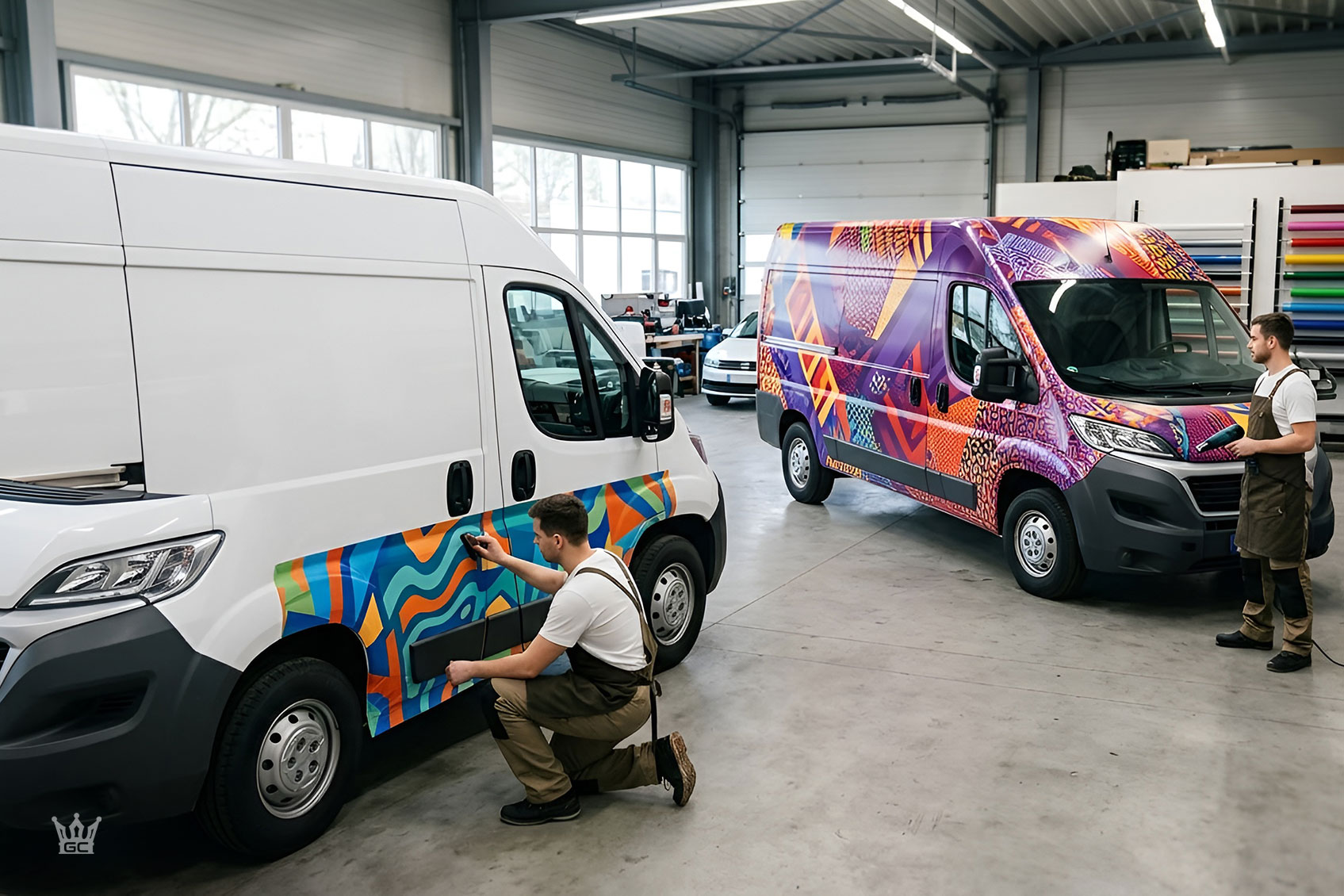
TL;DR
A full wrap covers most or all visible exterior panels on a vehicle, making it the right choice for complete colour changes, consistent fleet branding, and large-format custom artwork. A partial wrap covers selected panels only, using the factory paint as part of the design, and works best for targeted business graphics, accent styling, and budget-conscious fleet branding. The difference between full wraps and partial wraps is coverage, not quality. Both can use the same premium vinyl and professional installation.
Quick Definitions
Before anything else, here is what full wraps and partial wraps are and when each is used in the simplest terms possible.
|
Term |
What it means |
Best used when |
|---|---|---|
|
Full wrap |
Vinyl film applied over most or all visible exterior painted panels |
Complete colour change, maximum brand presence, full-vehicle artwork, fleet consistency |
|
Partial wrap |
Vinyl film applied to selected panels or sections |
Targeted commercial branding, accent styling, budget control, fast turnaround, easy future updates |
|
Spot graphics / lettering |
Individual vinyl decals, logos, names, and contact details |
Basic business identification, low-cost signage, simple updates |
Think of full and partial wraps as coverage levels. They describe how much of the vehicle gets wrapped, not how good the materials or installation are. A partial wrap can use the exact same premium cast vinyl and laminated print system as a full wrap. The only difference is how many panels it covers.
3M’s Wrap Film Series 2080 product bulletin, for example, lists its film for full colour vehicle wraps, accents, and partial decoration wraps, using the same product across all coverage levels. source
What Is a Full Wrap?
A full vehicle wrap is vinyl film applied over nearly all visible exterior painted panels to create a complete colour change, custom design, or full-vehicle branded look. It typically includes major surfaces like doors, guards (fenders), bonnet, bumpers, rear panels, and often mirrors. Whether the roof, windows, door jambs, and hidden edges are included depends on the specific project scope.
The word “full” deserves a small asterisk. A full wrap usually means full visible exterior coverage. It does not always mean every hidden crevice. Door jambs, deep returns, under-bonnet areas, and the undersides of panels may cost extra or may not be recommended at all. On large commercial vans, the roof might be omitted because nobody can see it from the ground.
Practitioners on Reddit confirm this nuance. Installers report that the depth of edge coverage depends on how different the wrap colour is from the factory paint. Drastic colour differences (white car to black wrap, for instance) may require wrapping farther into door edges and trim areas so the original paint does not peek through at certain angles. source
For a standard colour-change project, a full wrap covers everything a pedestrian or other driver would normally see. That is its purpose: total visual transformation.
If you are weighing a full wrap against repainting, the key advantage is reversibility. A wrap can be removed to reveal the original paint underneath. For a deeper comparison, read about whether a wrap or respray is better for colour change.
When Is a Full Wrap Used?
Full wraps make sense in specific situations where partial coverage would compromise the result.
Choose a full wrap when:
-
You want a complete colour change (matte, satin, gloss, metallic, or colour-flip finishes).
-
Your brand colour needs to dominate the entire vehicle.
-
The design or artwork needs to flow uninterrupted across every panel.
-
You need fleet vehicles to look identical regardless of their original factory colours.
-
You are building a show car, race livery, or motorsport vehicle.
-
You want no factory paint visible from any normal viewing angle.
-
You are wrapping a premium vehicle, EV, or luxury car for a reversible transformation.
Fleet managers often land on full wraps when their vehicles come in mixed colours. If half the fleet is white and the other half is silver, a full commercial wrap forces visual consistency. The alternative, a partial wrap that leaves factory paint exposed, would make the fleet look inconsistent.
Wrap industry instructor Matt Richart makes a related point: if the existing paint colour does not match the desired design or brand scheme, the project may need a full wrap simply to cover the conflicting base colour. source
You can see colour-change wrap examples to get a feel for how full wraps look across different vehicle types and finishes.
What Is a Partial Wrap?
A partial vehicle wrap is vinyl film applied to selected areas of the vehicle. Common panels include sides, rear doors, bonnet, roof, tailgate, canopy, quarter panels, or some combination of these. The factory paint remains visible and ideally becomes part of the overall design.
Partial wraps are often described as covering roughly one-quarter to three-quarters of the vehicle’s exterior, though shops define packages differently. source
A partial wrap is not the same thing as decals or lettering. Decals and lettering are individual vinyl elements (a logo, a phone number, a tagline). A partial wrap covers larger panel sections with printed or coloured film to create a more integrated, cohesive look. That said, partial wraps and lettering can be combined on the same vehicle, and often are.
The distinction matters because it changes how people perceive the vehicle. A white ute with two door decals reads as “basic signage.” The same ute with a designed partial wrap across the doors, tailgate, and canopy reads as “branded vehicle.”
Common Partial Wrap Packages
Rather than thinking about partial wraps as a single category, it helps to think in terms of panel strategy:
-
Doors and rear: The most common commercial setup. Logo, services, and phone number sit on the highest-visibility panels.
-
Half wrap: Rear half of the vehicle plus sides. Popular for vans and utes.
-
Three-quarter wrap: Sides, rear, plus bonnet or upper panels. Approaches full-wrap impact at reduced coverage.
-
Bonnet, roof, and mirror accents: Common for personal styling. Think black roof on a white car, or carbon-fibre-look bonnet.
-
Tailgate and canopy: Specific to utes and 4x4s. The tailgate is one of the most-read panels on any work vehicle.
-
Rear window perforated graphics: Printed film with tiny holes that allow visibility from inside. Subject to legal requirements around driver sightlines.
When Is a Partial Wrap Used?
Partial wraps are strategic, not second-best. Practitioners on Reddit describe partial commercial wraps as often the best “bang for your buck” because they deliver full-colour graphic impact while skipping vehicle “dead zones” that do not carry useful information. source
Choose a partial wrap when:
-
The vehicle’s factory colour works with the design (white, black, grey, or already close to brand colours).
-
You want strong visual impact on selected high-visibility panels.
-
You are branding a work vehicle or fleet and want to control costs.
-
You may need to update phone numbers, services, or branding later.
-
You want accent styling like a contrasting roof, bonnet, stripes, or mirror caps.
-
You need faster turnaround and less vehicle downtime.
-
You want to test a finish or style before committing to a full wrap.
-
You are spreading a branding budget across multiple vehicles rather than fully wrapping one.
A practical rule for deciding: if the uncovered paint looks intentional, a partial wrap works. If the uncovered paint looks like a compromise or clashes with the graphics, a full wrap is the better path.
Looking for design inspiration? Browse car wrap ideas and creative trends to see how partial and full wraps can be styled.
Full Wrap vs Partial Wrap: Side-by-Side Comparison
Understanding what full wraps and partial wraps are and when each is used becomes easier with a direct comparison.
|
Factor |
Full wrap |
Partial wrap |
|---|---|---|
|
Coverage |
Most visible exterior panels |
Selected panels or sections |
|
Visual impact |
Maximum transformation |
Strong when designed around the base colour |
|
Typical cost |
Higher (more material, more labour) |
Usually lower, but design complexity still matters |
|
Install time |
Longer (more panels, more detail) |
Often faster |
|
Best for |
Colour change, premium branding, full artwork, fleet consistency |
Business graphics, accent styling, budget control, easy updates |
|
Factory paint visibility |
Hidden from normal viewing angles |
Part of the finished design |
|
Vinyl coverage on paint |
More panels get a vinyl layer |
Only wrapped panels get coverage |
|
Future updates |
Larger rework if details change |
Easier to swap out individual sections |
|
Common risk area |
Horizontal panel ageing, edge-coverage expectations |
Awkward transitions, colour mismatch with factory paint |
One thing this table does not capture: a partial wrap is not always proportionally cheaper. Wrap professionals on Reddit highlight that half the vinyl does not mean half the design, consultation, or detail work. A partial wrap with complex transitions and awkward panel edges can sometimes require more planning than a straightforward full colour-change wrap. source
Commercial Vehicles: Full Wrap or Partial?
For business vehicles, the question of what full wraps and partial wraps are and when each is used usually comes down to visibility, repeatability, and budget.
When a Full Wrap Works for Business
A full commercial wrap is the right call when:
-
The brand needs maximum presence on every vehicle.
-
Franchise or corporate guidelines require specific colours that differ from the factory paint.
-
A “hero vehicle” needs to stand out at events, job sites, or in traffic.
-
The fleet includes vehicles in different factory colours and needs to look uniform.
When a Partial Wrap Works for Business
A partial wrap often makes more sense for service businesses, tradies, and growing companies because:
-
The rear and side panels do most of the communication work. Roofs and lower panels rarely get read.
-
A readable phone number and URL on flat, visible panels can outperform busy full-panel artwork.
-
Budget goes further when spread across more vehicles rather than concentrated on one.
-
Details like phone numbers, service lists, or even business names change. Updating a partial wrap is simpler and cheaper than redoing a full one.
In a Reddit discussion about service vehicle branding, a pressure-washing business owner argued for simple door logos and large phone numbers first, noting that work trucks exposed to chemicals and equipment wear benefit from graphics that are easy and affordable to replace when details change. source
Design readability matters more than coverage area for commercial vehicles. Vehicle wraps live in moving traffic, glare, and rain. A design article from SignServant recommends large rear phone or URL text, high contrast, simple visual hierarchy, and testing readability from 40 to 60 feet away. source
Spend coverage where people actually see and read it. The rear and side panels usually work harder than the roof.
For fleet projects, vehicle downtime matters too. Full wraps take longer per vehicle. If a van earns revenue on the road every day, the faster install time of a partial wrap can be a real advantage. Learn more about fleet wrapping turnaround times and how scheduling works. You can also view commercial vehicle graphics examples to see what different coverage levels look like on real work vehicles.
Personal Vehicles: Full Wrap or Partial?
The decision for personal vehicles follows different logic. It usually comes down to how dramatic the change should be and whether protection is part of the goal.
|
Goal |
Better fit |
|---|---|
|
Total colour change (matte, satin, gloss, metallic) |
Full wrap |
|
Black roof, bonnet, stripes, or mirror accents |
Partial wrap |
|
Custom artwork, anime wrap, or race livery |
Usually full wrap |
|
Testing a colour or finish before committing |
Partial wrap |
|
EV styling and reversible transformation |
Full wrap or partial, depending on scope |
|
Stone-chip and scratch protection |
PPF, not standard vinyl wrap |
EV owners often gravitate toward full wraps because the factory colour options from manufacturers like Tesla or BYD can feel limited. A full satin or matte wrap on a Model Y, for example, creates a look that is not available from the factory and is fully reversible. The Tesla wrap guide covers the considerations specific to wrapping EVs, including sensor placement and panel design.
Wraps vs PPF: An Important Distinction
If the main goal is protecting paint from stone chips, scratches, and road debris rather than changing the colour, the right product is paint protection film, not a vinyl wrap. Vinyl wraps do cover and shield the paint underneath from UV and minor surface wear, but they are not engineered for impact protection the way PPF is.
PPF is a thicker, optically clear (or satin-finish) urethane film designed to absorb rock chips and self-heal light scratches. It is a different product solving a different problem.
If you want both a colour change and serious paint protection, the two products can sometimes be combined or layered depending on the application. Learn more about paint protection film options to understand where PPF fits.
What Makes a Partial Wrap Look Good (or Bad)
A good partial wrap looks intentional. A bad partial wrap looks like a full wrap that ran out of vinyl.
Signs of a Well-Designed Partial Wrap
-
The factory paint colour complements or matches the brand palette.
-
Wrap edges follow natural body lines, panel gaps, or trim edges rather than stopping randomly mid-panel.
-
Phone numbers, URLs, and key text sit on flat, visible panels.
-
The rear view has one clear call-to-action.
-
There is strong contrast between text and background.
-
Coverage avoids the roof and bonnet if those panels are not needed for the message.
Signs of a Poorly Designed Partial Wrap
-
The factory paint clashes with the wrap colours.
-
Edges stop in the middle of a panel with no visual logic.
-
Text crosses door gaps, handles, or sensors.
-
Too many services, social media icons, and phone numbers competing for attention.
-
Low contrast that becomes invisible in bright sun or rain.
-
Critical information placed only on the bonnet or roof where few people read it.
-
The overall impression is “unfinished” rather than “designed.”
Vehicle wrap designers on Reddit stress that real vehicles are not flat templates. Designers should collaborate with installers because panels have curves, handles, body gaps, and sensor cutouts that affect where text and graphics can realistically sit. A design that looks great on a 2D mockup can fall apart on a 3D vehicle if seams, overlaps, and trim are not planned for. source
Installation and Material Quality
Whether the project is a full wrap or a partial wrap, material and installation quality determine how the finished product looks and how long it lasts.
Professional wrap films from manufacturers like 3M and Avery Dennison are cast vinyl engineered for complex vehicle curves. 3M’s 2080 series uses Controltac repositionable adhesive and Comply air-release channels so the film can be adjusted during installation and applied without trapped air bubbles. source Avery Dennison’s MPI 1105 series is designed for fleet branding and vehicle wraps, with conformable cast construction and air-egress adhesive technology for clean application on curves and recesses. source
A partial wrap can be technically demanding in its own right. Complex die-cut edges, transitions that need to look seamless against the factory paint, and graphics that wrap around body contours all require skill and planning. A full wrap can actually be simpler from a design perspective (one colour, every panel) even though it is physically more labour-intensive because it covers more surface area.
Quality Signs to Look For
Regardless of coverage level, a well-installed wrap should have:
-
Clean, post-heated edges with no lifting.
-
No visible bubbles, wrinkles, or creases.
-
Panels cleaned and prepped properly before application.
-
Film selected for the vehicle’s specific curves and contours.
-
Text and graphics positioned away from deep recesses and complex trim.
Practitioners on Reddit note that edge lift is often caused by poor prep, low-quality film, or skipping the post-heating step rather than by the coverage level itself. source
Gold Coast and Queensland Considerations
Understanding what full wraps and partial wraps are and when each is used is one thing. Understanding how they perform on the Gold Coast is another.
UV Exposure Is Year-Round
Queensland’s UV Index sits at 3 or above all year round, even during winter months, according to Queensland Health. source That constant UV exposure affects wrap longevity, particularly on horizontal panels.
Bonnets and roofs take more direct sun and radiant heat than vertical doors and side panels. 3M’s own warranty documentation distinguishes between panel orientations and notes reduced warranted durability in hot or arid regions. source Wrap professionals in Sign Builder Illustrated also warn that hoods and roofs will not last as long as vertical sides and that environmental conditions play a real role in wrap lifespan. source
On the Gold Coast, the sun is not a footnote. If the vehicle lives outdoors, ask your installer how the chosen film, finish, and coverage will hold up on horizontal panels. For partial wraps, excluding the roof and bonnet can actually be a smart longevity decision unless the styling goal specifically requires them. For vehicles that spend time outside, proper aftercare matters. Here is a guide on how to clean a vinyl wrap to get the most life from the film.
Vehicle Colour-Change Registration
In Queensland, if a wrap changes the vehicle colour that is recorded on your registration, you should check the current TMR requirements. TMR lists colour among the registration details that must be updated within 14 days when changed, using the Change of Vehicle Particulars Notification form. source
This applies mainly to full colour-change wraps rather than partial wraps that leave most of the factory colour visible. It is not a complicated process, but it is worth knowing about before the vehicle leaves the workshop.
Design for Local Conditions
For commercial wraps in the SEQ corridor (Gold Coast through to Brisbane and the Tweed), design for real-world viewing conditions. That means high contrast for bright sunlight, readable fonts for traffic speeds, and graphics that do not wash out in glare or rain. The rear panel is your most valuable advertising space on Gold Coast roads because the vehicle behind you at a traffic light has nothing else to look at.
Decision Checklist: Which Wrap Coverage Do You Need?
This framework goes beyond “depends on budget.” Walk through these questions to narrow the choice.
1. What is the goal?
Colour change, branding, protection, promotion, or accent styling? Colour change almost always means full wrap. Protection means PPF. Branding and styling could go either way.
2. Does the base colour help or hurt?
A white or black vehicle is easy to design around for a partial wrap. A bright or unusual factory colour that clashes with brand colours may force a full wrap.
3. Which panels actually get seen?
For business vehicles, rear and side panels usually carry the message. The roof rarely matters unless the vehicle parks in areas with elevated foot traffic.
4. Is the vehicle garaged or outdoors?
Vehicles parked in Gold Coast sun need better aftercare and may benefit from avoiding unnecessary coverage on horizontal panels that age faster.
5. How long can the vehicle be off the road?
Full wraps take more workshop time. Partial wraps are often faster, which matters for revenue-generating vehicles.
6. Will details change?
If the phone number, services, or branding might evolve, modular partial wraps or graphics are easier to update than a full printed wrap.
7. One vehicle or a fleet?
For fleets, partial wraps can stretch the budget across more vehicles. Full wraps may be needed if vehicles come in mixed factory colours.
8. Is protection the real priority?
If stone chips, scratches, and paint preservation matter more than colour or branding, explore PPF rather than vinyl wrap.
Not sure whether your vehicle needs full coverage or a strategic partial wrap? Gold Coast Wrap Kings can assess the vehicle, base colour, design goal, and panel layout before recommending coverage. Get in touch for a recommendation.
Questions to Ask Before Approving a Quote
These questions apply whether you are getting a full wrap or partial wrap and will help you understand exactly what you are paying for.
-
Is this full visible exterior coverage, or are door jambs included?
-
Is the roof included in the quote?
-
Are bumpers, mirrors, and handles included or quoted separately?
-
Is the film a printed graphic with laminate, or solid colour-change film?
-
For a partial wrap, which specific panels are covered?
-
Where will the seams and joins be?
-
Will the factory colour show at edges, and does the design account for that?
-
What vehicle prep is needed before installation?
-
How long will the vehicle be in the workshop?
-
How should the wrap be washed and maintained afterward?
-
If the colour changes significantly, do registration details need updating with TMR?
Frequently Asked Questions
Is a partial wrap the same as decals or lettering?
No. Decals and lettering are individual vinyl pieces, such as a logo, business name, or phone number, applied directly to the paint. A partial wrap covers larger panel sections with printed or coloured vinyl film to create a more cohesive, integrated design. The two can be combined on the same vehicle, but they are different products with different visual impact.
Does a full wrap always include the roof?
Not necessarily. On smaller cars getting a colour change, the roof is almost always included because it would look odd leaving it out. On large commercial vans or trucks, the roof is often omitted because nobody sees it from ground level. Whether the roof is included should be spelled out in the quote.
Does a full wrap include door jambs?
Not always. Door jambs and hidden return edges are more involved to wrap and may be quoted separately. Installers typically push deeper into edges when the wrap colour contrasts heavily with the factory paint, since the original colour would otherwise peek through when doors are opened. source
Which lasts longer, a full wrap or a partial wrap?
Coverage level does not determine lifespan. Film quality, installation prep, UV exposure, parking habits, washing routine, and panel orientation all matter more. Horizontal panels like bonnets and roofs age faster than vertical sides, regardless of whether the vehicle has a full or partial wrap. Good aftercare extends the life of either option. Read more about how to maintain your car wrap.
Is a vinyl wrap the same as paint protection film?
No. Vinyl wraps are designed for colour change, styling, and graphics. Paint protection film is a thicker, usually clear urethane film designed to absorb stone chips and self-heal light scratches. They solve different problems. If protection is the priority, explore PPF options rather than choosing a vinyl wrap.
Can a partial wrap look professional?
Absolutely, provided the factory paint colour is part of the design rather than an afterthought. Many experienced wrap professionals actually frame partial commercial wraps as the strongest value option because they put graphics on the panels that get the most attention and skip areas that add cost without adding visibility. source
Which is better for business advertising, a full or partial wrap?
A full wrap delivers maximum brand presence and works best when the entire vehicle needs to become a mobile brand asset. A partial wrap works best when clear, readable branding on high-value panels can achieve the goal with less coverage. For service businesses, a large phone number and URL on the rear and doors often generates more calls than a complex full-panel design with small text.
Do I need to update my Queensland registration if I wrap my car?
If the wrap changes the colour recorded on your registration, Queensland TMR requires you to notify them within 14 days using the Change of Vehicle Particulars Notification form. source This typically applies to full colour-change wraps rather than partial wraps that leave the majority of the original colour visible.
FAQ
Australian DIY kits start from approximately $295 AUD for a single panel (like a full bonnet kit) from suppliers like Paintgard. A full front kit ranges from roughly $500 to $1,200 USD depending on the brand and film tier. Full-body kits run $1,500 to $2,200 USD. Compare that to $4,000 to $7,000 USD for a professional full-body install.
No. The Highland has completely redesigned front and rear bumpers, different headlight shapes, and no fog lamp cutouts. Every major kit seller lists separate products for the Highland (2024+) and the pre-Highland (2017 to 2023). Always verify your model year before ordering.
A hair dryer works as a substitute but is less effective. It produces lower, less focused heat, which makes it harder to conform the film around compound curves like the front bumper. For flat panels and door cups, a hair dryer is adequate. For bumpers and fenders, a proper heat gun makes a noticeable difference.
The front bumper, without question. Its compound curves require aggressive heat and stretching, and most pre-cut kits split it into multiple pieces that create visible seam lines. Practitioners on Reddit consistently recommend starting with easier panels (hood, door cups) to build confidence before attempting the bumper.
Budget two to four hours per panel for a first-time installer. A full front (bumper, hood, fenders, mirrors) can easily take an entire weekend. YouTube walkthroughs from Drive Protected and others show that even experienced DIYers work methodically through each section.
Pre-cut kits for first-timers, every time. The consensus across Tesla forums and Reddit is unambiguous on this point. Bulk rolls offer better edge coverage and lower per-metre cost, but they require cutting on the car, which risks scoring Tesla’s thin paint. That damage is permanent and requires repainting.
Yes. Once the PPF has fully cured (at least 48 hours, ideally a week), you can apply a ceramic coating directly on top. The PPF’s clearcoat layer is designed to accept ceramic coatings. The combination provides impact protection (PPF) plus chemical and UV resistance (ceramic), which is the most complete paint protection setup available.
It depends on your goals. DIY PPF on a Model 3 saves roughly 60 to 70 percent compared to professional installation and delivers perfectly acceptable results on flat panels, door cups, and headlights. For compound-curve panels like the front bumper, full-body matte finishes, or if you want a labour warranty, professional installation is the better choice. Many owners take a hybrid approach: DIY the easy panels and pay a pro for the bumper.